.png)
.png)
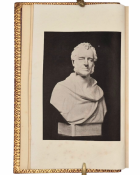
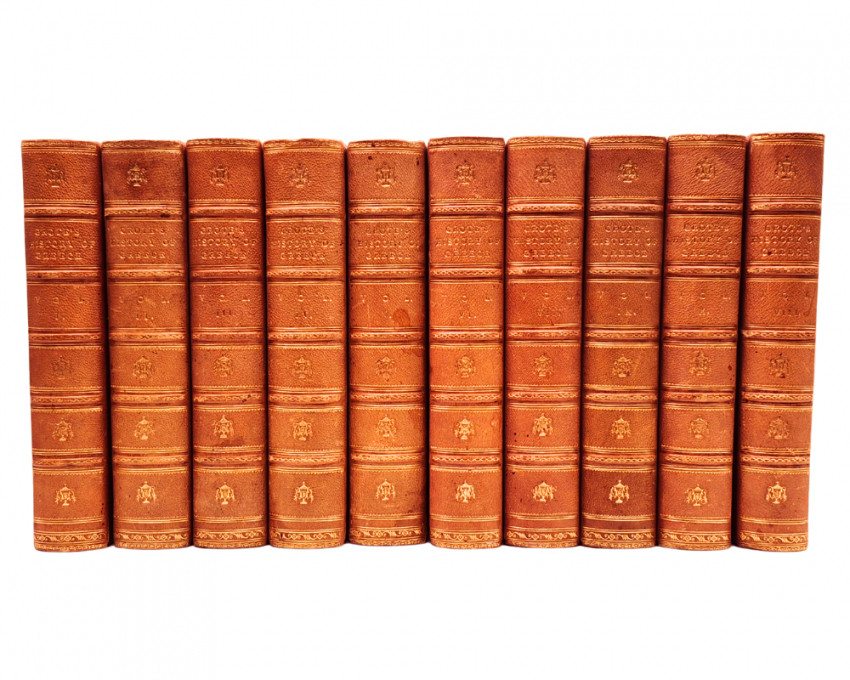
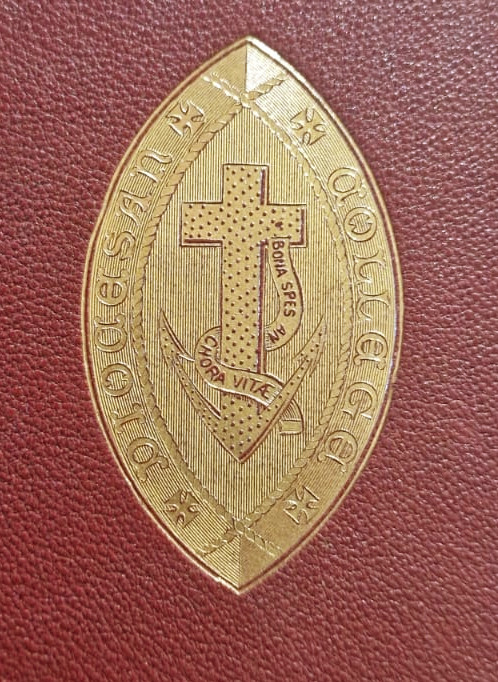
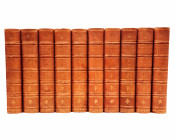
Fourth edition: 10 volumes, handsomely bound in full brown morocco, all edges gilt with gilt crest of Diocesan College ("Bishops") and decoration on the upper covers, titled gilt on the spines - which are slightly faded, inner gilt dentelles, marbled endpapers, page 103 of volume 1 has been clumsily folded a the bottom corner, a very good set.
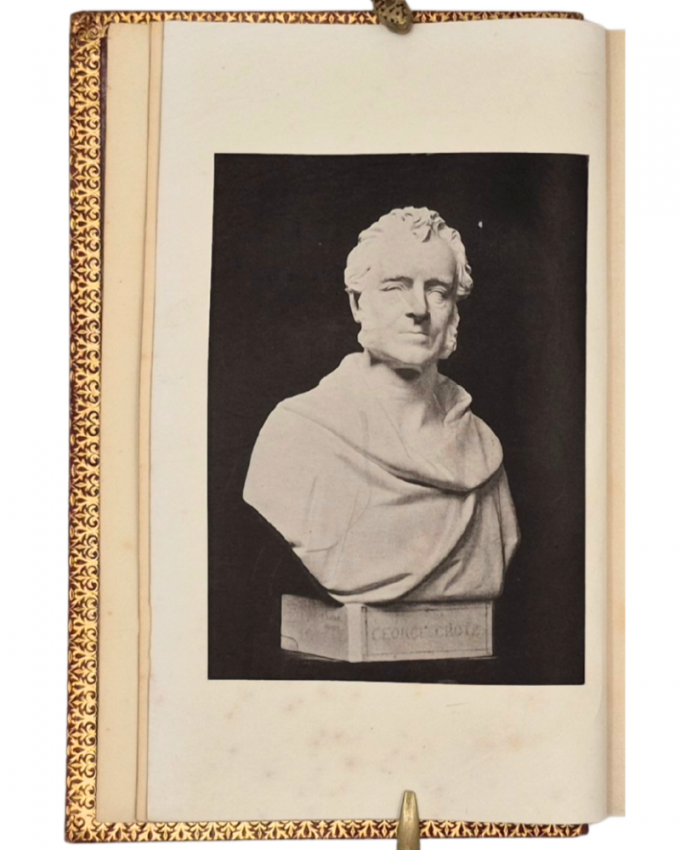
'George Grote, (born Nov. 17, 1794, Clay Hill, near Beckenham, Kent, Eng. - died June 18, 1871, London), English historian, noted for his works on ancient Greece. At the age of 16 Grote joined his father's bank in London and worked in it until 1843, using his spare time to perfect his command of Greek and to learn German, economics, and philosophy. From 1832 to 1841 he was a member of Parliament for the City of London.
'Having already published works on contemporary politics and philosophy, Grote devoted himself entirely to the History of Greece, which was published in 12 volumes between 1846 and 1856; it ended with the events of 301 BC. It was quickly recognized (in the original or in translation) as the best Greek history in any language, and its authority remained unchallenged for almost half a century. Grote, it may be noted, never visited Greece.
In 1849 Grote reassumed an earlier active interest in University College, London. He became its treasurer in 1860 and its president in 1868. From 1862 until his death he was also vice-chancellor of the University of London. He refused a peerage that Prime Minister William Gladstone offered him in 1869. Grote was buried in Westminster Abbey.' Britannica (https://www.britannica.com/biography/George-Grote)
The History of Greece was well received and a commercial success; it was used at English universities, went through several editions, and became the standard work in English for the next half century; it was also translated into German and French. Profits from the book paid for the building of a new residence at East Burnham, Buckinghamshire, in 1853, which was named History Hut. The main gratification for Grote, however, was living a scholarly life, and in spite of the endless hours devoted to the book, he observed, 'My day is always too short'. Fascinated as he was by Greece, when invited to join John Stuart Mill on a journey to that country, he declined. Oxford Dictionary of National Biography (https://www.oxforddnb.com/display/10.1093/ref:odnb/9780198614128.001.0001/odnb-9780198614128-e-11677)
A History of Greece is a monument of 19th-century scholarship, the 10-volume fourth edition is widely considered the finest library edition of this important work.
The gold crest on the upper covers shows the heraldic elements: The vesica-shaped (pointed oval) gold stamp shows a shield bearing a Latin Cross, the symbol of the Anglican Church, over an anchor, with two motto ribbons reading "BONA SPES" (upper) and "ORA VITAE" (lower). The surrounding legend reads "DIOCESAN COLLEGE".
The mottos translate as: "Bona Spes" — "Good Hope", a direct reference to the Cape of Good Hope and "Ora Vitae" — "Pray for Life" or "Prayer of Life," reflecting the school's Anglican Christian foundation.The Diocesan College ("Bishops") was established on 2 October 1849 by Robert Gray, the first Anglican Bishop of Cape Town. It is a private, English-medium boarding and day school for boys situated in the suburb of Rondebosch in Cape Town and is one of the oldest and most distinguished schools in South Africa.
- Overall Condition: Very good
- Size: 8vo (218 x 140 mm)