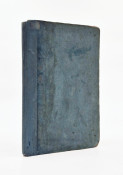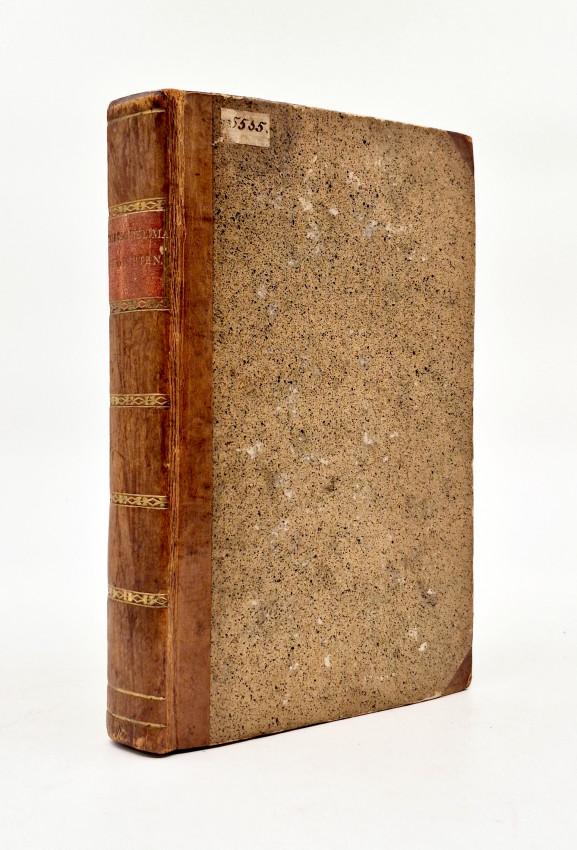
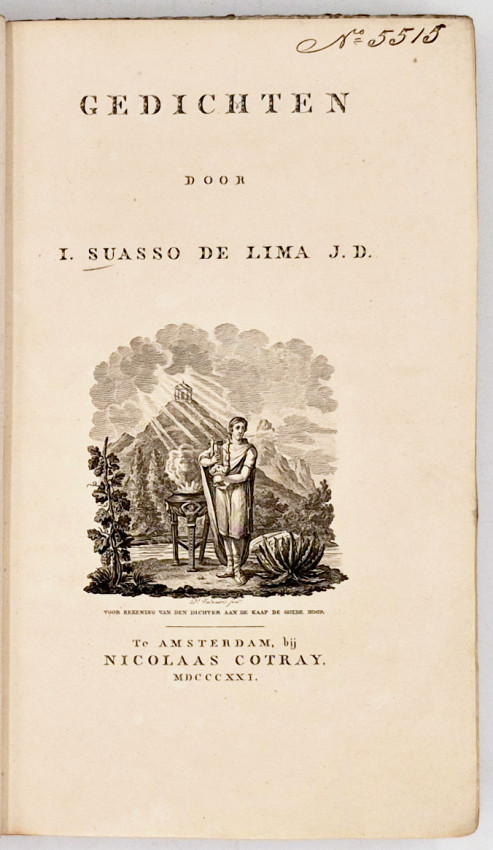
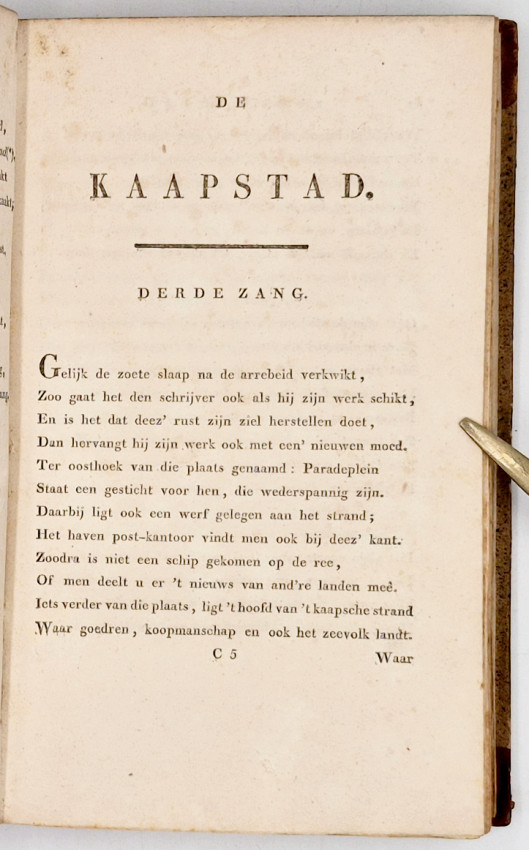
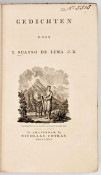
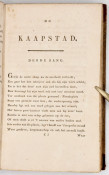
First Edition: xvi, 186 pages, wood engraved vignette on the title page, half title page, printed on good quality but not watermarked laid paper, edges uncut, most pages unopened, contemporary half brown leather with a red title label, sprinkled paper sides, bookplate on the front paste-down endpaper, a very good copy.
(https://www.encyclopedia.com/religion/encyclopedias-almanacs-transcripts-and-maps/de-lima-joseph-suasso)
Joseph Suasso De Lima (1791–1858), South African writer and journalist. Member of an Amsterdam family of Portuguese origin, he qualified in law, wrote for Amsterdam publishers, and in 1816 went on a government mission to Batavia. In 1818 he settled at the Cape as printer, publisher, and translator (of Hebrew, among other languages). One of the early South African literary figures to use Dutch, he wrote poems, plays, pamphlets, almanacs, and directories. His versatility and his lameness were both butts for the enemies he made in various controversies. He defended the form of colloquial Dutch spoken at the Cape, opened the first Dutch bookshop in South Africa, and ran the first weekly paper, the satirical De Versamelaar, for several years from 1825. His Gedichten appeared in Amsterdam in 1821; his Nieuwe Gedichten in 1840. In 1825 he published his brief Geschiedenis van de Kaap de Goede Hoop, the first manual of Cape history. De Lima joined the Dutch Reformed Church in 1833, but made a donation to the building fund of the first Cape synagogue in 1849.
An Encyclopaedia of South African Theatre and Performance (ESAT)(https://esat.sun.ac.za/index.php/Joseph_Suasso_de_Lima)
'Born in Amsterdam, the son of Portuguese Jews, on 27 June 1791, though he converted to Christianity at an early age. Trained as a lawyer. He was conversant with at least eleven languages and an active member of the Free Masons. He married Gertruida Bakker and they had one daughter. He left her in in 1826 ostensibly because of her profligate lifestyle, and she died in Cape Town in 1836.
'After a brief period as lawyer in Amsterdam and a short and undistinguished career in Batavia (1816-1818), he and his wife settled in Cape Town in 1818, maintaining himself with translation, till he became a schoolmaster at the Evangelical Lutheran Church in 1823. He also became fairly well-known as a poet and translated some novels (e.g. a sentimental novel called Raymond).
'After initially befriending and working with his contemporary C.E. Boniface, the two soon became implacable enemies and exchanged public invective in the forms of poems and dialogues ("Zamensprake") to the joy of the public, including Boniface's satiric rewriting of Von Kotzebue's De intrigue aan het venster as Limaçon de Dichter and his own satire Clasius, of Het Proces om een Komedielootjie (1834). Ridiculed by Boniface particularly for his small stature and his physical deformities (which were likened to those of Pope), which made him an easy target for his enemies - although his superior dignity and wit caused him to the more respected in general society.
'In 1826 he started up a weekly newspaper in Dutch, De Verzamelaar (1826-1848), which became the Kaapsche Courant in 1827, but was out of business by 1830, although De Lima kept trying to resuscitate it, notably from 1839 to 1848.
'In 1826 he also began a Dutch "Leesboekery" ("reading bookshop"), which also did not do so well.
'In 1835 he began a "Boek-, Papier- en Prentenwinkel" ("Book, Paper and Picture Shop"), opening a second shop in 1838 and expanding to create the "Zuid-Afrikaanse Bazaar en Boekwinkel" ("South African bazaar and Bookshop"), which eventually did well enough to stabilize his life to a degree until his death in 1858, though he was never really financially successful. He was also the author of the first history of the Cape published in Africa (Geschiedenis van de Kaap de Goede Hoop, 1825).
'He died in the Cape in 1858.'
Mendelssohn (Sydney) South African Bibliography, volume 1, page 443, 'Poems by I. Suasso De Lima. Published for the author, a resident of the Cape of Good Hope. The volume, which is dedicated to Sir J. A. Truter, President of the Court of Justice at the Cape, contains a poem entitled" Kaapstad," in four cantos. These verses (De Lima remarks in his Preface) give a simple description of the town, but neither from the historical nor geographical point of view. In the Catalogue of the library of Mr. J. F. Wicht, of Cape Town, it is stated that " De Lima was a curious and picturesque figure in old Cape Town life; poet, directory-compiler, publisher, bookseller, &c.; full of learning, enthusiasm, and always in difficulties."'
- Overall Condition: Very good
- Size: 8vo (225 x 140 mm)
- Sold By: Clarke's Africana & Rare Books
- Contact Person: Paul Mills
- Country: South Africa
- Email: [email protected]
- Telephone: 021 794 0600
- Preferred Payment Methods: Visa & Mastercard via PayGate secure links and Bank transfers.
- Trade Associations: ABA - ILAB, SABDA

Similar lots in the current auction View all
Click on an item to view more details and to bid.