
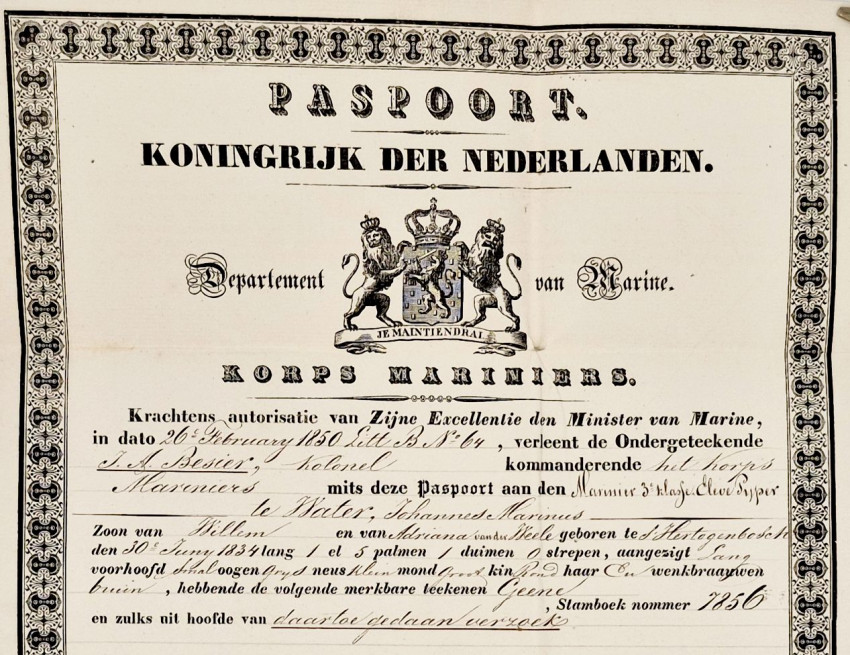
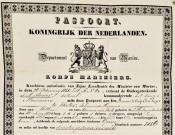
Krachtens autorisatie van Zijne Excellentie den Minister van Marine, in dato 26 February 1850 Litt. B. N°. 64, verleent de Ondergeteekende J.A. Bosier, kolonel kommanderende het korps Mariniers, mits deze Paspoort aan den Marinier 3e klasse Clee Pyper
te Water, Johannes Marinus
Zoon van Willem en van Adriana van de Welt, geboren te 's Hertogenbosch den 30 Juny 1834, lang 1 el 5 palmen 1 duimen 0 strepen, aangeziigt lang, voorhoofd kaal, oogen grijs, neus slim, mond —, kin Rond, haar Eu, wenkbraauwen bruin, hebbende de volgende merkbare teekenen Geene, Stamboek nommer 1856
en zulks uit hoofde van daartoe gedaan verzoek
KINGDOM OF THE NETHERLANDS: KORPS MARINIERS
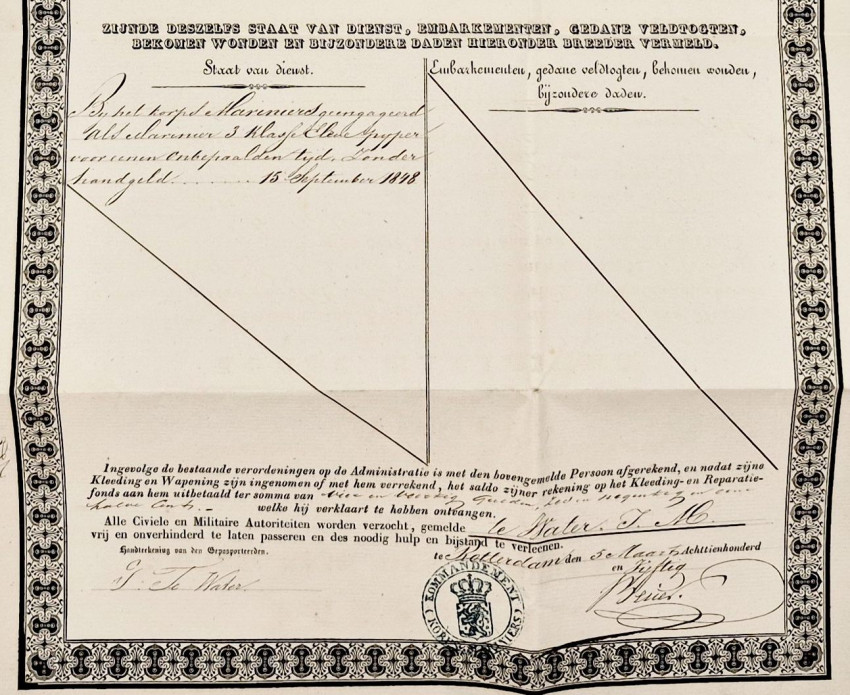
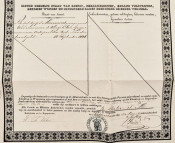
ZIJNDE DESZELFS STAAT VAN DIENST, EMBARKEMENTEN, GEDANE VELDTOGTEN, BEKOMEN WONDEN EN BIJZONDERE DADEN HIERONDER BREEDER VERMELD.
Staat van dienst | Embarkementen, gedane veldtogten, bekomen wonden, bijzondere daden
Bij het korps Mariniers geëngageerd als Marinier 3e klasse Clee Pyper voor eenen onbepaalden tijd zonder handgeld — 15 September 1848
Alle Civiele en Militaire Autoriteiten worden verzocht, gemelde te Water J.H. vrij en onverhinderd te laten passeeren en den noodig hulp en bijstand te verleenen.
te Amsterdam den 5 Maart achtttienhonderd en Vijftig
J. Te Water
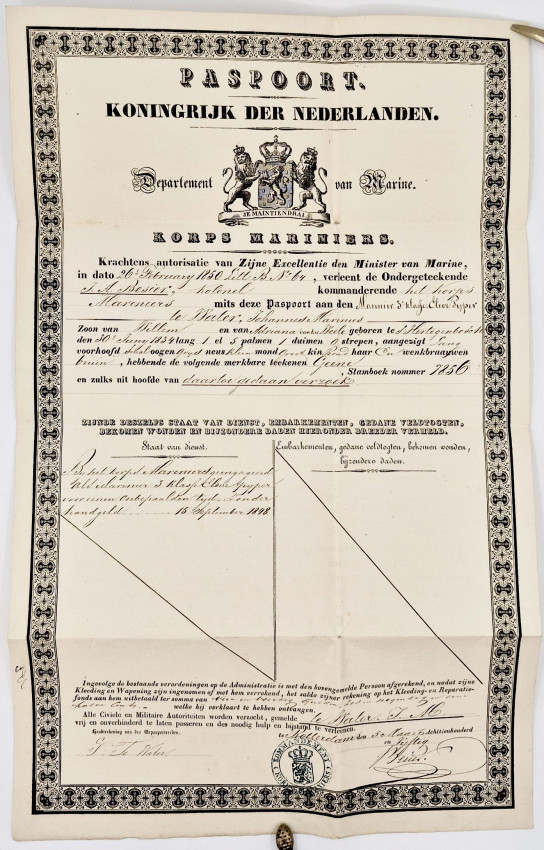
Printed on good quality laid and watermarked paper, within a decorative border and official crest, with folds.
A military discharge passport like this served several practical purposes simultaneously in mid-19th century Netherlands. It would have been used as an identity document and a passport. It was essentially the bearer's only form of official identification in civilian life. The detailed physical description — height, eye colour, hair colour, forehead, nose, chin — substituted for what today would be achieved with a photograph. Without such a document, a man had virtually no way to prove who he was to authorities. As a Travel Document it explicitly requests all civil and military authorities to allow the bearer to "pass freely and unhindered" — making it function like a passport in the modern sense. In early 19th-century Europe, internal travel between towns and provinces was still regulated, and a discharged soldier without papers could be treated as a vagrant or deserter. It proved the bearer had left military service legitimately. For Johannes Te Water, aged sixteen, it served as his identity document, passport, discharge certificate and service record.
Johannes Marinus Te Water followed his older brother to South Africa in late 1856 or early 1857. He became prominent in the commercial life of Graaff -Reinet.
- Sold By: Clarke's Africana & Rare Books
- Contact Person: Paul Mills
- Country: South Africa
- Email: [email protected]
- Telephone: 021 794 0600
- Preferred Payment Methods: Visa & Mastercard via PayGate secure links and Bank transfers.
- Trade Associations: ABA - ILAB, SABDA


