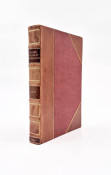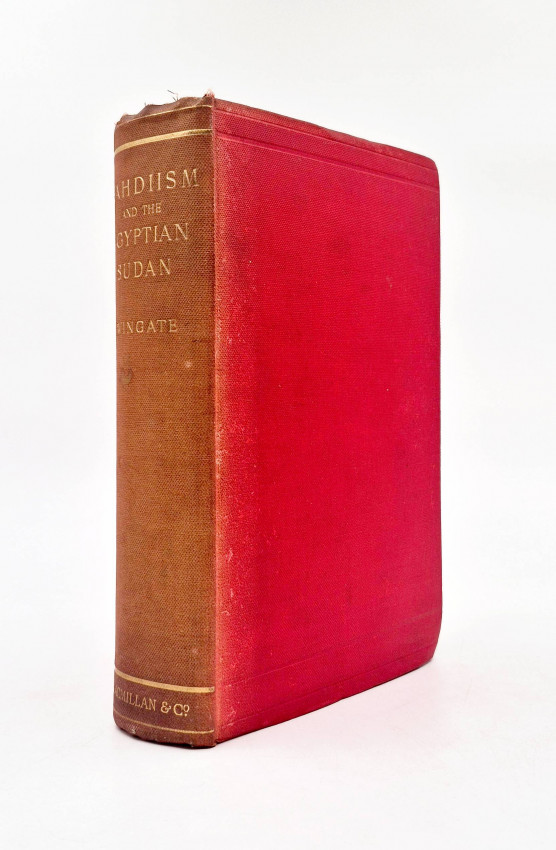
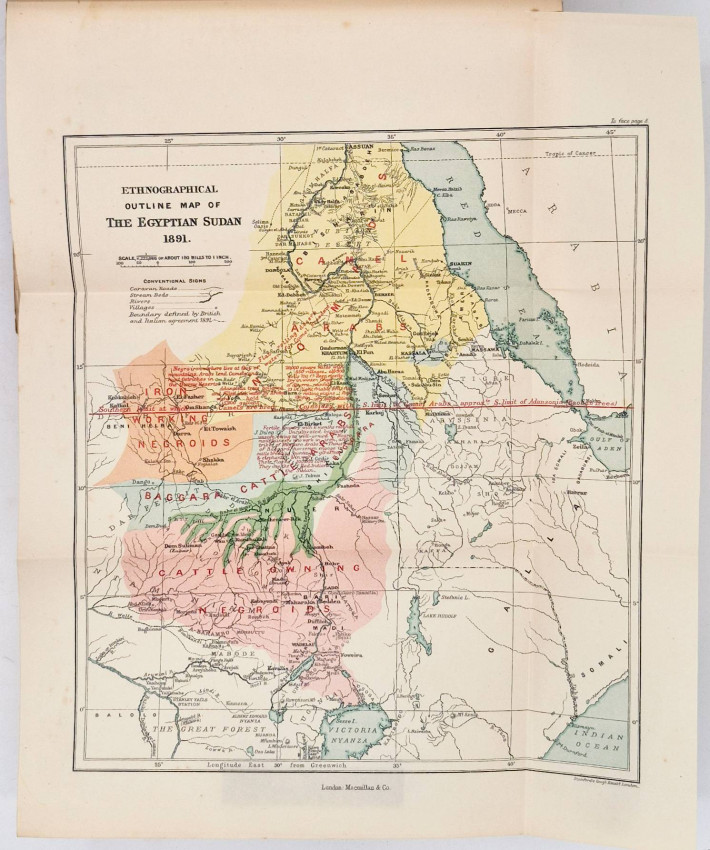
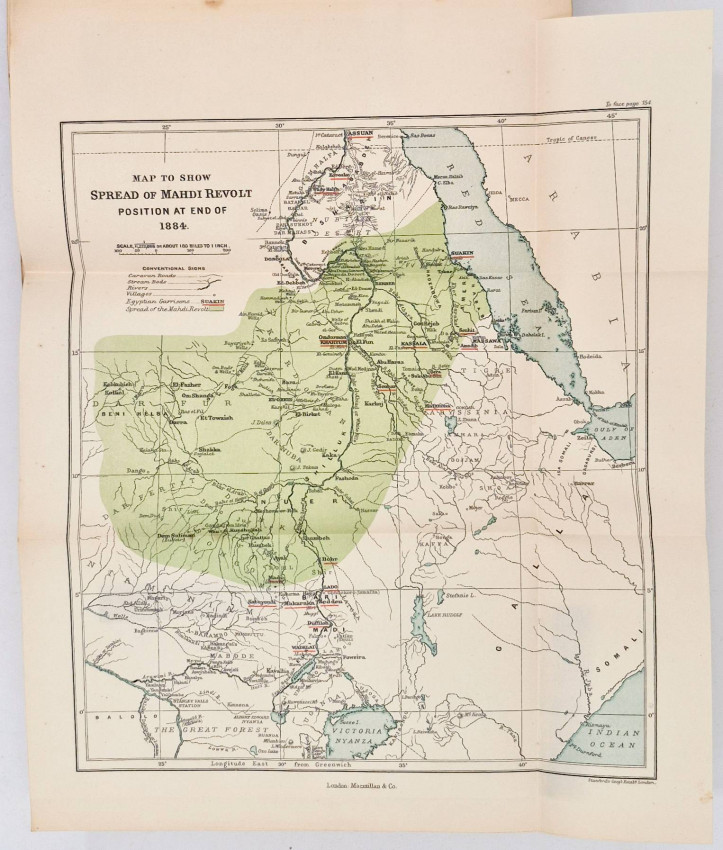
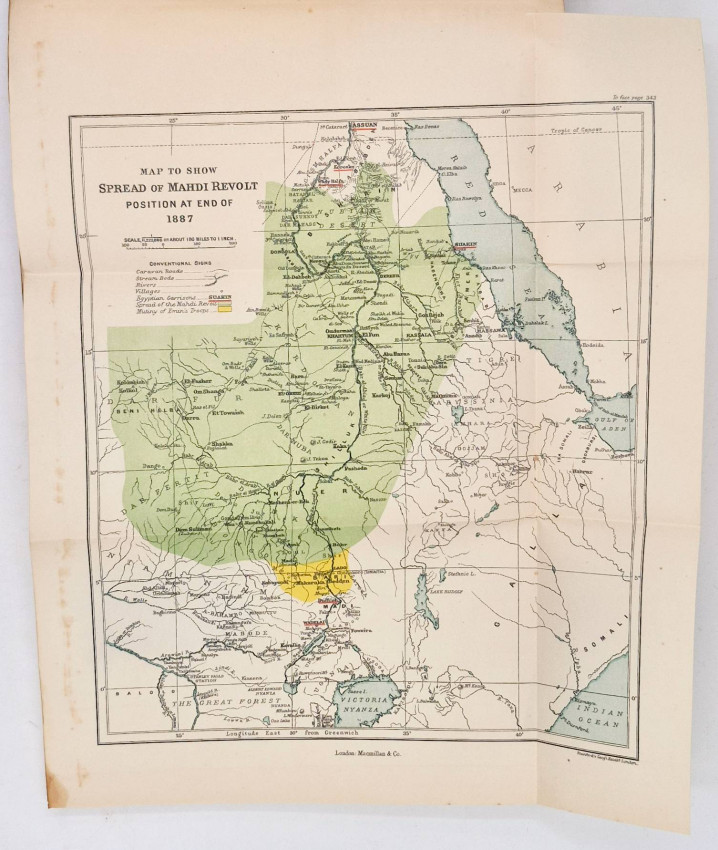
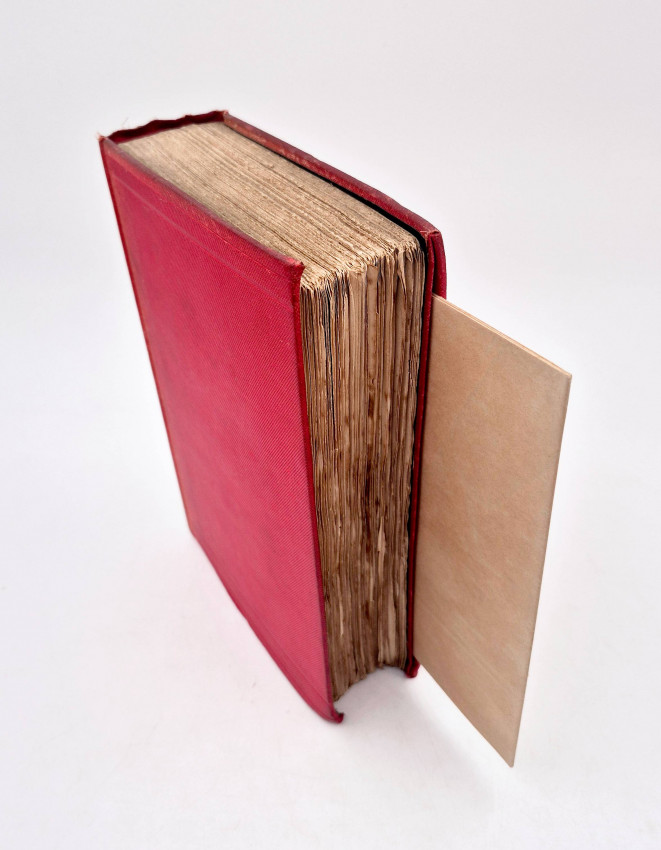
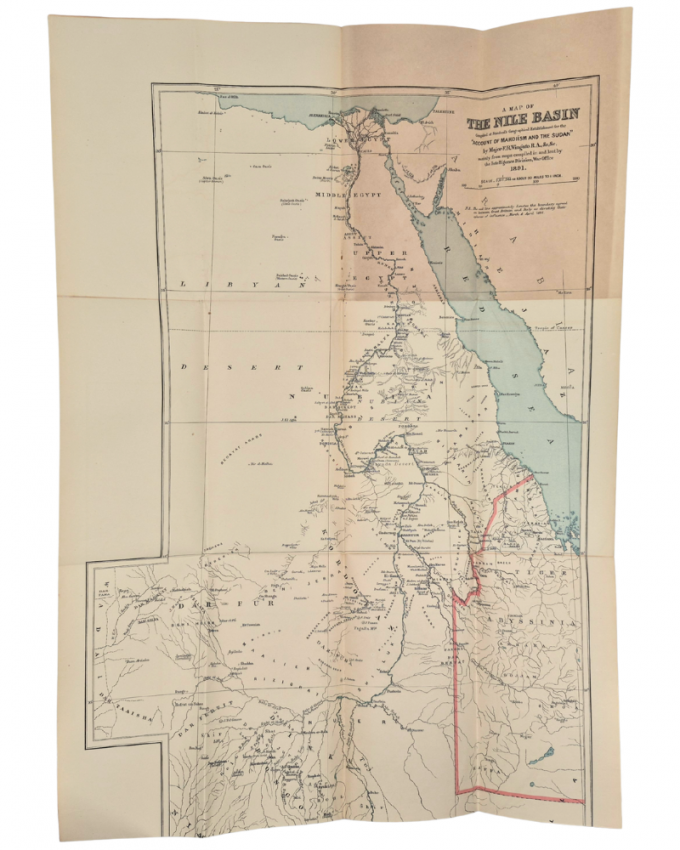
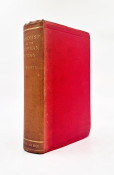
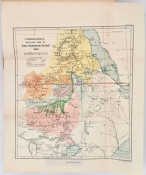
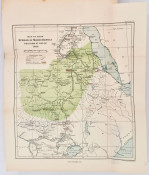
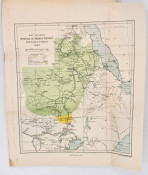

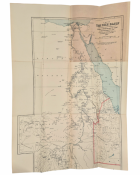
First Edition: xxviii, 617 pages, 30 maps and plans - many coloured, large folding map in a pocket in the back cover, original red cloth titled gilt on the spine which is faded, black endpapers, the rear hinge is weak due to the large map in the cover, uncut fore edges, bookplate on the front paste-down endpaper, a very good copy.
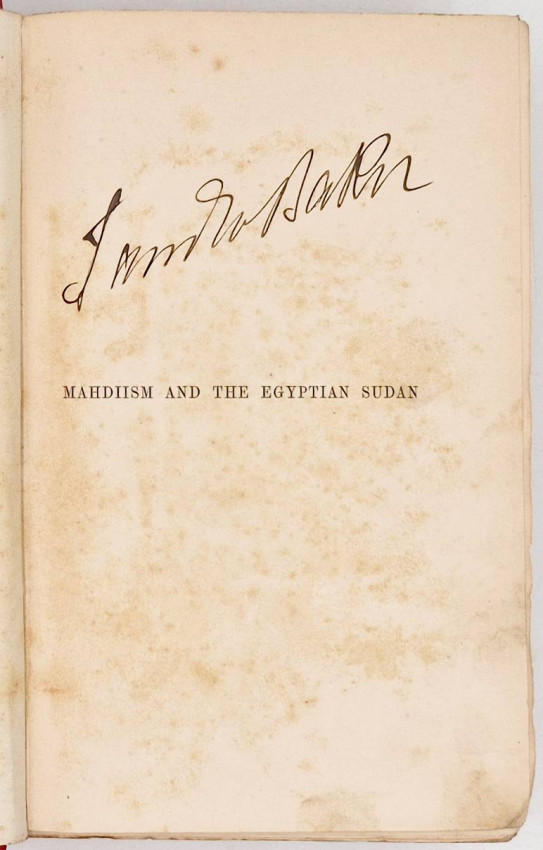
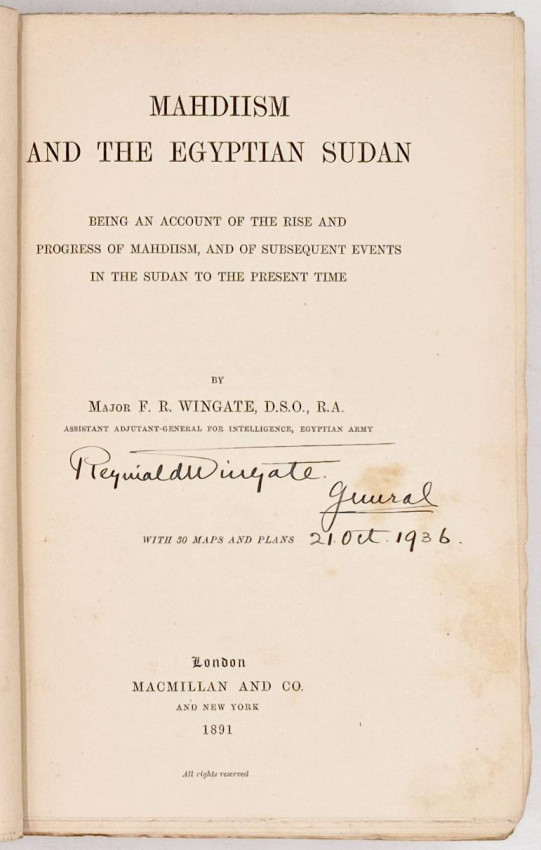
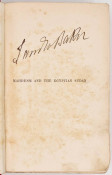
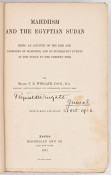
Signed by Sir Samuel Baker, the African explorer and big game hunter, on the half title page and presumed to be his own copy, and by the author - Reginald Wingate, General, 21 Oct 1936 - beneath his name on the title page.
Royal Collection Trust (https://www.rct.uk/collection/1079816/mahdiism-and-the-egyptian-sudan-being-an-account-of-the-rise-and-progress-of), 'Wingate joined the Egyptian Army in 1882 and played a leading role in Sudanese campaign of 1898. He wrote this book in collaboration with Ernest Ayscoghe Floyer, inspector-general of Egyptian telegraphs, although his name does not appear in print. It was published in 1891 as part of a propaganda campaign in which Wingate presented the Sudanese Mahdiyya movement as the embodiment of evil, with the purpose of encouraging the British public to support further military action in the region.
'Later, in 1897, Wingate was made an extra ADC to Queen Victoria. She conferred on him the Knight Commander of the Order of St. Michael and St. George the following year.
'During the Sudan Campaign of 1898 Sir Reginald Wingate was Director of Military Intelligence of the Egyptian Army. Afterwards he visited Queen Victoria in Balmoral where, on 5 September 1899, he presented her with trophies from the Battle of Omdurman.'
Oxford Dictionary of National Biography (https://www.oxforddnb.com/display/10.1093/ref:odnb/9780198614128.001.0001/odnb-9780198614128-e-36977), ‘…Britain had occupied Egypt in 1882, and although early evacuation was an oft-stated goal, the conditions that had brought about the occupation tended to prolong it. One of these was the state of the Egyptian army, which had rebelled and been defeated and disbanded by the British. It was to the nascent new Egyptian army, under British officers, that Wingate was seconded in 1883. He was aide-de-camp to the sirdar (commander-in-chief), Sir Evelyn Wood (a lifelong patron) in 1883–4, and when Wood resigned in the aftermath of General Gordon's débâcle at Khartoum in 1885, Wingate too left Egypt. After an unsatisfactory year in Britain, however, spent at Fort Rowner, Gosport, and as aide-de-camp to Wood at Colchester, Wingate returned to the Egyptian army in 1886 as assistant military secretary to the new sirdar, Sir Francis Grenfell.
‘Wingate spent the next twelve years as an increasingly prominent figure in the Anglo-Egyptian campaign against the Sudanese Mahdist state. The Mahdi himself had died in June 1885, but his successor, the khalifa 'Abdallahi, proved formidable. While Britain eschewed responsibility for Sudan, as the occupying power in Egypt she could not ignore a militant threat to Egypt's borders. But while British civilian authorities on the scene (most notably Sir Evelyn Baring, who was the chief British representative in Egypt from 1883 to 1907) and in London would not countenance an expensive ‘reconquest’, British soldiers in Egypt saw it as their mission to 'avenge Gordon' and conquer Sudan. For years the civilians had their way; border skirmishes were the rule, and after August 1889, when an invading Mahdist army was easily annihilated at Tushki in the Nubian Desert, there seemed little practical reason for an advance. This came only in 1896, when, mindful of French movements towards the upper Nile and wishing to divert the Sudanese from the embattled Italians in Eritrea, the British government authorized a limited Anglo-Egyptian advance into Sudan.
‘Wingate had played an important official and personal role in planning, co-ordinating, and indeed in winning approval for that advance. As successively (or, in the understaffed Egyptian army, simultaneously) assistant military secretary, assistant adjutant-general for recruiting, and, most notably, from 1888 as assistant adjutant-general for intelligence and from 1892 as director of military intelligence, Wingate became not only the chief collector of information on Mahdist Sudan, but ironically also its chief disseminator to the British public. In October 1891 the first of three books of which he shared authorship appeared, Mahdiism and the Egyptian Sudan. Largely a military history of the period 1883–9, the book won appreciation in specialist military and political circles, but produced little public response (or income). Learning from this experience, Wingate published in October 1892 Ten Years' Captivity in the Mahdi's Camp, an account of the adventures of an escaped priest, Josef Ohrwalder, which was an instant critical and commercial success. This was followed finally, and most notably, in February 1896, by Fire and Sword in the Sudan, an account of the experiences of the Austrian Rudolf Slatin, an Egyptian official who had absconded from Sudan the previous year. All of these works brought Wingate to the favourable notice of the British military and political establishment, and brought the lurid details of alleged Mahdist barbarism to the attention of the British public.’
- Overall Condition: Very good
- Size: 8vo (230 x 150 mm)