
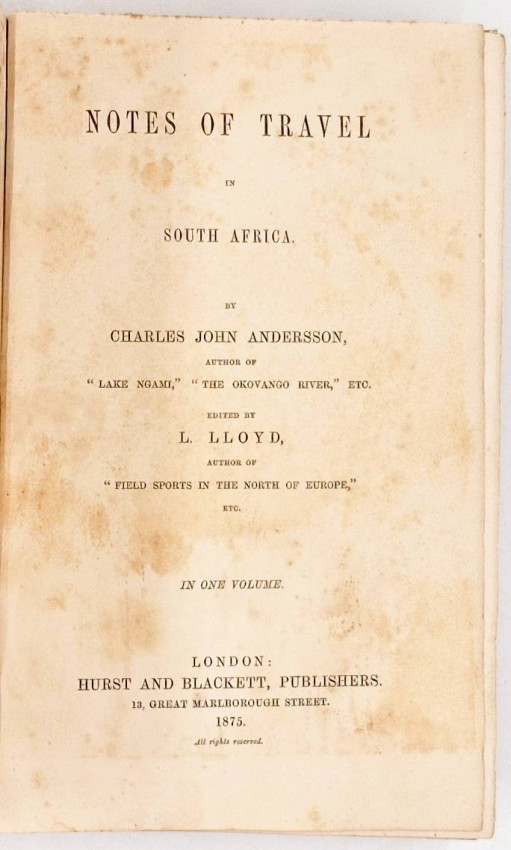
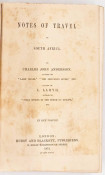
Edited by L. Lloyd.
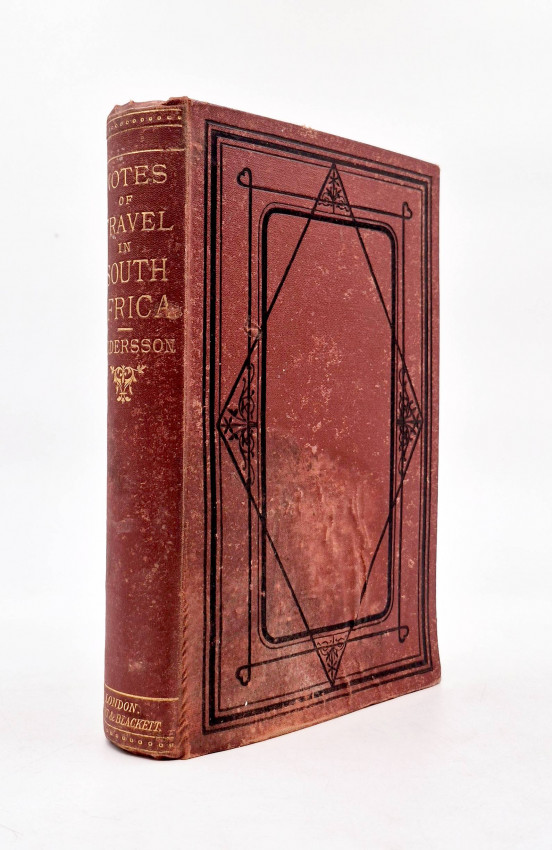
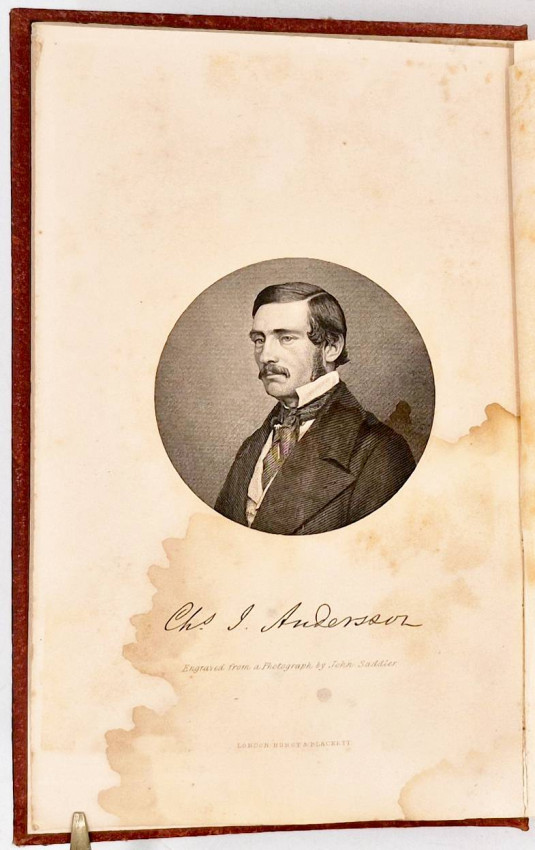
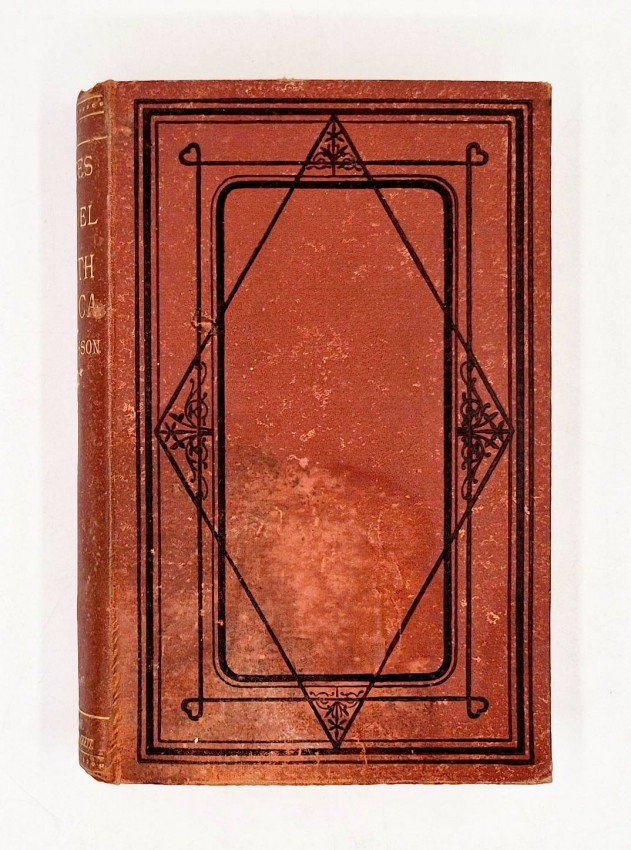
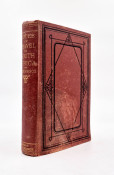
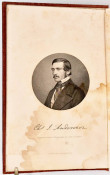
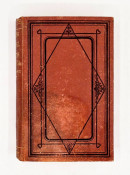
First edition: 338 pages, engraved frontispiece portrait of the author, original decorated brown cloth, titled and decorated gilt on the spine, water marks on the covers, preliminary and end pages as well as the frontispiece, uncut fore-edge with light foxing, pages unopened, starting to work loose at the hinge between pages 112- 113.
S2A3 Biographical Database of Southern African Science (https://www.s2a3.org.za/bio/Biograph_final.php?serial=63): 'Charles John (or Carl Johan) Andersson (1827-1867), adventurer, trader, explorer and collector of natural history specimens, was the son of the English hunter Llewellyn Lloyd and Kasja Andersdotter, who was Swedish. He started studying zoology at the University of Lund in 1847, but left after only one term because of insufficient funds. He spent two years mainly hunting and collecting in Sweden. In 1849 he went to England to sell his collections and met Francis Galton who accepted him as companion for an expedition to Lake Ngami (in present Botswana), which had just been visited by David Livingstone. They arrived in Table Bay in June 1850, proceeded to Walfish Bay, and travelled to unexplored Ovamboland. They did not manage to reach Lake Ngami, but Andersson collected about 500 bird skins and 1000 insects, many of which were sold to European collectors. Galton returned to England with Andersson's collections in January 1852, but provided equipment for Andersson to undertake further expeditions. The latter first undertook a trip overland to Cape Town to sell cattle. There, in November 1852, he completed a map showing the route Galton and he had followed, with notes on the tribes they met with or heard about. This manuscript map was sent to the Royal Swedish Academy of Sciences and is still in its archive.
'Andersson's next expedition took him to Lake Ngami in 1853. He was the first European explorer to travel up the Taoghe River, which at that time fed the lake with water from the Okavango Delta. He returned to Walfish Bay with substantial natural history collections. An itinerary of his journey with the latitudes of prominent places was published in the South African Commercial Advertiser and as a pamphlet in Cape Town in 1854. At that time he returned to Sweden because his father was ill. He described his travels in a comprehensive article in the Journal of the Royal Geographical Society and in an important book, Lake Ngami, or, exploration and discoveries during four years' wandering in the wilds of south-western Africa (London, 1856). The map which accompanied the book, on a scale of 52 miles to the inch (1: 3 785 000) was the first to show the route to Ngamiland from the Namibian coast. This and other maps by him were partly based on dozens of astronomical observations to determine the latitude of various places.
'Back in South Africa in October 1856 Andersson worked briefly as a mining superintendent for the Walfish Bay Mining Company. In March 1858 he left on his next hunting expedition, intending to explore the Kunene River in Angola. However, in March 1859 he arrived at he Okavango River, which he observed flowing towards the Kalahari. This was an important geographical discovery. An illustrated account of this expedition, The Okavango river: a narrative of travel, exploration, and adventure, was published in London in 1861. A collection of insects made during this arduous journey was donated to the South African Museum in Cape Town in 1860. Long after his death Roland Trimen of the South African Museum, in the preface to his book South African butterflies... (1887-1889), acknowledged Andersson's donation of butterflies from Damaraland.
'After marrying Sarah Jane Aitchison in Cape Town in July 1860, Andersson and his wife returned to Otjimbingwe to trade. While this was at first successful, his active support of the Hereros in their war with the Namas resulted in the Namas confiscating the cattle he was sending south to the Cape. At this time, in 1863, Thomas Baines visited Otjimbingwe and illustrated some of the birds Andersson had collected. In June 1864 Andersson led the Hereros in a successful battle against the Namas, but was severely wounded in the process and went to Cape Town for medical attention in May 1865. While recuperating he undertook a systematic description of the birds of Damaraland, with assistance from E.L. Layard, but did not finish the work. After his death the manuscript, with the bulk of his remaining collections, passed into the hands of the British ornithologist John H. Gurney who published it in 1872 as Notes on the birds of Damaraland and the adjacent countries of South-West Africa - one of the few major works on Namibian birds.
'Andersson was an important explorer of Namibia. With Galton he was the first European to reach Ovamboland from the south, and he pioneered the route from Hereroland to Lake Ngami. His most important contributions to geographical knowledge are shown on his "Map of the principal part of Damaraland" (scale approximately 1:1 650 000), which was published in the Journal of the Royal Geographical Society in 1866. In May that year he left Cape Town on his final expedition, mainly to trade, accompanied by Axel Eriksson and Captain T.G. Een. They reached the Kunene River, but Andersson fell ill and died in Ovamboland in July 1867. His diary was edited by L. Lloyd and published in 1875 under the title Notes on travel in South Africa. It includes a fine description of bird life.
'The birds collected by Andersson during his 16 years of travelling formed an important contribution to the material available to European and South African ornithologists and several species or subspecies were named in his honour. Anthoscopus caroli (Grey Penduline-Tit), still commemorates the Latin version of his first name (Carolus). The University of Lund awarded him an honorary doctorate, but the news reached South Africa only after his death. Andersson's Vlei, south of Lake Ngami, was named after him.'
Mendelssohn (Sidney) South African Bibliography volume 1 pages 42 – 43: This is the last record of the adventures of the author, the narrative being continued up to the time of his death on the banks of the Cunene River. The volume contains a description of a battle between the Namaquas and Damaras, the latter having been led by the author, who was severely wounded in the contest. Other chapters give information about the Ovambo and there are interesting notes about the game birds of the country and the river Cunene.'
- Size: 8vo ( 230 x 150 mm)
- Sold By: Clarke's Africana & Rare Books
- Contact Person: Paul Mills
- Country: South Africa
- Email: [email protected]
- Telephone: 021 794 0600
- Preferred Payment Methods: Visa & Mastercard via PayGate secure links and Bank transfers.
- Trade Associations: ABA - ILAB, SABDA


