
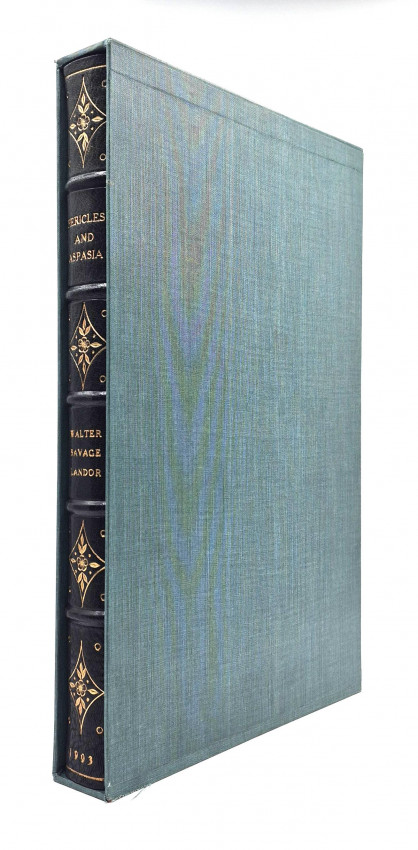
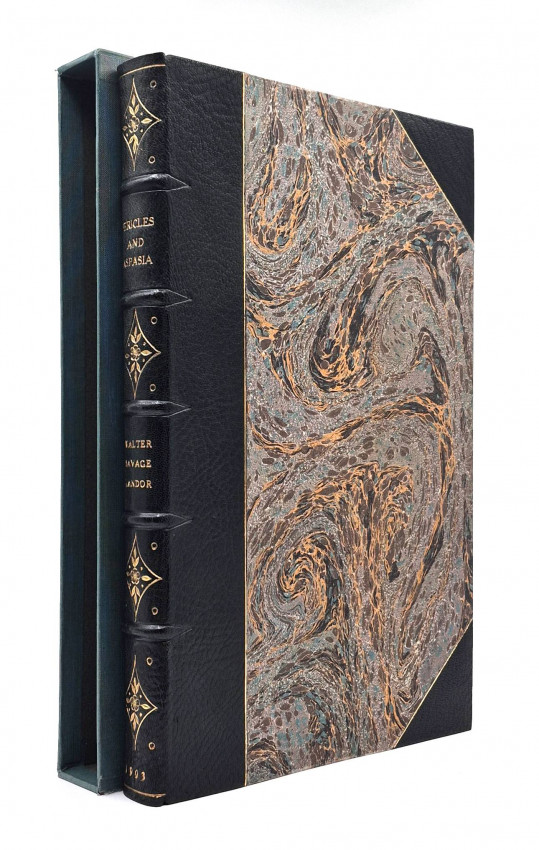
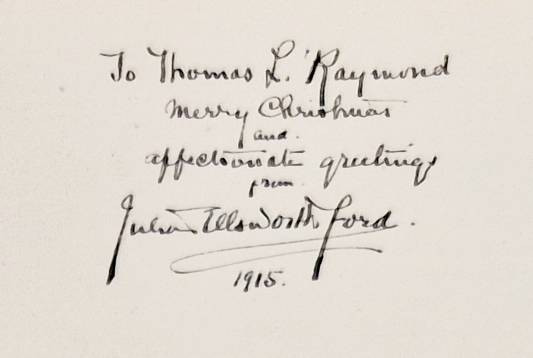
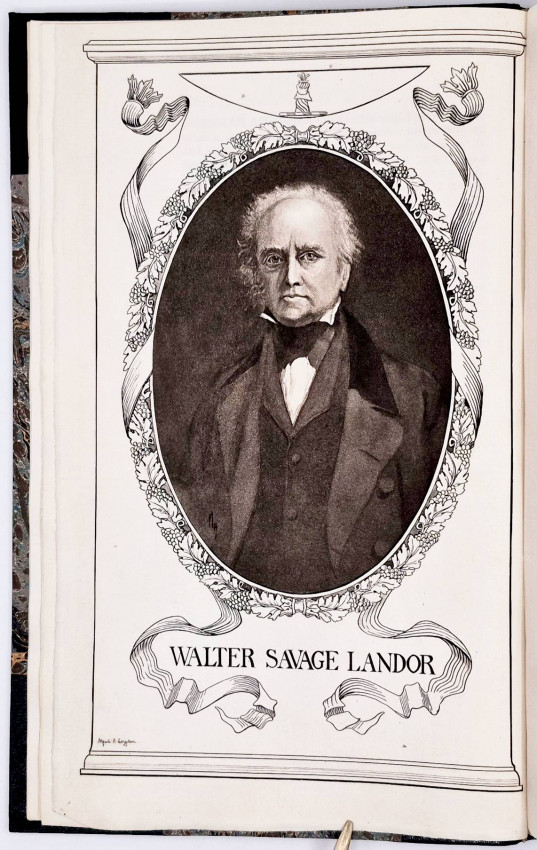
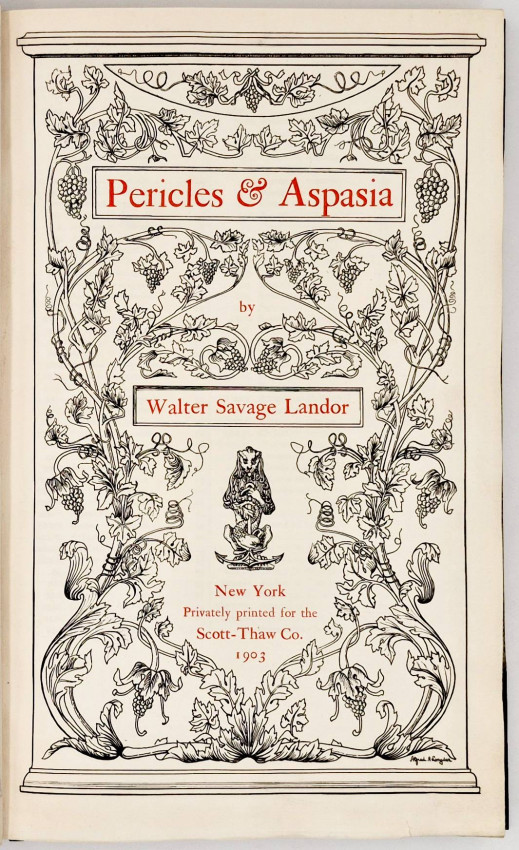
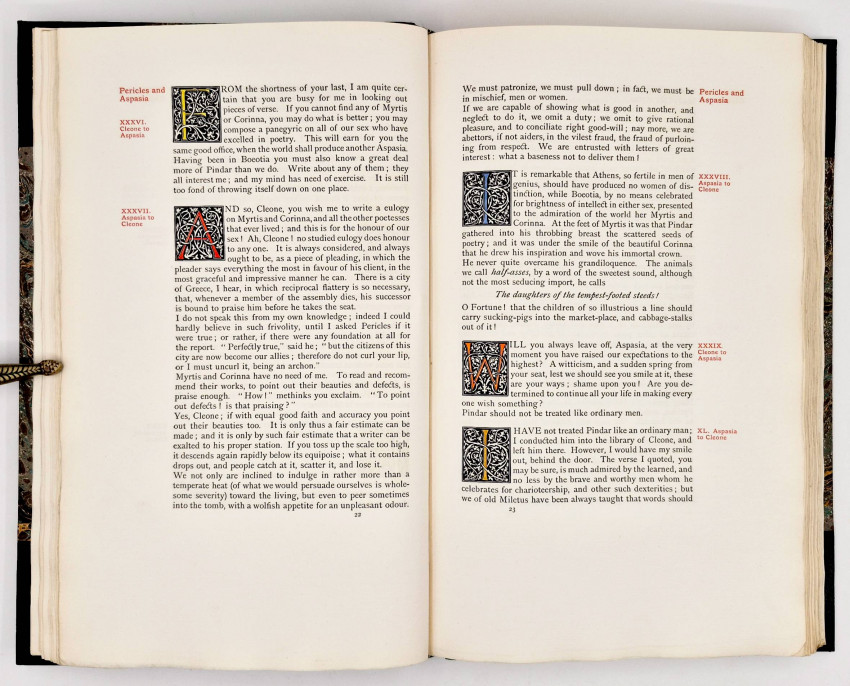
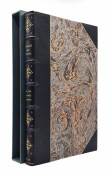
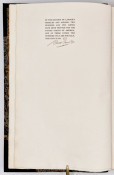
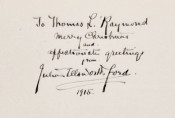
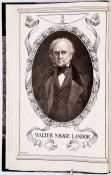
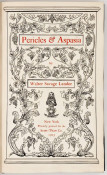
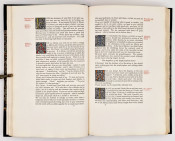
Frontispiece portrait of Landor, 235 pages and the Chiswick Press colophon page, handsomely bound in half dark green morocco with marbled paper sides and endpapers, titled and decorated gilt on the spine, top edge gilt, other edges uncut, signed in gilt '19 Grabau 33' at the bottom of the front free endpaper, neat inscription in ink on the front free endpaper, contained in a light blue cloth slip case, the initial letters on pages one to thirty three have been partly coloured by hand, a fine copy.
Editor's note: 'Pericles And Aspasia was first published in two volumes in 1836. Considerable additions were afterwards made, and it was reprinted with Landor's final corrections in the Collected Edition of his Works published in 1876. In the present edition these corrections are incorporated by the kind permission of Messrs. Chapman and Hall. The revision of the text has been entrusted to Mr. G. Ravenscroft Dennis, who has also superintended the printing of the volume. The author's few notes have been placed at the end of the book, and an Index of First Lines of the Lyrics scattered throughout the work and also a General Index have been added. The editor's thanks are due not only to Mr. Chas. T. Jacobi, Manager of the Chiswick Press, but also to Mr. Horace Hart, Controller of the Oxford University Press, who has improved the appearance of the book by many practical suggestions and much friendly criticism. The frontispiece and title-page have been designed by Mr. Alfred A. Longden, the portrait being based on the painting by Sir William Boxall, R.A., in the Victoria and Albert Museum.'
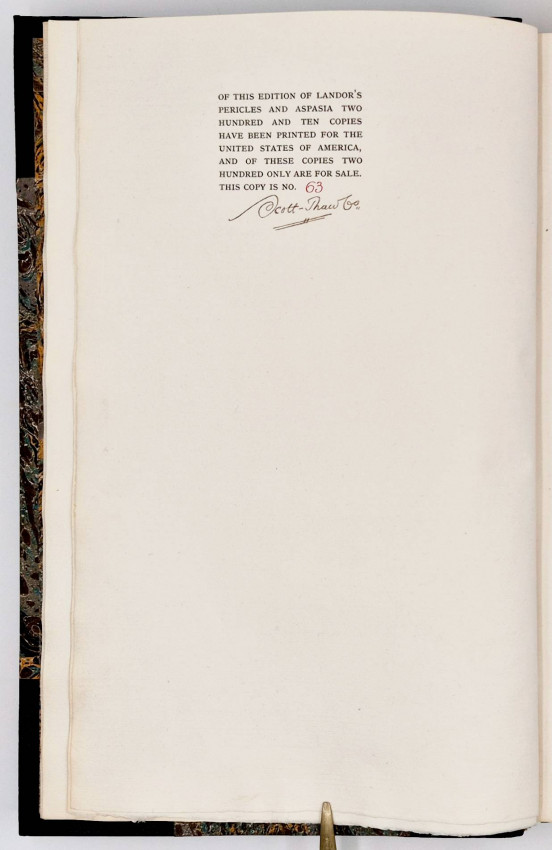
The colophon reads: Of this edition of Landor's Pericles and Aspasia two hundred and ten copies have been printed for the United States of America, and of these copies two hundred only are for sale.
This copy id No. 63. Scott-Thaw Co.
Wikipedia (https://en.wikipedia.org/wiki/Walter_Savage_Landor): 'Walter Savage Landor (30 January 1775 – 17 September 1864) was an English writer, poet, and activist. His best known works were the prose Imaginary Conversations, and the poem "Rose Aylmer," but the critical acclaim he received from contemporary poets and reviewers was not matched by public popularity. As remarkable as his work was, it was equalled by his rumbustious character and lively temperament. Both his writing and political activism, such as his support for Lajos Kossuth and Giuseppe Garibaldi, were imbued with his passion for liberal and republican causes.[1] He befriended and influenced the next generation of literary reformers such as Charles Dickens and Robert Browning..... "Pericles and Aspasia", which was to become one of his most appreciated works, was published in March 1836. It is in the form of an Imaginary Conversation and describes the development of Aspasia's romance with Pericles, who died in the Peloponnesian War, told in a series of letters to a friend Cleone.'
University of Delaware Library Special Collections (https://findingaids.lib.udel.edu/repositories/2/resources/1633) 'John Frederick Grabau was born in Wisconsin in 1878. He trained as an artistic bookbinder, apprenticing in the printing shop of Gies & Co. and at Peter Paul’s bookbindery. In 1902, Grabau became the protégé of Louis H. Kinder at the Roycroft community bindery. Kinder founded the Roycroft Bindery in 1896 and attracted many talented young artists, including Grabau, Harry Avery, and Charles Youngers. The Roycroft community produced some of the finest hand-crafted books, furniture, lamps and metalwork of the Arts and Crafts Movement. Grabau left Roycroft in 1905 to found the Derome Bindery in Buffalo, New York. He named the bindery after Nicolas Derome, who was noted for his dentelle borders. Grabau died in Aurora, New York, in 1948.'
- Overall Condition: Fine
- Size: Folio 350 x 220 mm)
- Sold By: Clarke's Africana & Rare Books
- Contact Person: Paul Mills
- Country: South Africa
- Email: [email protected]
- Telephone: 021 794 0600
- Preferred Payment Methods: Visa & Mastercard via PayGate secure links and Bank transfers.
- Trade Associations: ABA - ILAB, SABDA


