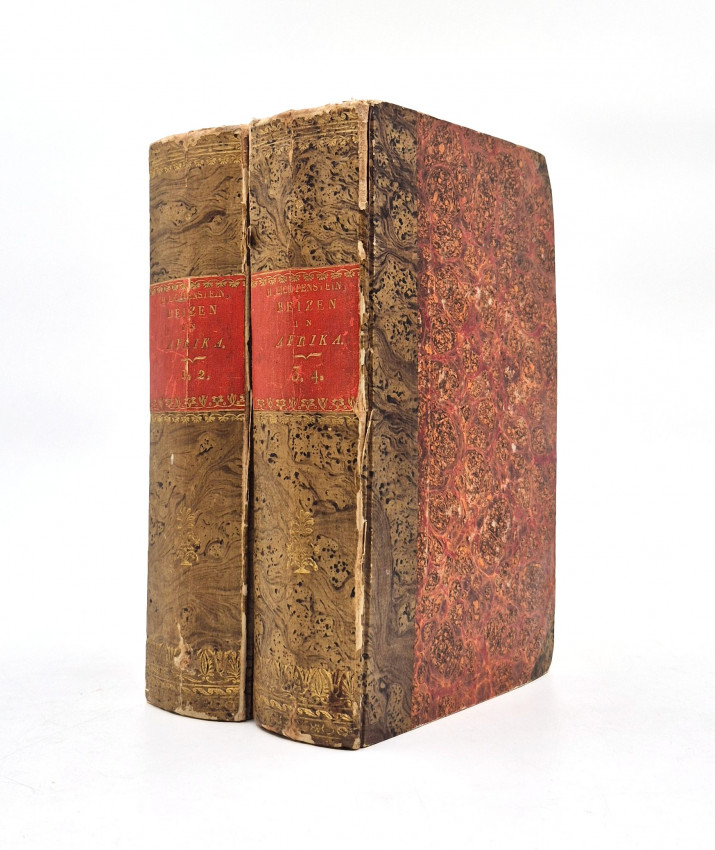
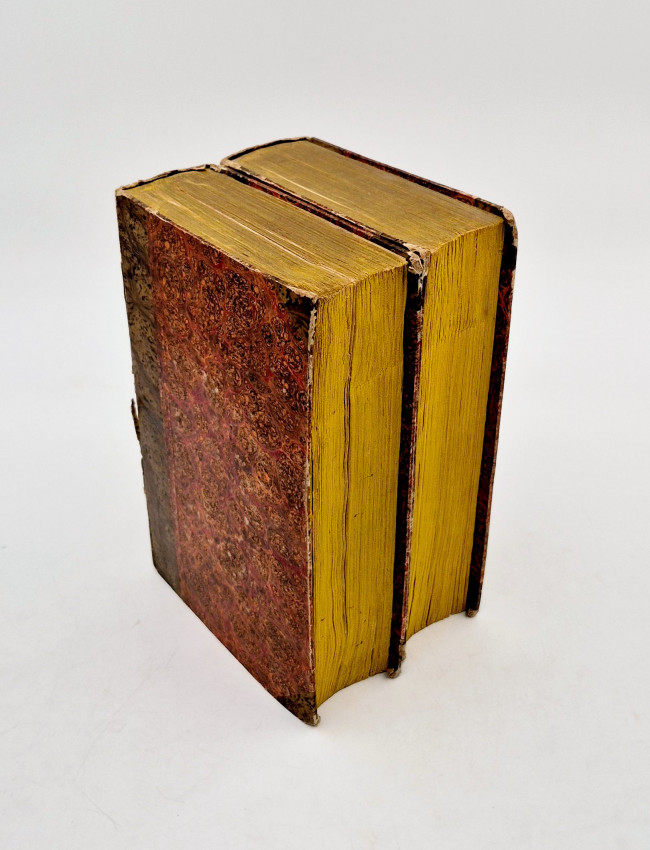
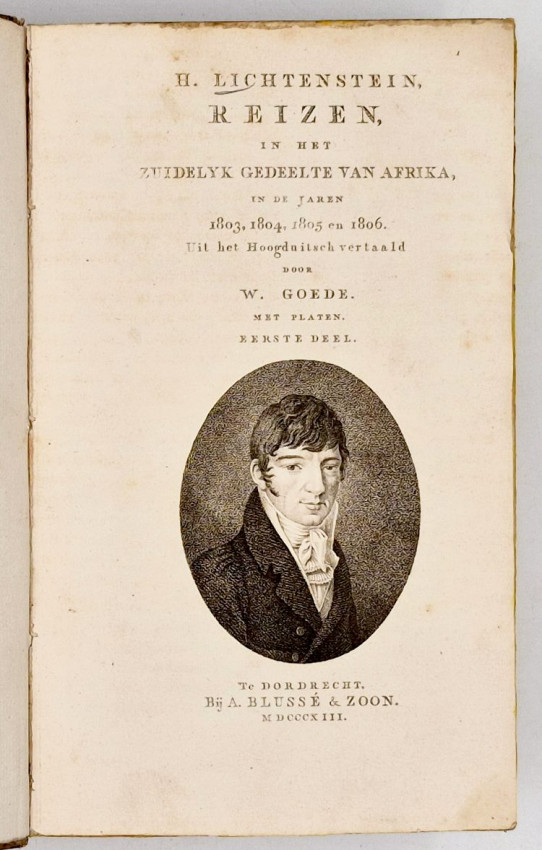
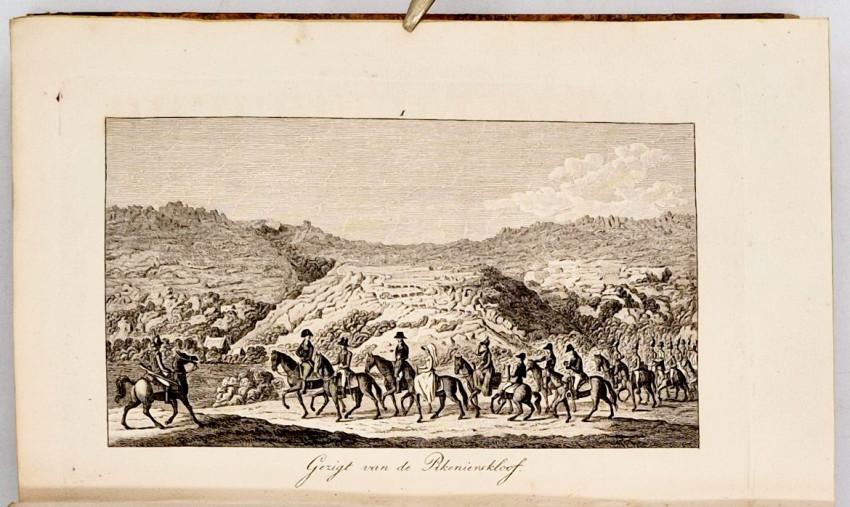
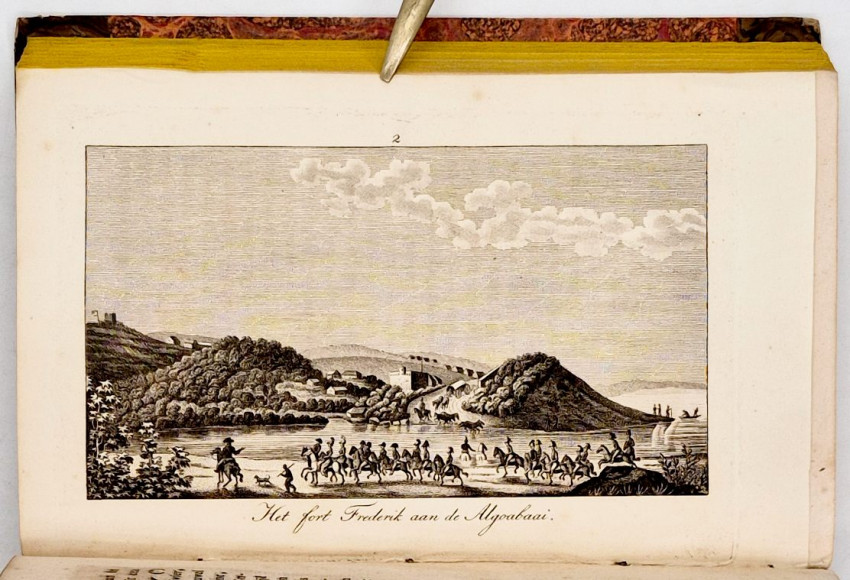
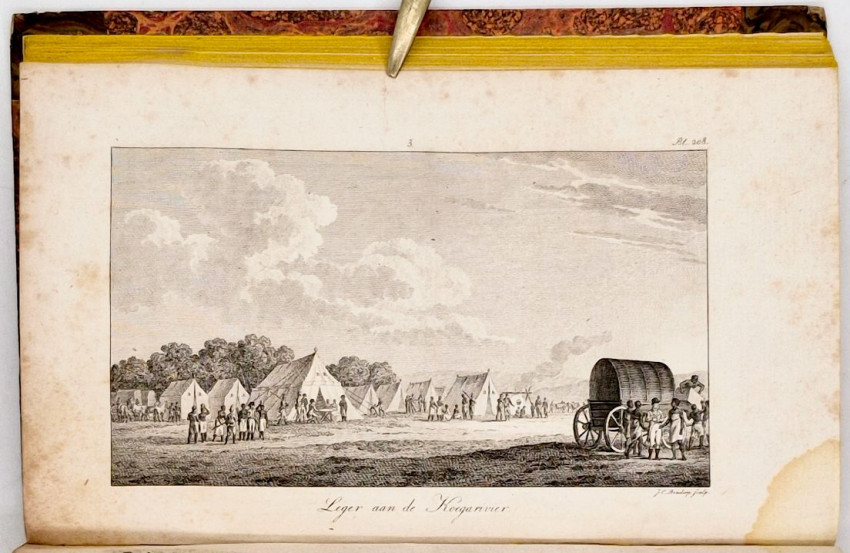
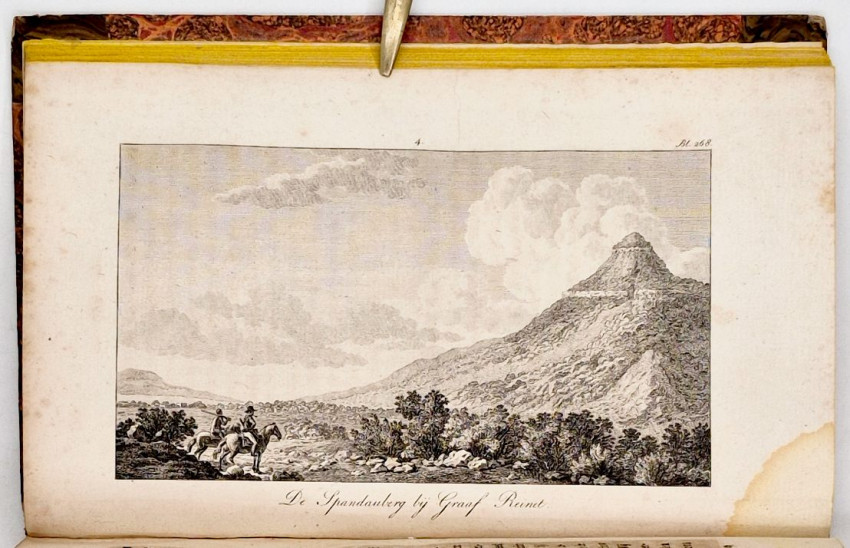
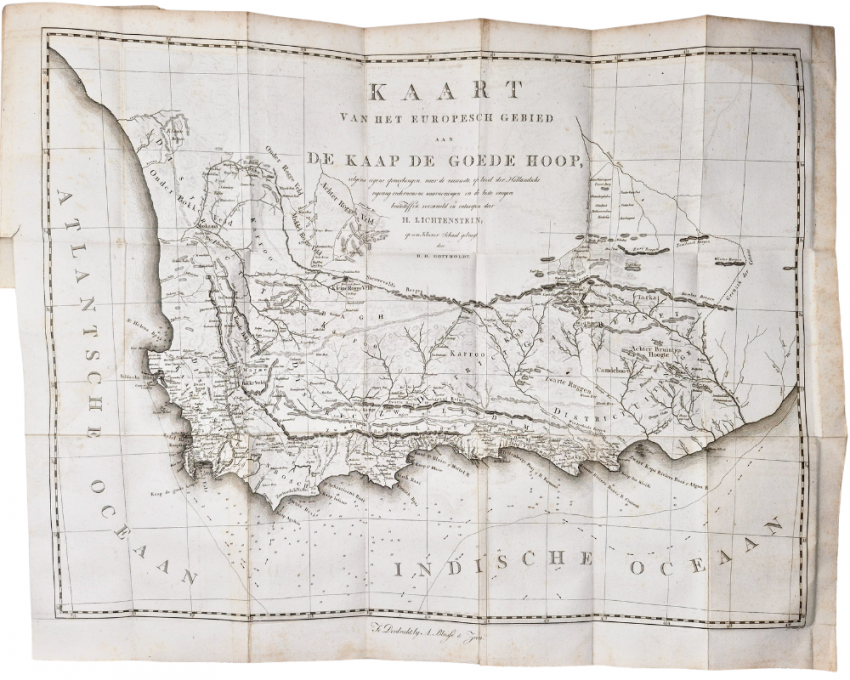
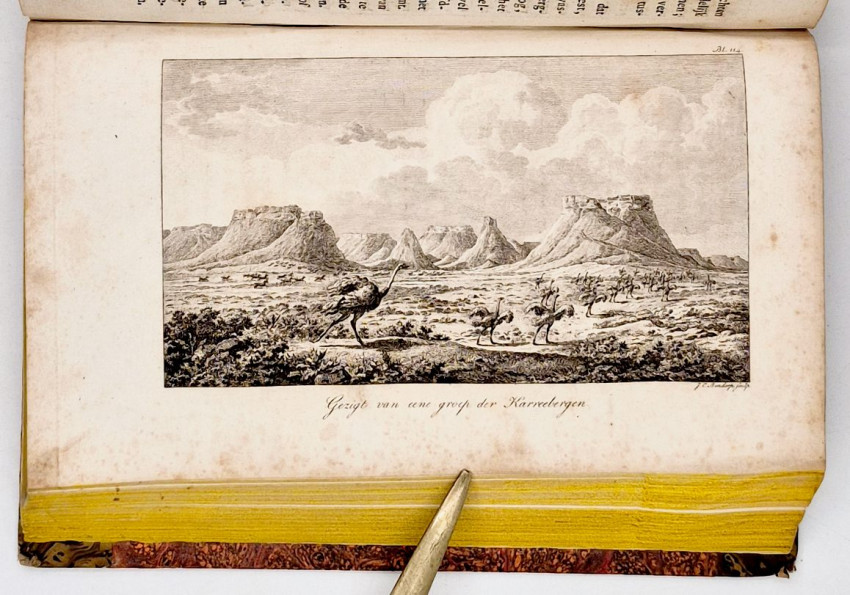
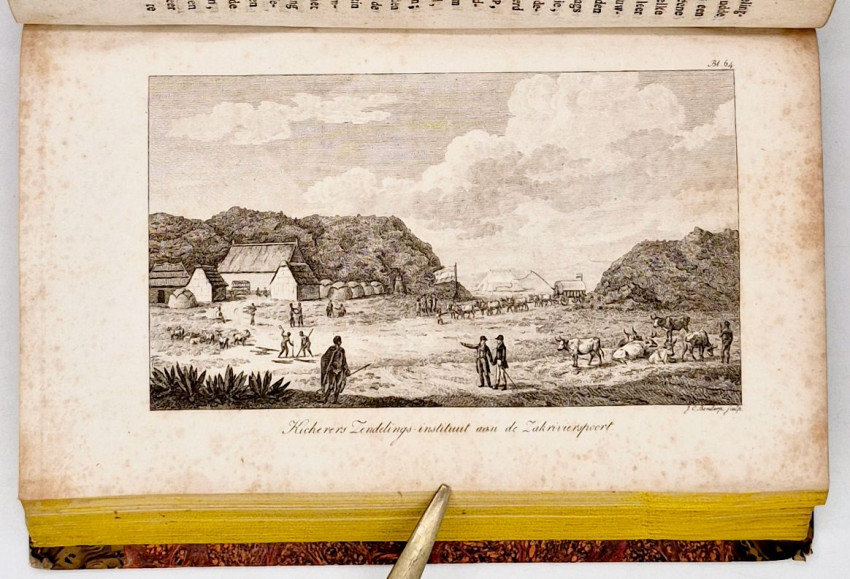
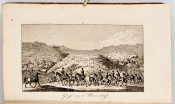
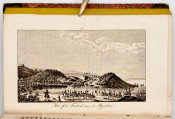
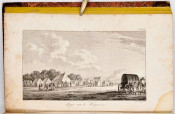
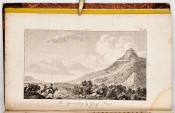
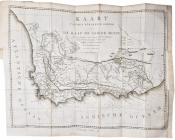
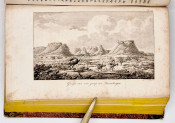
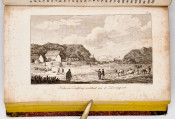
First Dutch Edition: 4 volumes in 2: 480, 346, 310 & 422 pages, small stipple engraved portrait of the author on the title page of volume I, 6 copper engraved plates and a large folding map of De Kaap de Goede Hoop, contemporary marbled paper covered boards (rubbed and worn) with red and gilt title labels on the spines, page edges dyed yellow, some light foxing and browning of the text in places, a very good copy.
S2A3 Biographical Database of Southern African Science (https://www.s2a3.org.za/bio/Biograph_final.php?serial=1681):
Lichtenstein, Dr Martin Hinrich Carl (medicine, zoology, plant collection)
Born: 10 January 1780, Hamburg, Germany.
Died: 3 September 1857, Baltic sea.
Hinrich (or Heinrich) Lichtenstein, German physician and naturalist, completed his schooling at the famous Johanneum High School in Hamburg, where his father was headmaster, and went on to study medicine at the Universities of Goettingen and Jena. He graduated as Doctor of Medicine (MD) in April 1802 at the University of Helmstedt. At that time General J.W. Janssens, who had just been appointed the first governor of the Cape Colony after its restoration to the Dutch, was looking for a family physician and a German tutor for his son to accompany him to the Cape of Good Hope. Lichtenstein, keen to learn more about this distant land, filled both positions. Before departing he spent a few days with the botanist and insect collector Count van Hoffmannsegg and his staff at Brunswick to acquaint himself with the procedure for collecting and preserving natural history specimens. He arrived at the Cape with the Janssens family in December 1802 and set about collecting information for a comprehensive account of the colony, including its geography, natural history, politics, ethnography and history.
Lichtenstein remained in South Africa for just over three years and undertook several journeys into the interior. In addition to his own observations he had access also to the journals kept by General Janssens and Commissary-General Jacob de Mist. In October 1803 he set out with de Mist and a large party on a six months tour of the colony. They first travelled north to Saldanha Bay and the mouth of the Berg River, then eastwards round the Piketberg, through Piekenierskloof to the Olifants River valley, passed north of present Calvinia, through the Roggeveld, and on to Roodezand (now Tulbach) on 20 November. Near Calvinia he saw the impressions of what he described as "eel fish" in the sedimentary rock, but these were probably trace fossils - markings left by living organisms rather than the organisms themselves. From Tulbagh they set off for the eastern frontier. During several days at Swellendam he collected plants and insects in the Duiwelsbosch forests, as well as seeds for the Cape Town botanic garden. Continuing along the coast to Knysna the party crossed the mountains where Prince Alfred Pass is now and travelled down the Langkloof, reaching Algoa Bay on 7 January 1804. They then proceeded north-eastwards to the Fish River and after failing to meet Chief Gaika returned through the Karoo and the Hex River Pass to Cape Town, which they reached on 23 May. Lichtenstein collected many natural history specimens during the 3000 km trip, and made detailed notes on the colonial mode of life.
During the following winter he collected plants and insects near Cape Town in his spare time, often accompanied by the pharmacist Peter H. Polemann. In September 1804 he travelled to Swellendam and surrounding areas, where he took the opportunity to visit J.A. Auge, who was by then blind and 93 years of age. By that time he had been appointed also as surgeon major to the Hottentot Light Infantry battalion and during the summer of 1804-1805 was involved in combating a deadly epidemic of dysentery among the Dutch troops. He described the epidemic in a paper in Hufelands Neues Journal der praktischen Arzneykunde in 1808, including its successful treatment with Calomel, a compound of mercury used earlier in India.
In 1805 Lichtenstein was requested to accompany an expedition led by H. de Graaff, landdrost of Tulbach, to conclude peace with the Bushmen, gain information about the Hottentots along the Orange River, and visit the country of the Bechuanas further north. His duties included observations of the natural history and native inhabitants. Departing from Tulbagh on 7 May 1805 the expedition crossed the Orange River at present Prieska. Accompanied by a local missionary they followed the route taken in 1801-1802 by P.J. Truter and Dr W. Somerville to the vicinity of present Kuruman, where they were well received by the Bechuana chief. Somewhere north of Prieska he discovered the mineral crocidolite (blue asbestos). It was described by the German chemist M.H. Klaproth, to whom Lichtenstein sent various mineral specimens. On the return journey he made an interesting collection of barbel, Clarius gariepinus, from a spring between present Carnarvon and Fraserburg. As the spring was not connected to any river the fish may have represented a relic population from a wetter climatic period. The species has not been collected so far south of the Orange River in later times. The return journey brought them back to Tulbagh early in August. This journey was the first during which he made astronomical observations to help determine his position.
Having encountered cases of smallpox on the border of the colony, he was ordered by the governor to return to the area and inoculate the inhabitants against the disease. He left Tulbach on 19 August, travelled to the Roggeveld and across the Ceres Karoo nearly to present Sutherland, returning to Tulbach on 9 September having travelled some 600 km and inoculated almost 300 persons. His observations on the outbreak and a detailed account of the steps taken by the authorities to prevent the spread of smallpox were described in a further paper in Hufelands Neues Journal der praktischen Arzneykunde in 1809.
Following the arrival of a large English fleet in January 1806 to take over the Cape, Lichtenstein returned to Europe in March with General Janssens party, having arranged and classified his collections before departure.
In June 1815 Lichtenstein married Victoria Hotho, the well-educated daughter of a wealthy Berlin industrialist, which enabled him to travel all over Europe. They eventually had three children. Both were members of the Berlin Choral Academy and their apartment became a meeting place for music lovers. The composer Carl Maria von Weber was among their friends. In 1816 Lichtenstein was elected a member of the exclusive Monday Club, consisting of just 30 persons from the upper intelligentsia. He died after a stroke on board a ship in the Baltic Sea, on his way back to Germany from Sweden. He was small in stature but of robust build, not attractive in appearance but possessing great charm, versatile and full of enthusiasm. His documents and papers are housed in the Staatsbibliothek in Berlin, while most of his correspondence is in the Institut fuer spezielle Zoologie and in the Zoologisches Museum of Humbolt University, Berlin. There are also several collections of his letters in various other German archives and libraries.
Lichtenstein was the first naturalist of note to penetrate beyond the Orange River and his wide interests and zest for collecting rivalled those of C.P. Thunberg and Anders Sparrman. On his main journeys he travelled fully equipped with his books, instruments and facilities for preserving specimens. He was commemorated in the plant genus Lichtensteinia (Fam. Umbelliferae), and in the species Gazania lichtensteinii, Anthospermum lichtensteinii, and Barleria lichtensteiniana.
- Overall Condition: Very good
- Size: 8vo (215 x 135 mm)