
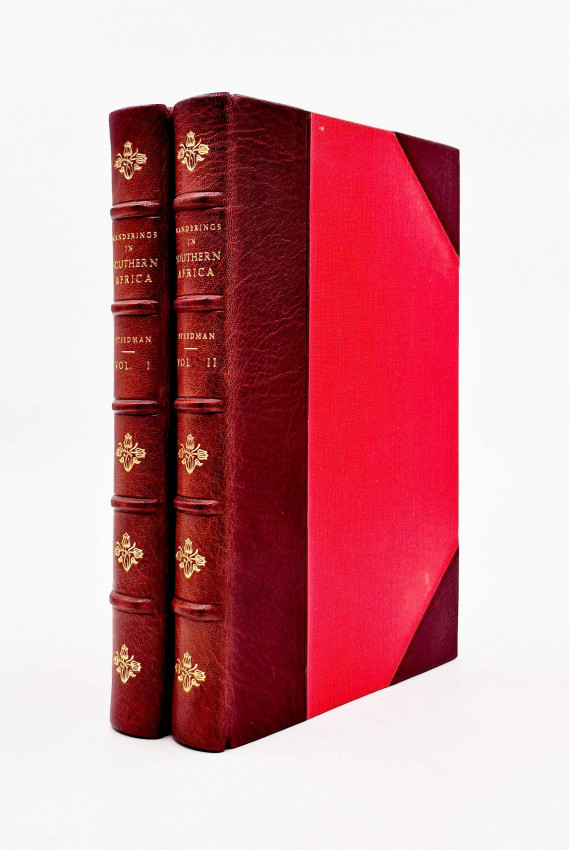
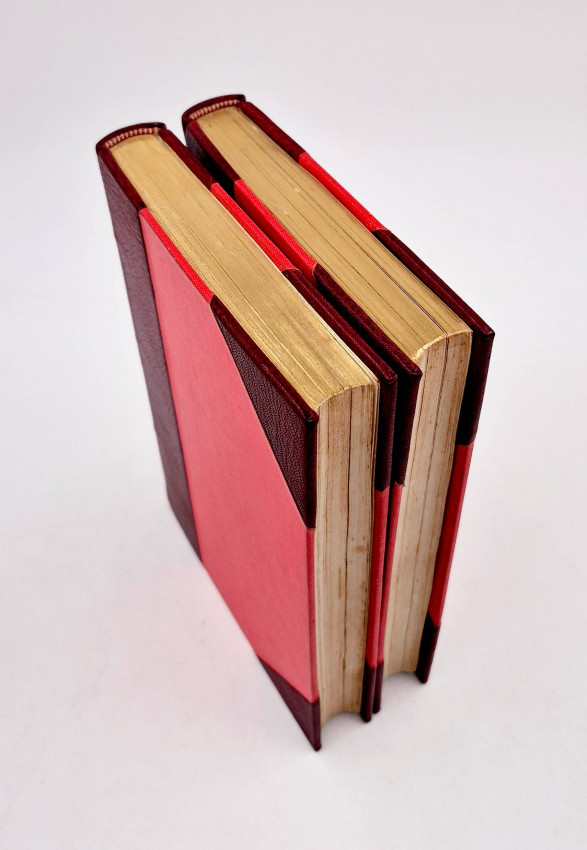
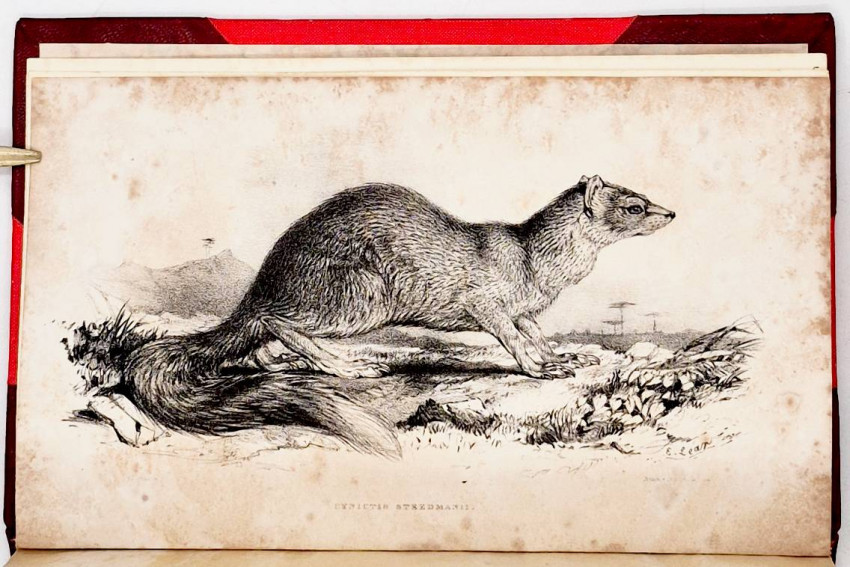
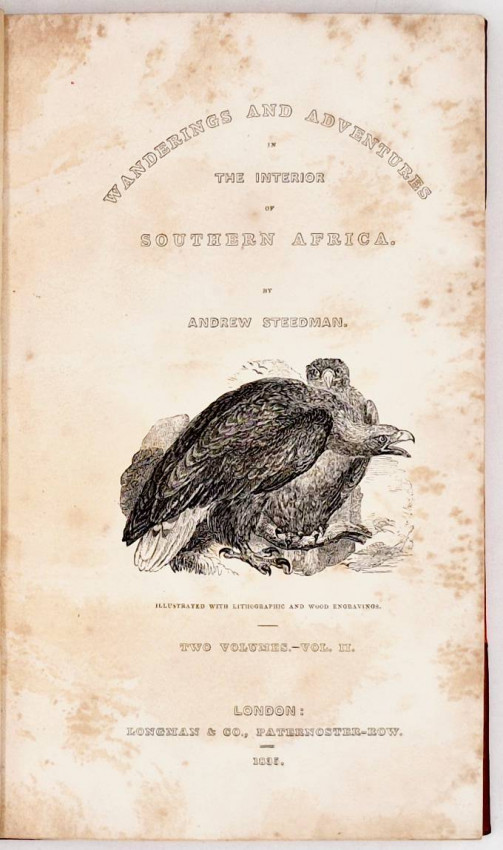
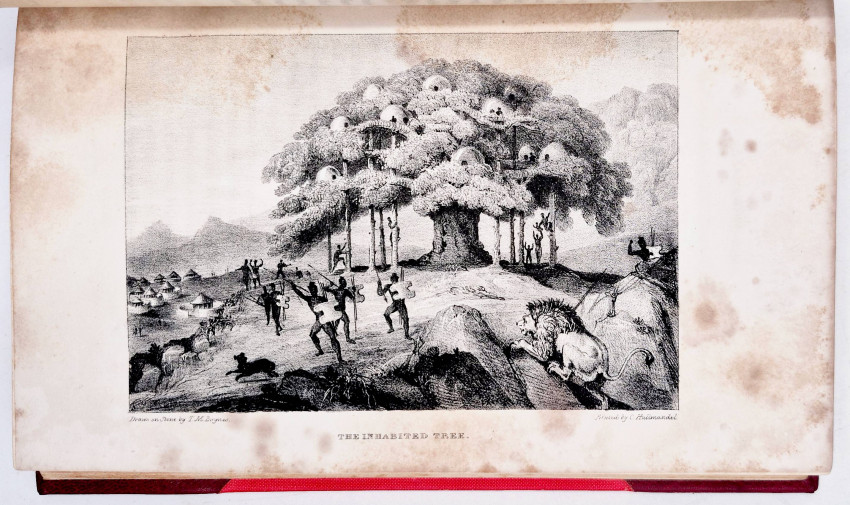
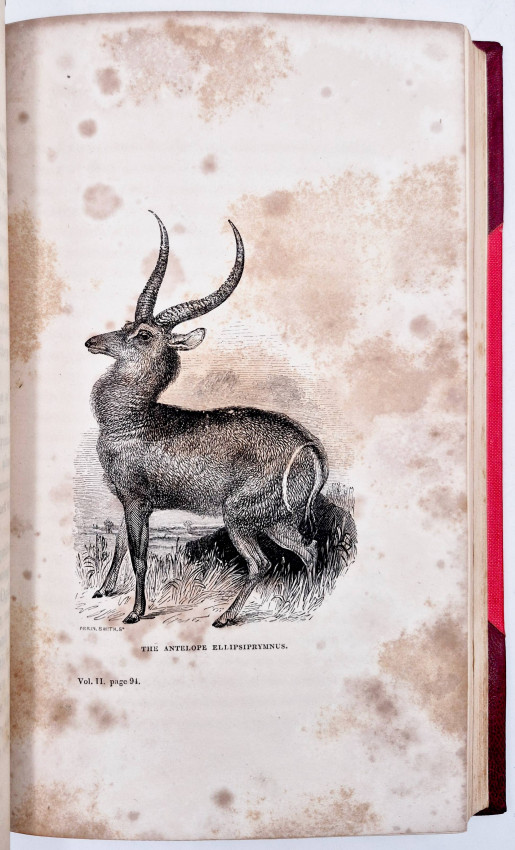
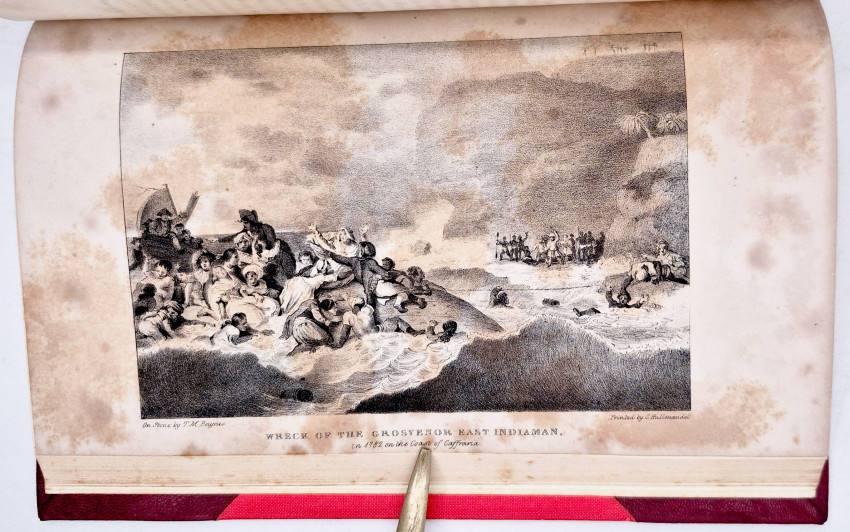
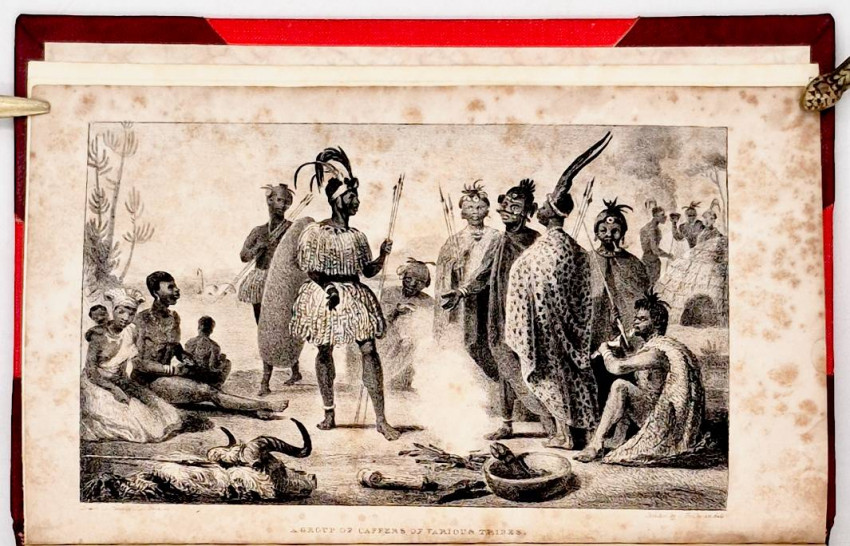
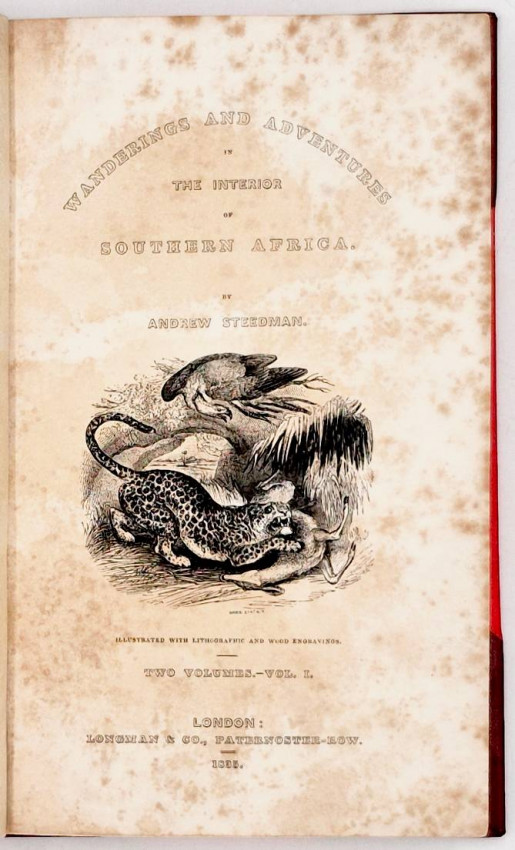
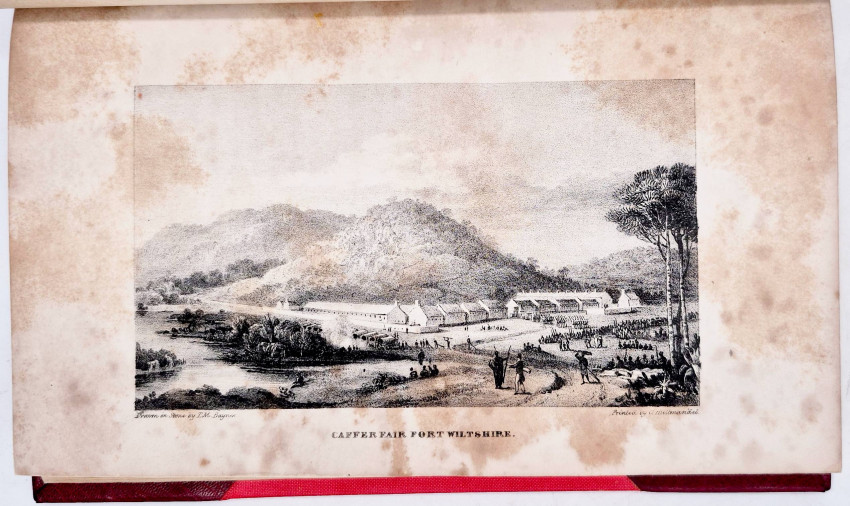
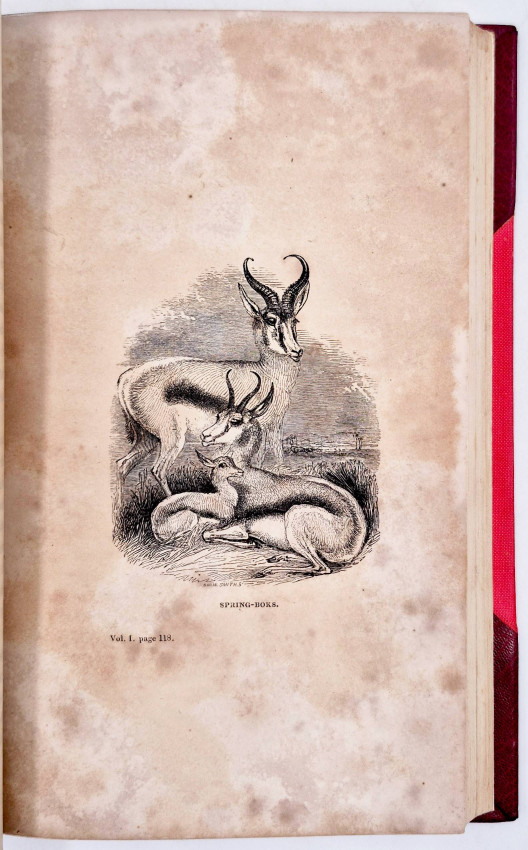
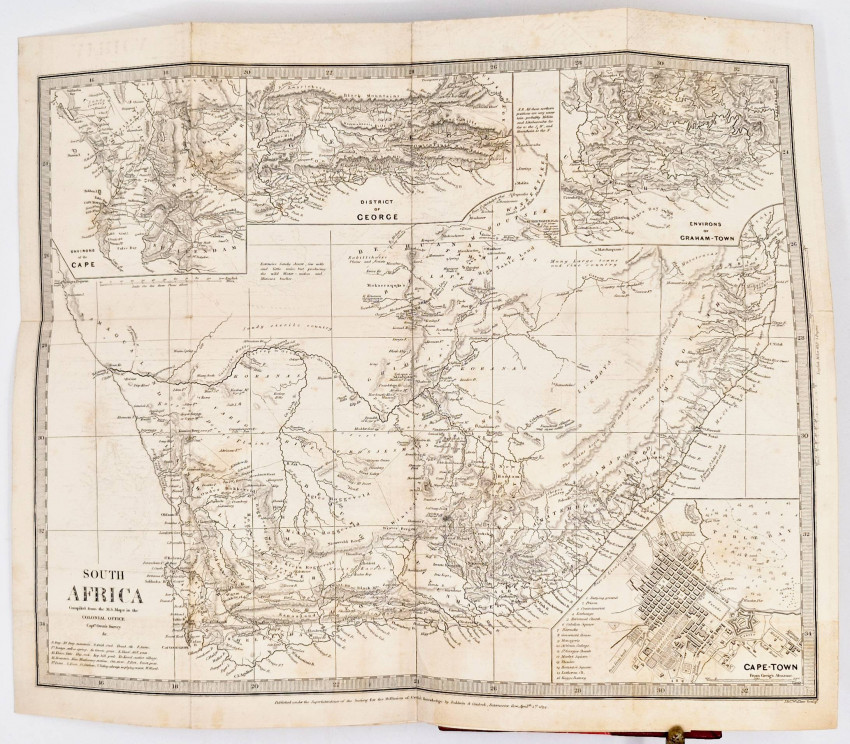
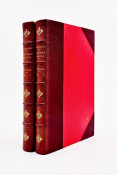
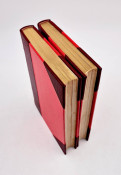
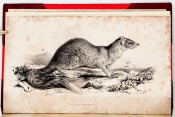
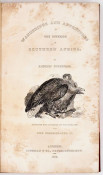
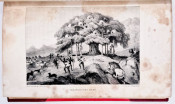
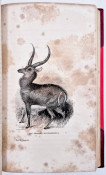
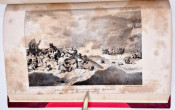
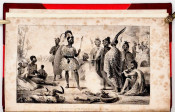
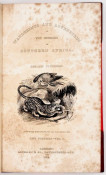
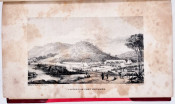
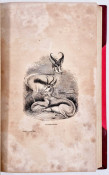
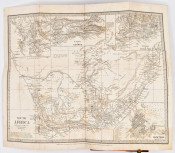
First Edition. 2 volumes, xii, 330 + 358 pages, lithographic frontispiece in each volume – in volume 2 this is of the species of Meerkat named after the author ‘Cynictis Steedmanii’ after a drawing by Edward Lear, title page vignettes, 10 plates, 1 folding map at the back of volume 1, handsomely bound in half maroon morocco with red cloth sides, marbled endpapers, top edges gilt, the frontispieces and plates are oxidised and is often the case with this work, some light foxing in the text, a very good copy.
Mendelssohn (Sidney) South African Bibliography volume 2, page 432: An account of travels in South Africa during which Mr Steedman traversed a great part of the Cape Colony and Kaffraria. He penetrated the country up to Griqualand West and collected much information about the fauna of the country. His name was given to a species of Meerkat 'Cynictis Steddmanii.'
S2A3 Biographical Database of Southern African Science (https://www.s2a3.org.za/bio/Biograph_final.php?serial=2694)
Steedman, Mr Andrew (vertebrate collection) Born: 1800, United Kingdom. Died: Date not known, Place not known.
'Andrew Steedman came to the Cape Colony from England as an independent 1820 Settler (i.e., he was not a member of an organised party of settlers). He arrived at Algoa Bay in June 1820 on the last of the settler ships, the Duke of Marlborough. He subsequently settled in Cape Town. The African court calendar and directory and its successor, the South African almanac and directory contain the following listings for Steedman: H. Steedman, woollen draper, at 8 Burg Street (1821, 1822), then Steedman & Co., woollen drapers and tailors, at 4 Markt Street (1823-1825) and at 23 Berg Street (1826), then Steedman & Co., general merchants, at 25 Berg Street (1827, 1828), and finally A. Steedman, merchant and general fitting-out warehouse, at 15 Berg Street (1829). It is likely that all these entries refer to the same person and that Andrew Steedman therefore was in business in Cape Town from 1821. The business must have been successful, for it enabled him to undertake three major journeys into the interior in search of natural history specimens.
'Steedman's first journey took him to Port Elizabeth by sea and from there to Grahamstown, where he obtained permission from the military to travel beyond the Keiskamma River (into the Ciskei). Traveling on horseback he visited Fort Wiltshire (some 20 km south of present Alice), visited various local chiefs down to Wesleyville (some 30 km south of present King William's Town), and returned to Port Elizabeth by more or less the same route.
'On 18 February 1829 Steedman married Kate P. Rose in Cape Town. He set out on his second journey on 30 September 1830 with an ox-wagon and travelled to the Great Karoo via the Hex River Valley, on to Beaufort West and Graaff Reinet, and from there via the Kompasberg to Colesberg. After nearly drowning in an attempt to cross the swollen Orange River he returned to Colesberg where he attended the laying of the foundation stone of the Dutch Reformed Church on 29 November 1830. From Colesberg he proceeded to Cradock and via Glen Lynden (on the Baviaans River east of Somerset East) to Grahamstown. After spending some time there he once again visited the Ciskei, reaching Tyume mission station (just north of present Alice) and re-visiting Fort Wiltshire, where he obtained much information about the local people and their customs from assistant staff-surgeon Nathaniel Morgan. From Grahamstown he returned to Cape Town overland by the established route.
Steedman set out on his third journey on 17 September 1831 with the intention of reaching Lattakoo (now Dithakong, some 60km north-east of Kuruman), chief town of the Tlhaping, the southernmost Tswana. He sent his ox-wagon on its way and first accompanied a friend to Beaufort West on horseback. From there he travelled to the mission station at Griquatown. Illness prevented him from continuing on to Lattakoo and after recovering he returned to Cape Town in November 1831.
'During his travels Steedman collected over 300 animals, including some that had not yet been described, as well as ethnographic specimens. Most of the animals were mounted by the Cape Town taxidermist P. Jules Verreaux. In June 1833 Steedman was still in Cape Town, where he subscribed the price of one share in the Cape of Good Hope Association for Exploring Central Africa (which funded the expedition of Dr Andrew Smith). Later that year he returned to England and arranged an exhibition of his animals in the Colosseum, Regent's Park, London. It was named "The African Glen" and opened in April 1834. It included a huge panorama made up of many South African scenes painted by the artist T.M. Baynes. The scenes included Grahamstown, the Karoo, Cape Town, Table Bay, mountain scenery, hunting scenes, and settlements of the indigenous inhabitants. Later he introduced variable lighting to create an impression of the landscape at different times of the day. Some of his exhibits featured predator-prey interactions. These novel and effective displays were forerunners of the dioramas and "habitat groups" in modern museum exhibits. The exhibition remained a popular attraction for a year and was described in a pamphlet entitled A description of an extensive collection of rare and undescribed specimens of natural history, collected in the interior of South Africa (London, 1833; 13th edition, 1836). Meanwhile he wrote Wanderings and adventures in the interior of southern Africa (London, 1835, 2 vols), based on a journal kept during his travels. The book was illustrated by Baynes and W. Harvey and included much information on the flora and fauna of the regions he had visited. An appendix (Vol. 2, pp. 145-253) contained information on Dr Andrew Smith's planned expedition, an account of the history of exploration in southern Africa by J.C. Chase, and A.G. Bain's journal of his trip to the Bechuana country. A facsimile reprint of the book was published in Cape Town in 1966. An article with the same title as the book was published in the Journal of the Royal Geographical Society (1835, Vol. 5, pp. 322-340).
'Nothing is known about Steedman's later life and it has been assumed that he did not return to South Africa. However, archival documents indicate that Andrew Steedman was involved in some 20 legal disputes in the Cape Colony during the periods 1828-1835 and 1840-1844. Furthermore, on 21 March 1840 A. Steedman, probably him, was elected a member of the committee of the Cape of Good Hope Agricultural Society at its annual meeting in Cape Town. Also, in April 1845 A. Steedman was listed as one of the signatories to a memorial supporting the establishment of a botanic garden in Cape Town. He therefore appears to have spent a second period in the Cape Colony from about 1840 to 1844 or 1845
'The Edward Lear frontispiece: (https://en.wikipedia.org/wiki/Edward_Lear) Edward Lear: Edward Lear (12 May 1812 – 29 January 1888) was an English artist, illustrator, musician, author and poet, who is known mostly for his literary nonsense in poetry and prose and especially his limericks, a form he popularised but which term he never used. See also his biography on the Edward Lear Society website: (https://edwardlearsociety.org/biography/). ‘When Steedman arrived in London in 1833 with his Cape specimens, including the newly-named Cynictis steedmanii, and exhibited them at the Colosseum, the obvious person to commission a scientifically accurate, finely observed drawing of the new species was Lear who was 21 years old and was, at that moment, the most sought-after zoological draughtsman in London.’
- Overall Condition: Very good
- Size: 8vo (220 x 145 mm)
- Sold By: Clarke's Africana & Rare Books
- Contact Person: Paul Mills
- Country: South Africa
- Email: [email protected]
- Telephone: 021 794 0600
- Preferred Payment Methods: Visa & Mastercard via PayGate secure links and Bank transfers.
- Trade Associations: ABA - ILAB, SABDA


