
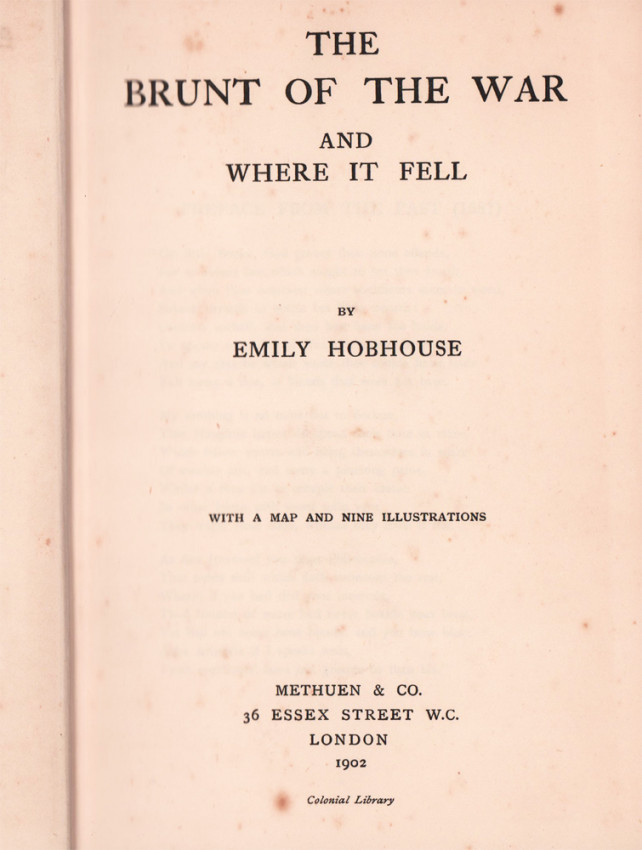
With a map and nine illustrations
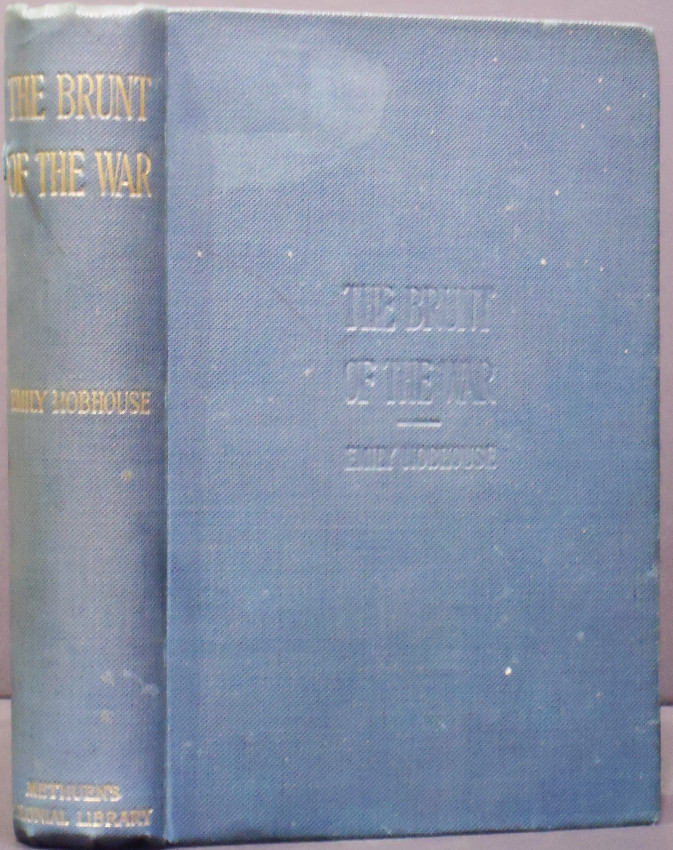
Methuen's Colonial Library edition: 356 pages + 40 pages publisher’s catalogue, 9 illustrations, folding map, blue cloth titled gilt on the spine – which is starting to fray at the top and the bottom and has a scuff mark under the title, uncut fore-edge and bottom edge with foxing, corners slightly bumped, a good copy.
Mendelssohn (Sidney) South African Bibliography volume 1, page 719: A perusal of this volume would probably lead the reader to believe that only that part of the South African population suffered during the war who were favourable to the Boer cause, and the author states, " Never before have women and children been so warred against. England, by the hands of Lord Roberts and Lord Kitchener, adopted the policy of Spain, while improving on her methods."
Emily Hobhouse 1860 – 1926. In 1899 Emily Hobhouse was appointed secretary of the South African Conciliation Committee, which was a group that opposed the British government policy regarding South Africa. Hobhouse was a humanitarian and pacifist who came to visit South Africa in December 1900, during the Anglo Boer War.
Hobhouse arranged a mass meeting in London in June 1900 where women protested against the actions of the British army in South Africa. Three months later she founded the South African Women and Children Distress Fund to collect money for Boer families. In South Africa, Hobhouse visited concentration camps set up by the British in the OFS and Transvaal. She showed the Boers held there kindness and handed out clothing and supplies.
On her return to Britain, she voiced her opposition to the concentration camps and reported on the conditions in these camps. She focused her campaign on the liberal opposition, and in this way was instrumental in the government decision to send a group of women, under Dame Millicent Fawcett, to look at the situation. Hobhouse was not part of this government commission, but it was her actions that put into play the forces that led to reform.
When she attempted to return to South Africa in 1901 she was arrested in Cape Town and sent back to Britain. She returned again after the war and helped set up home industries in the OFS and Transvaal to help rehabilitate the Boer families. Hobhouse was also concerned about the Indian situation, and was upset that the Boers suppressed them. She had expected them to act differently after they had fought for their own freedom. She assisted Gandhi when he needed it in 1913.
In 1913 she was invited to unveil the Woman’s Monument in Bloemfontein, and bad health meant she could not return to Britain immediately after the event. She died on 8 June 1926 and had her ashes spread at the Women’s Monument. http://www.sahistory.org.za/people/emily-hobhouse
- Overall Condition: A Good Copy
- Size: 8vo (200 x130mm)
- Sold By: Clarke's Africana & Rare Books
- Contact Person: Paul Mills
- Country: South Africa
- Email: [email protected]
- Telephone: 021 794 0600
- Preferred Payment Methods: Visa & Mastercard via PayGate secure links and Bank transfers.
- Trade Associations: ABA - ILAB, SABDA


