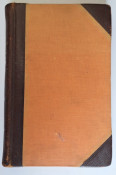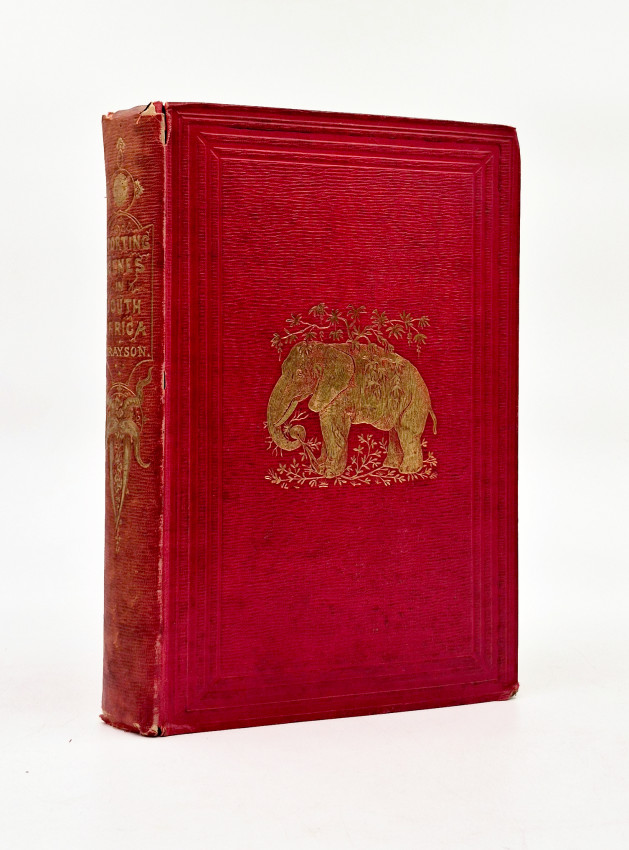
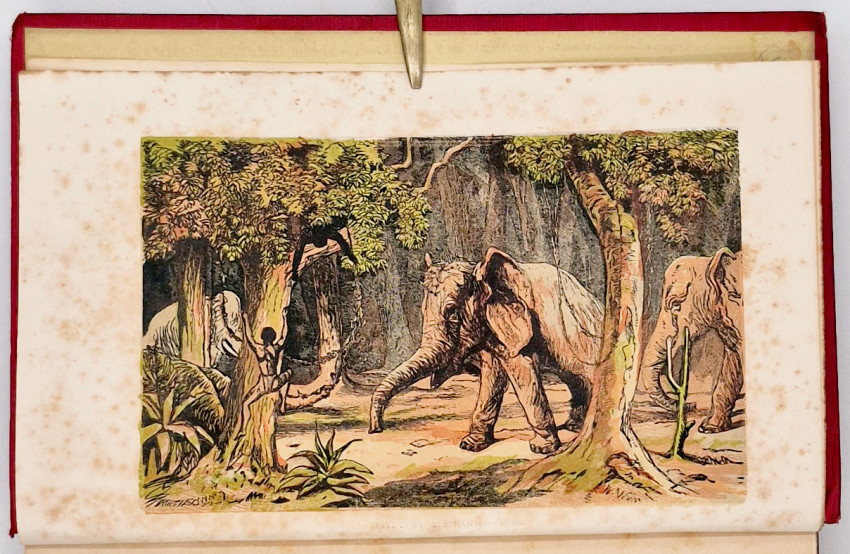
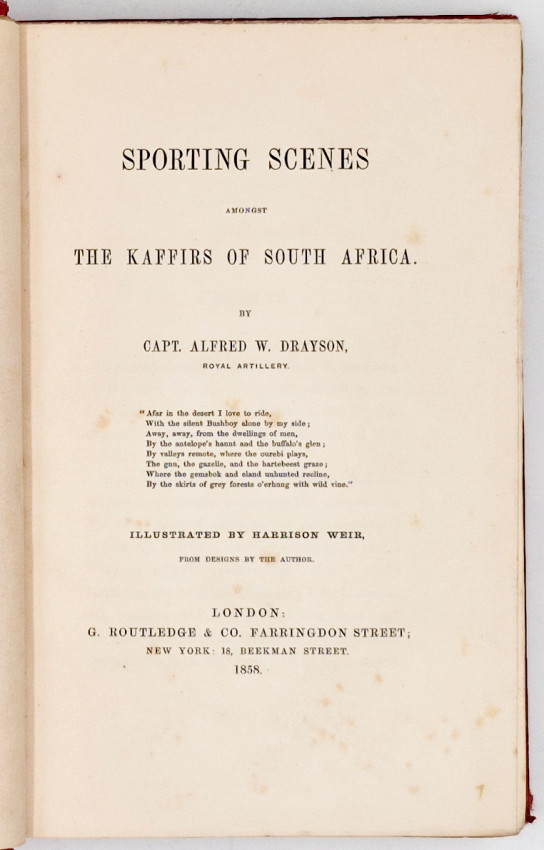
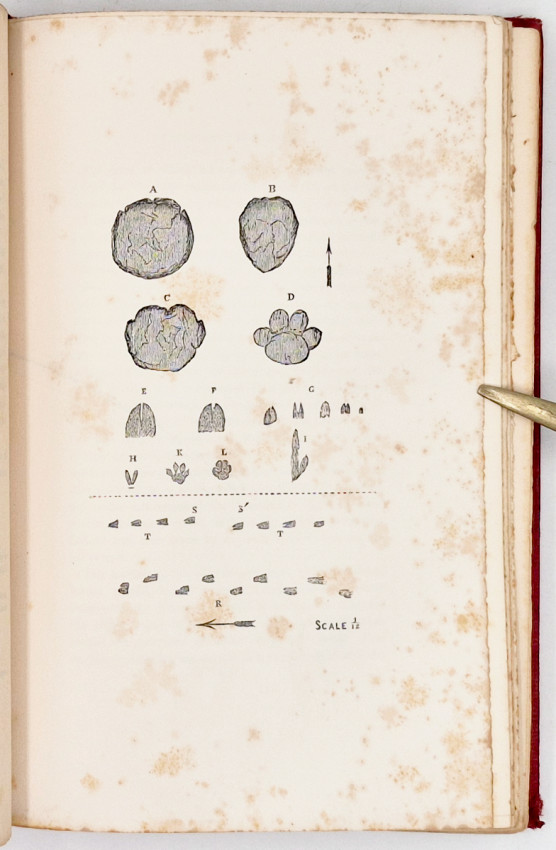
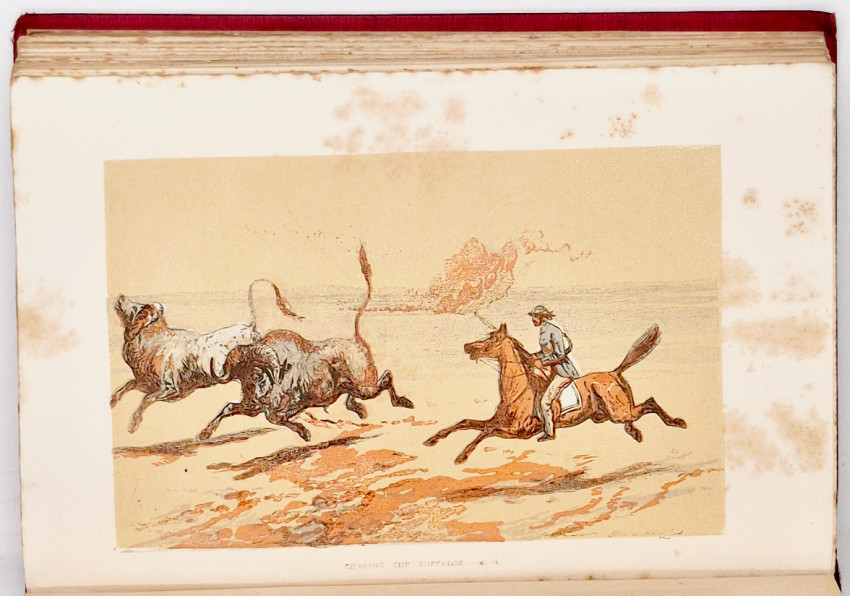
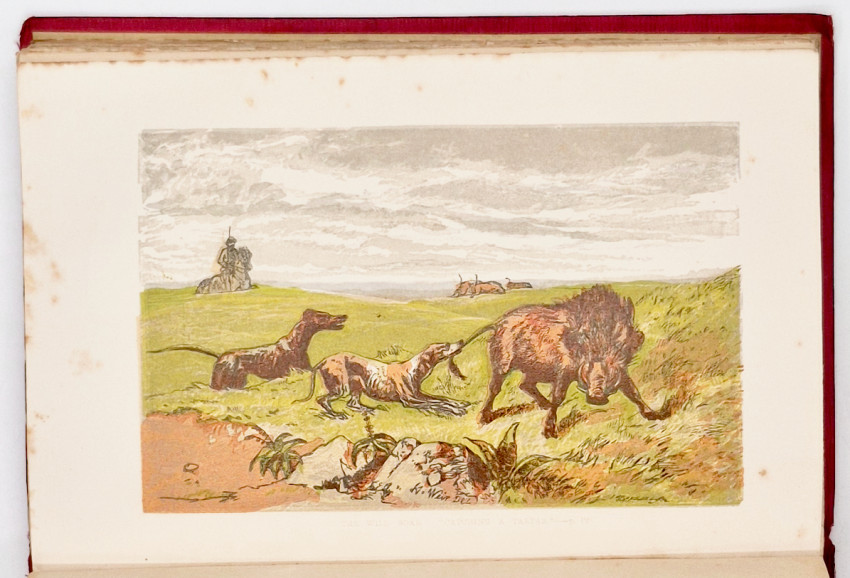
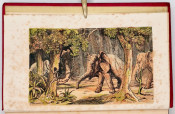
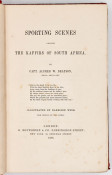
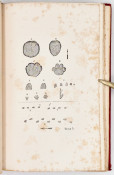
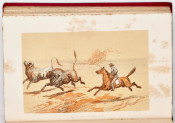
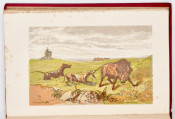
First Edition: 327 pages, double-tinted lithographic frontispiece and 7 double-tinted lithographic plates, 1 engraved plate of paw prints, original red straight grained cloth with a gilt vignette of an elephant on the upper cover and gilt decoration and titling on the spine - the cloth is frayed at the top and bottom of the spine, edges uncut, foxing on the plates and tissue guards - the lithographs are inked in brown with a heavy green overlay which makes them unusually vibrant but which causes the foxing on the tissue guards, the plates are generally described as chromolithographs (a technique involving the use of multiple lithographic stones) indicating many colours were used but in fact only two colours are employed, the front free endpaper is missing, bookplate on the front paste-down endpaper, a very good copy.
Wikipedia (https://en.wikipedia.org/wiki/Alfred_Wilks_Drayson) Alfred Wilks Drayson (also Wilkes) (1827–1901) was an English army officer, writer and astronomer. He was a personal friend of Arthur Conan Doyle, who dedicated to him the short story collection The Captain of the Polestar. Drayson graduated in 1846 at the Royal Military Academy, Woolwich. Commissioned, he then served in the Seventh Xhosa War. He rose through the ranks of the Royal Artillery, being promoted captain in 1854, on his return from South Africa; major in 1868; lieutenant-colonel in 1869, and colonel in 1874. He was in India around 1877, and was based at Halifax, Nova Scotia for five years. From 1858 to 1873 Drayson was on the Military Topography staff at the Royal Military Academy, Woolwich, serving as Professor of Surveying and Topographical Drawing. He retired from the army in 1883 with the honorary rank of major-general, and became president of the Portsmouth Literary and Scientific Society.
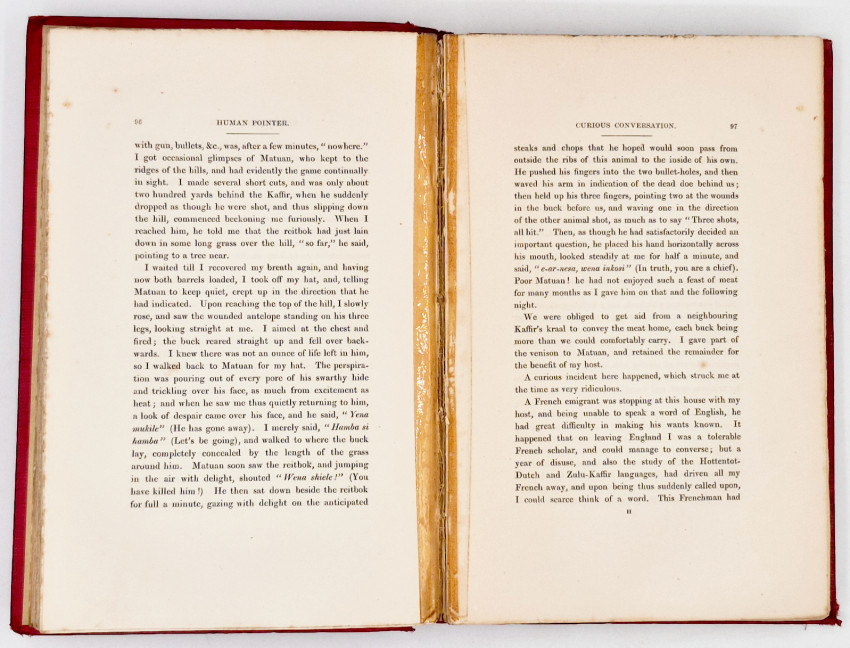
The book is primarily a memoir recounting hunting expeditions (sporting scenes) in the border regions between the Cape Colony and the territories of the Xhosa people (referred to by the historical term "K.....s"). It details the pursuit of large game—lions, buffalo, elephant, and antelope—mixed with observations on the customs of the indigenous people and the hardships of military life on the frontier. It is one of the foundational texts of South African big-game hunting literature, rivalling the works of Cornwallis Harris and William Cotton Oswell. It provides a detailed, if often condescending, record of the frontier environment, military routines, and the social and political atmosphere leading up to the major border wars of the mid-19th century.
Harrison William Weir (1824–1906) was one of the most prolific and influential British illustrators of the Victorian era, particularly renowned for his work focusing on animals and natural history.
- Overall Condition: Very good
- Size: 8vo (225 x 150 mm)
- Sold By: Clarke's Africana & Rare Books
- Contact Person: Paul Mills
- Country: South Africa
- Email: [email protected]
- Telephone: 021 794 0600
- Preferred Payment Methods: Visa & Mastercard via PayGate secure links and Bank transfers.
- Trade Associations: ABA - ILAB, SABDA

Similar lots in the current auction View all
Click on an item to view more details and to bid.