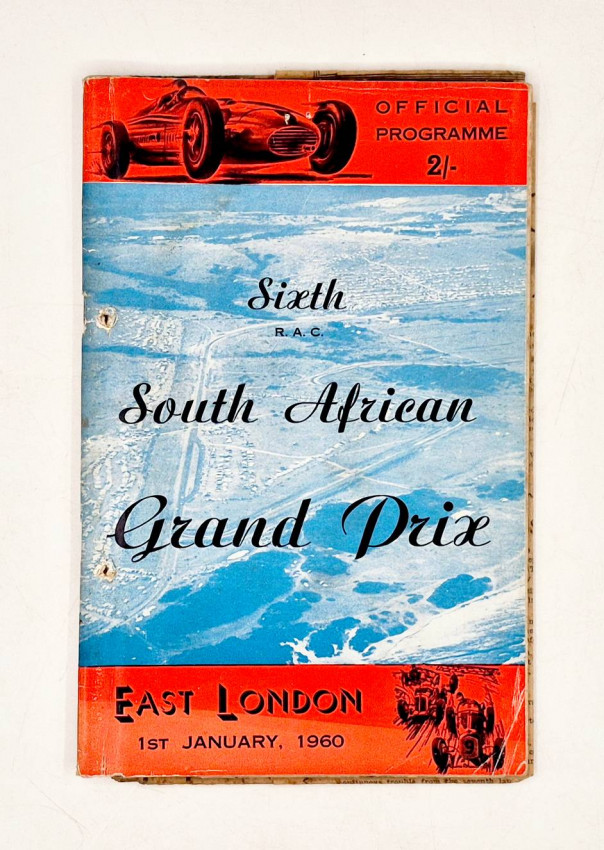
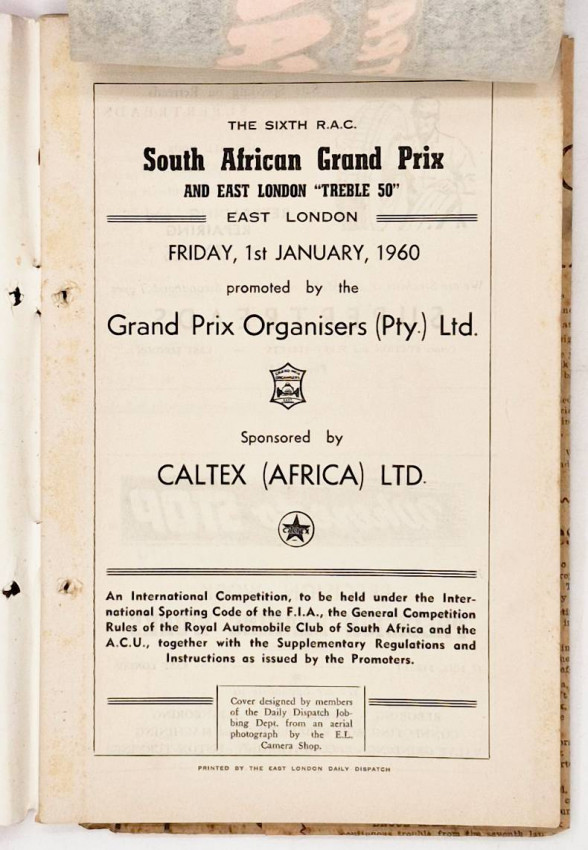
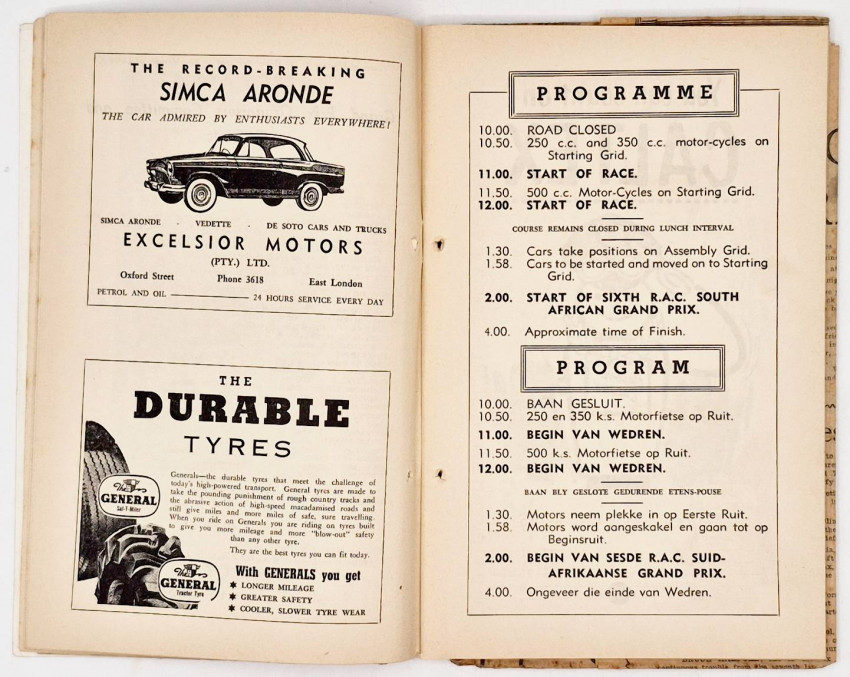
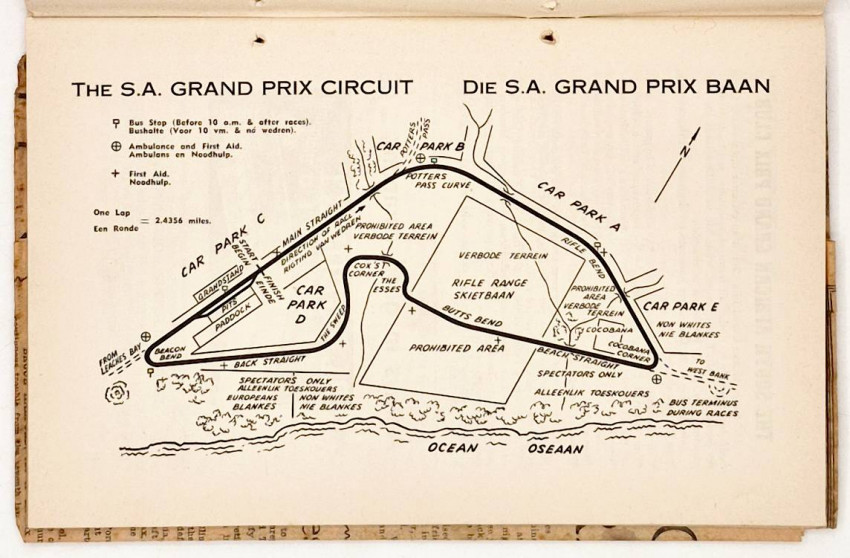
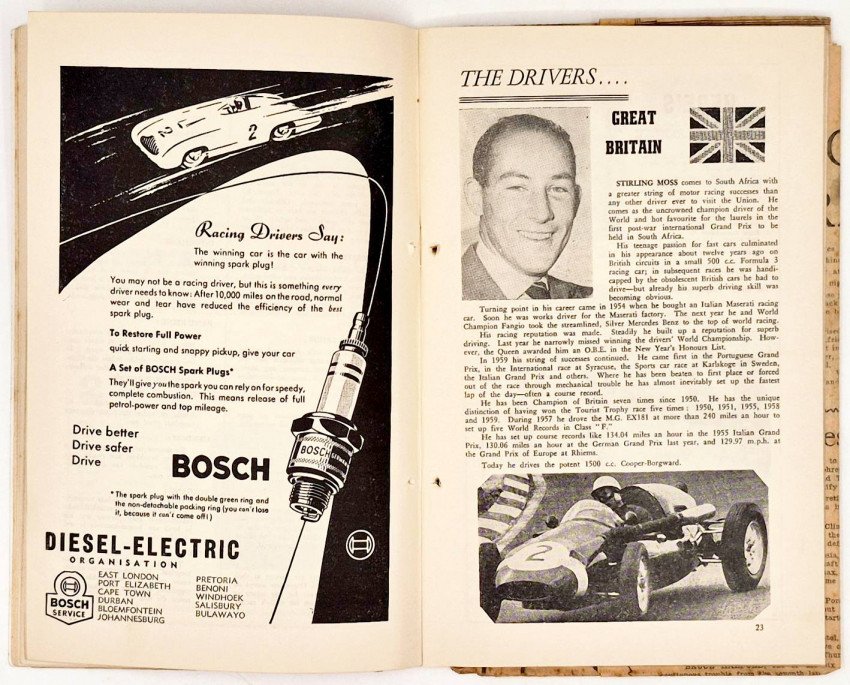
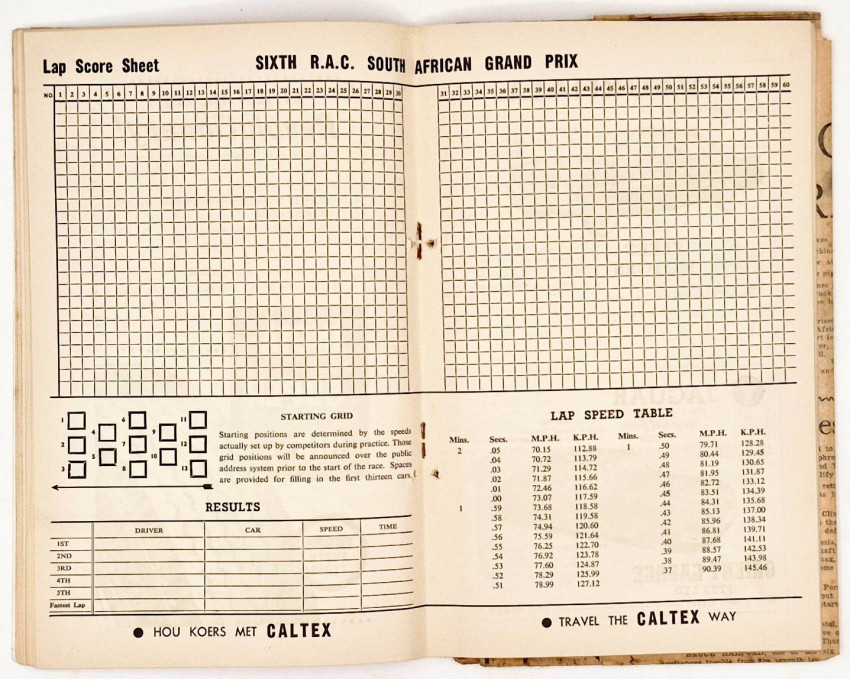
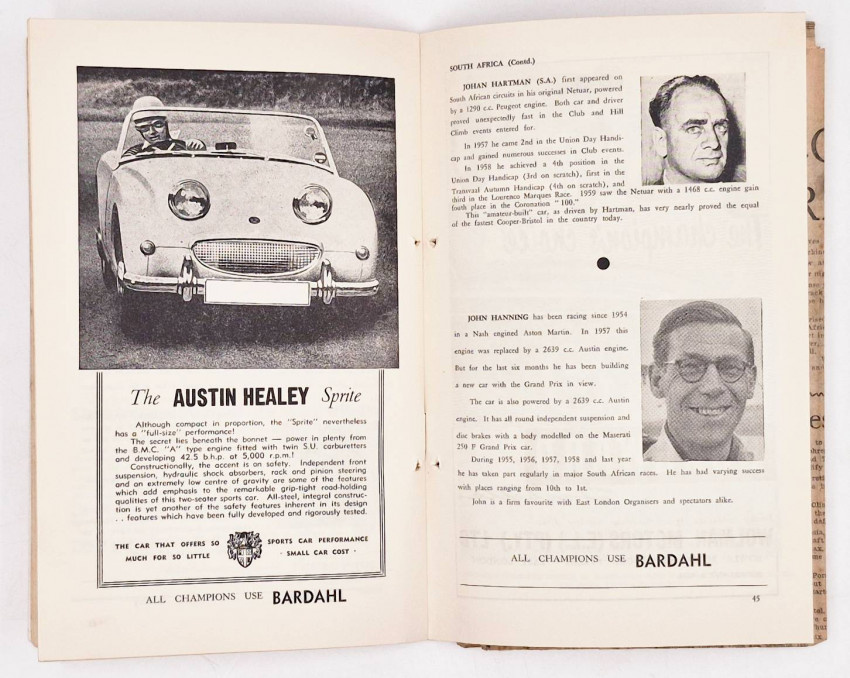
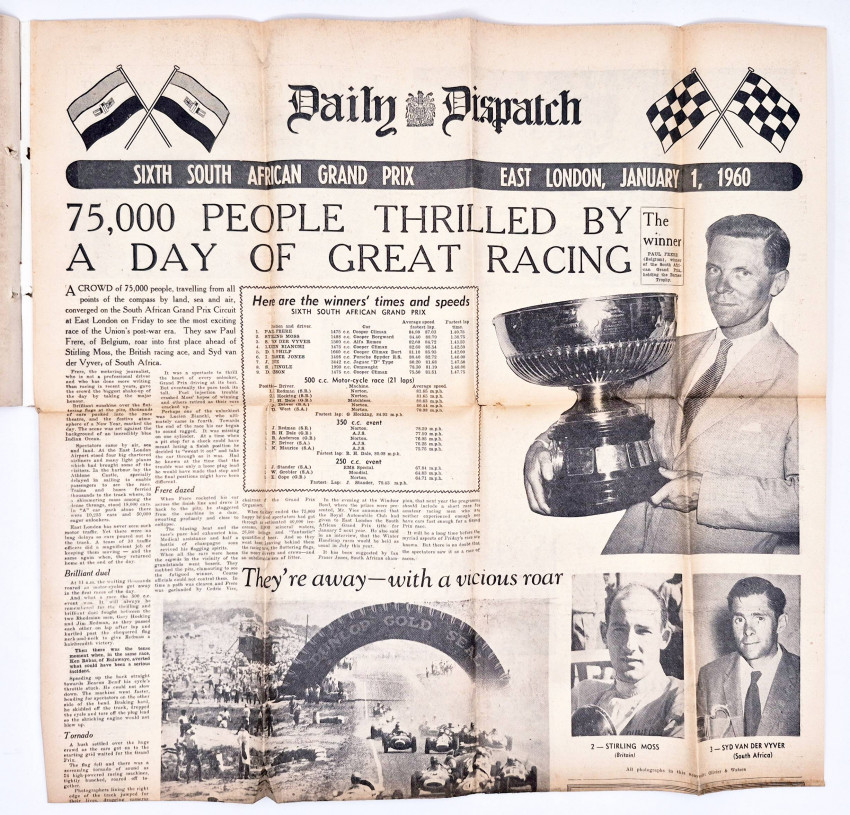
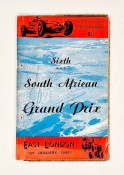
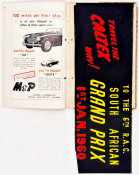
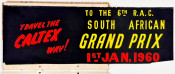
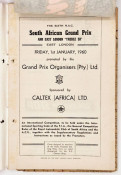
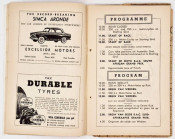
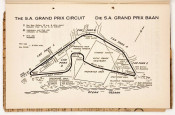
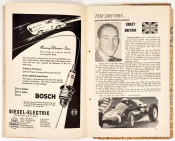
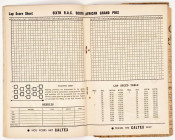
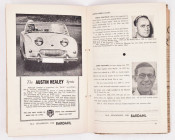
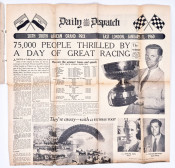
64 pages, 220 x 140 mm, pictorial paper covers, contents include a group photograph of The Committee - S.A. Grand Prix Organisers, programme, map of the circuit, the drivers pages 23 - 53, lap score sheet (unused), trophies and awards. Commercial advertisements throughout. A Caltex advertising flyer is attached to the title page and a four-page insert from the Daily Dispatch is pasted onto the last page of the programme. This gives extensive coverage and numerous photographs of the race, the drivers and the times and speeds.
The race was run to Formula Libre rules over 60 laps, covering a total distance of 235.5km on the 3.9km circuit. 1st: Paul Frere, Cooper-Climax, 60 laps. 2nd: Stirling Moss, Cooper-Borgward, 60 laps. 3rd: S. van der Vyver, Cooper-Alfa Romeo, 60 laps. 4th: Lucien Bianchi, Cooper-Climax, 59 laps. 5th: D.W. Philip, Cooper-Climax, 59 laps. 6th: I. Fraser-Jones, Porsche Spyder RS, 57 laps. 7th: John Love, Jaguar D-type, 57 laps. 8th: Sam Tingle, Connaught, 57 laps. 9th: Dick Gibson, Cooper-Climax, 56 laps.
The winner, Paul Frère was a racing driver and journalist from Belgium. He participated in eleven World Championship Formula One Grands Prix and also won the 1960 24 Hours of Le Mans driving for Ferrari with fellow Belgian Olivier Gendebien. The Cooper-Borgward driven by Stirling Moss is one of the most unusual cars in the entry. Rob Walker, the privateer entrant who ran Moss's cars throughout this period, had fitted a Cooper chassis with a Borgward 1.5-litre four-cylinder engine, a German unit from the Bremen manufacturer that was briefly one of the most technically advanced racing engines of the late 1950’s, with desmodromic valve gear giving extraordinary rev capability. Despite taking fastest lap, Moss finished second, suggesting the Borgward engine, while fast, may have required a degree of management over race distance. (https://www.silhouet.com/motorsport/archive/f1/nc/1960/1960.html)
- Size: 220 x 140 mm