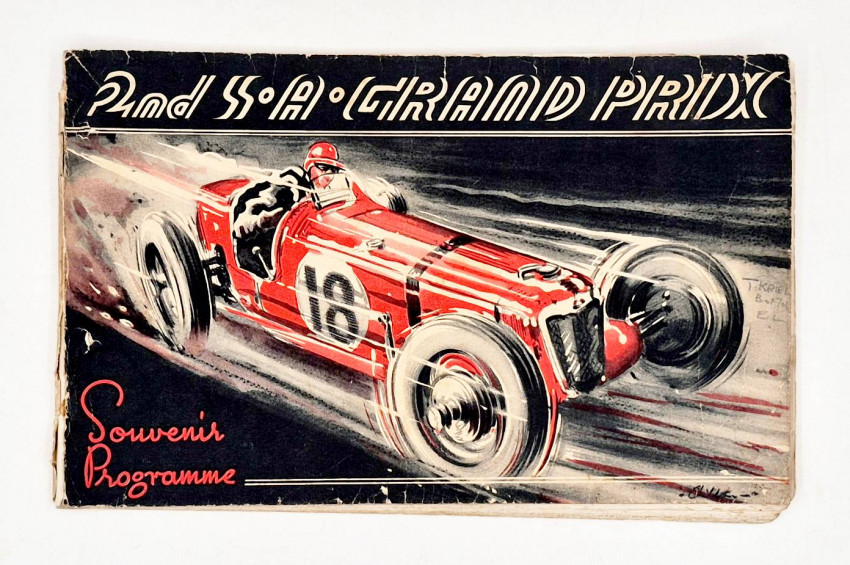
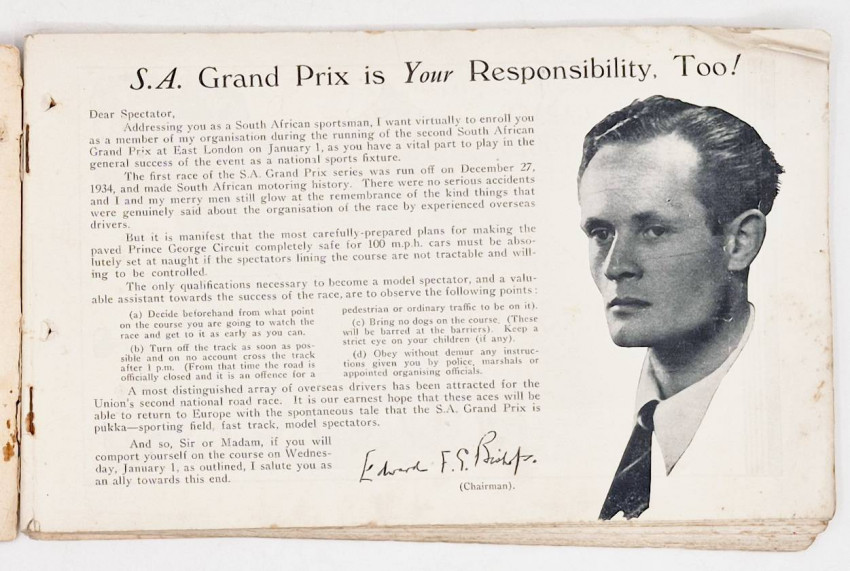
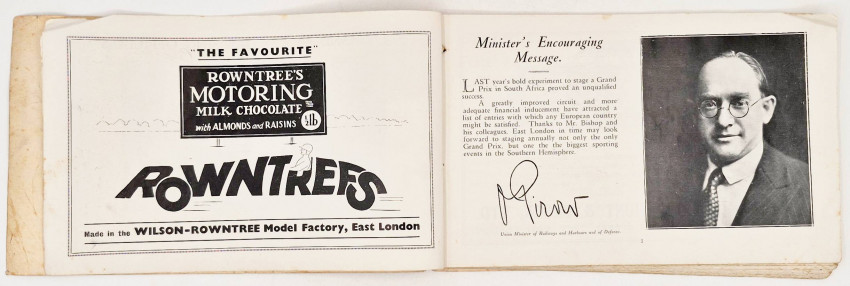
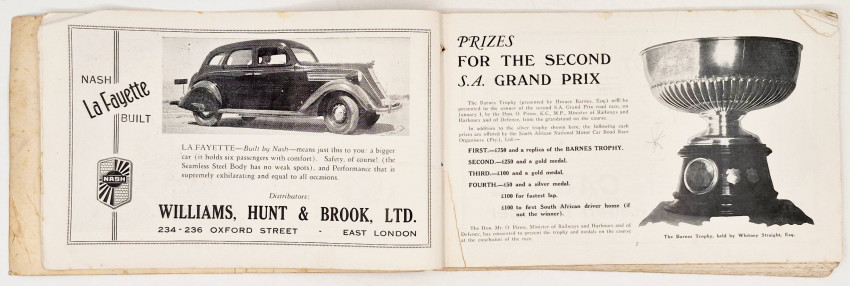
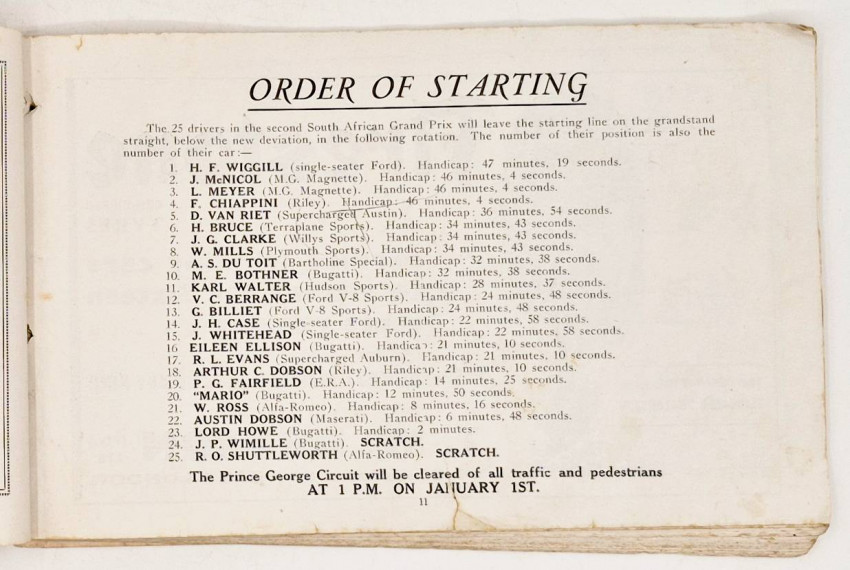
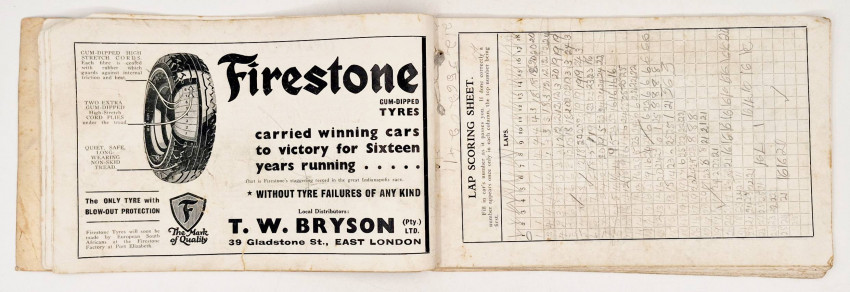
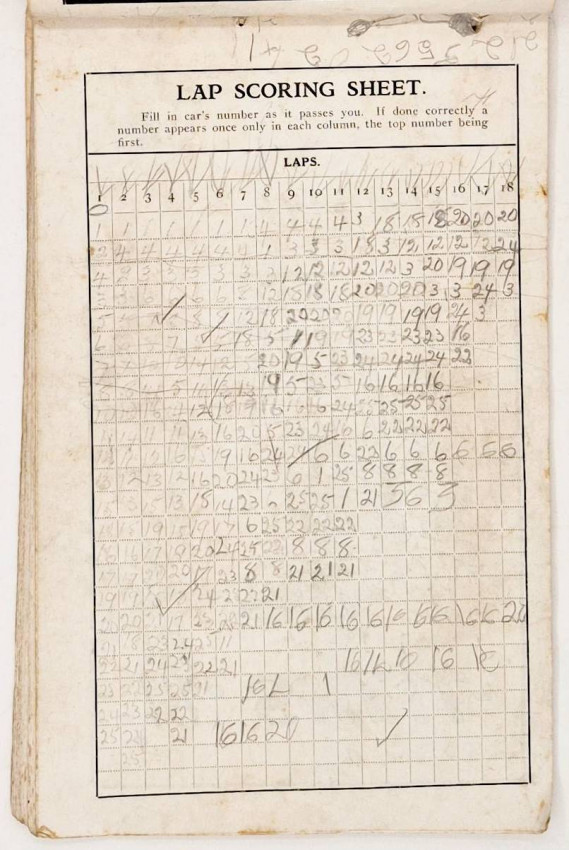
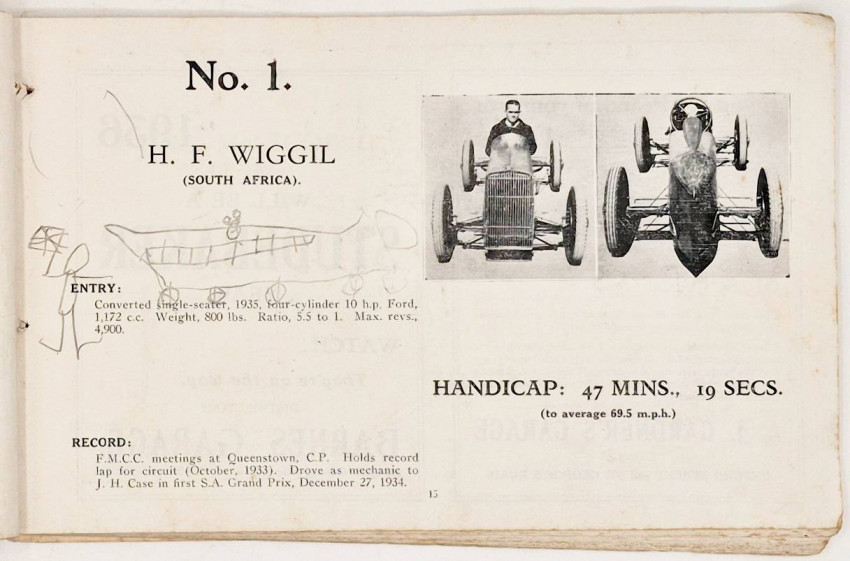
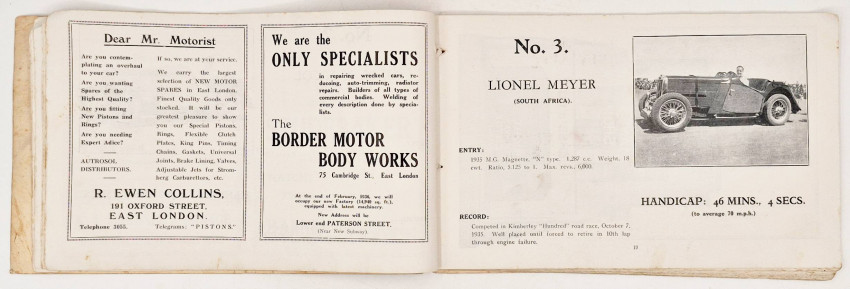
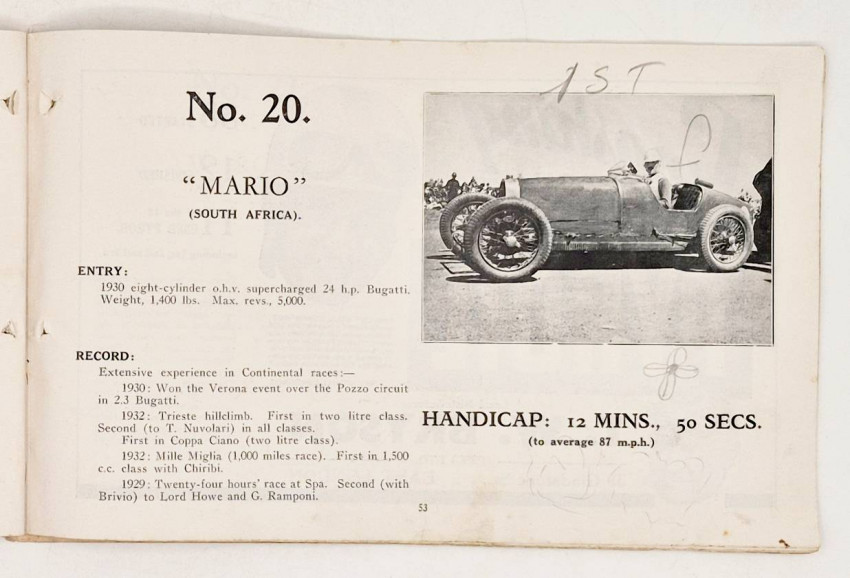
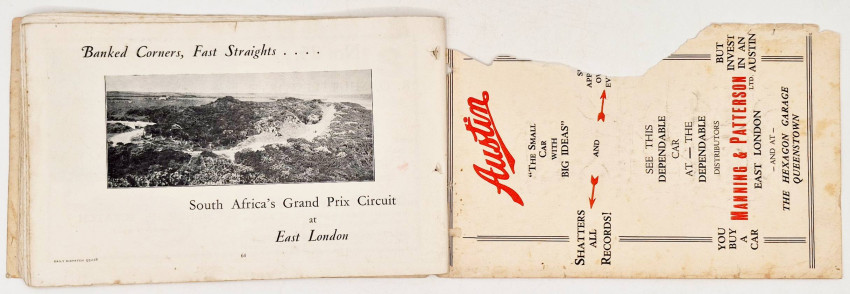
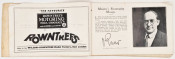
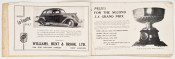
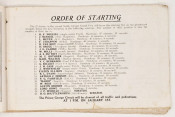
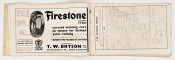
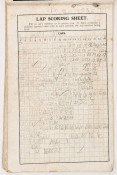
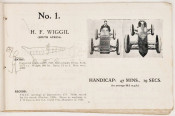
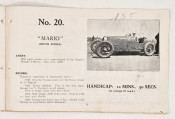
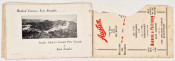
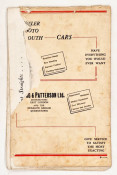
64 pages, 150 x 240 mm, pictorial printed light card covers, contents include a group photograph of the S.A. Grand Prix Organising Officials, prizes for the Second S.A. Grand Prix, Order of Starting (25 drivers), lap scoring sheet (used), names and photographs of the drivers and their cars with technical details and the starting handicaps, each page faced by a commercial advertisement. The covers are very worn with some loss at the back cover, child's pencil scribbles on some pages.
The 1936 South African Grand Prix was the second running of the country's premier international motor race which established South Africa as an important destination on the pre-war Grand Prix calendar. Following the success of the inaugural race in December 1934, the organizers modified the circuit and attracted a stronger international field.
The Prince George Circuit measured 17.74 kilometres in length on public roads. The race was run over twelve laps or approximately 212 kilometres (132 miles). The circuit featured long straights, sweeping bends and fast coastal sections that suited the powerful supercharged Grand Prix cars of the mid-1930's. The race was a great attraction for the Eastern Cape drawing an estimated crowd of 82,000 spectators along the coastal roads.
The race was won by Mario Mazzacurati, the Italian-born driver who had settled in South Africa. He drove a Bugatti Type 35B, 2.3-litre supercharged straight-eight, approximately 135–140 bhp, four-speed gearbox and rear-wheel drive. He completed the race in approximately 2 hours and 16 minutes, defeating a strong field of European and South African entrants. The sole woman drive was Eileen Ellison from England.
The race was run under Formula Libre handicap rules (essentially unrestricted Grand Prix rules), allowing cars of different capacities to compete.
The procedure was broadly as follows:
1. Practice times were recorded during official practice.
2. The stewards estimated each car's likely race speed, taking into account:
practice lap times, previous racing performances, the capabilities of the car, and, where
appropriate, the driver's reputation.
3. Each entrant was then allocated a time handicap.
4. The slowest cars started first, at the official starting time.
5. Progressively faster cars were released at fixed time intervals.
6. The fastest Grand Prix cars started last—sometimes many minutes after the first starters.
7. The winner was simply the first car to cross the finishing line after allowing for the staggered start.
(Sources: Motor Sport Magazine, Motor Sport Memorial and Wikipedia, AI)
- Size: 150 x 240 mm
.jpeg)