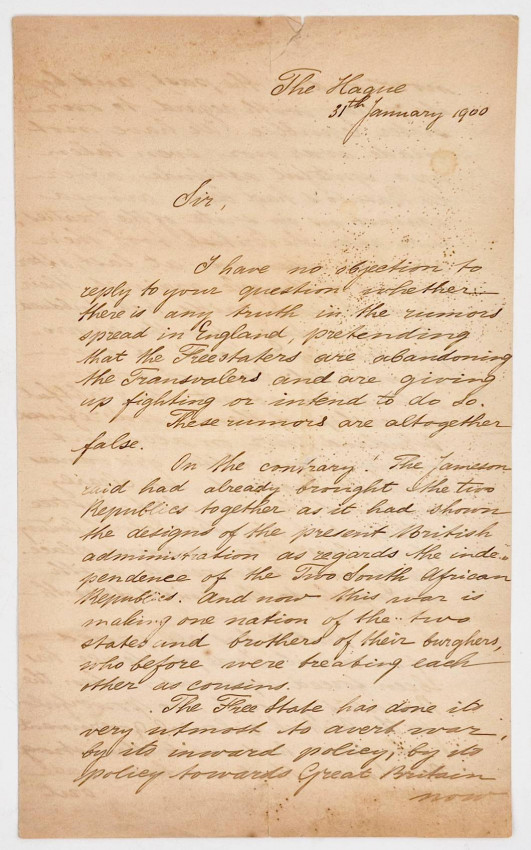
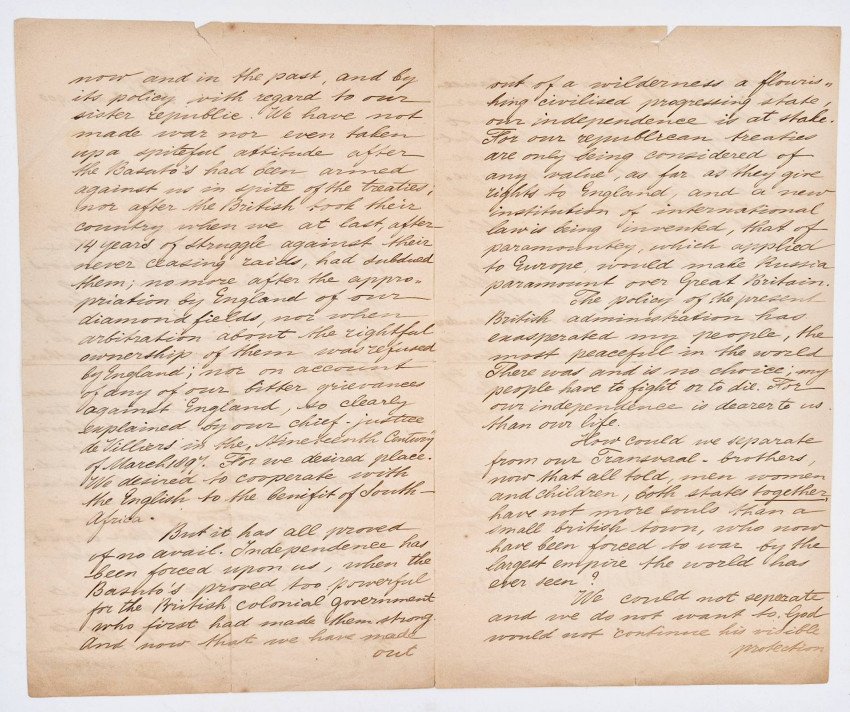
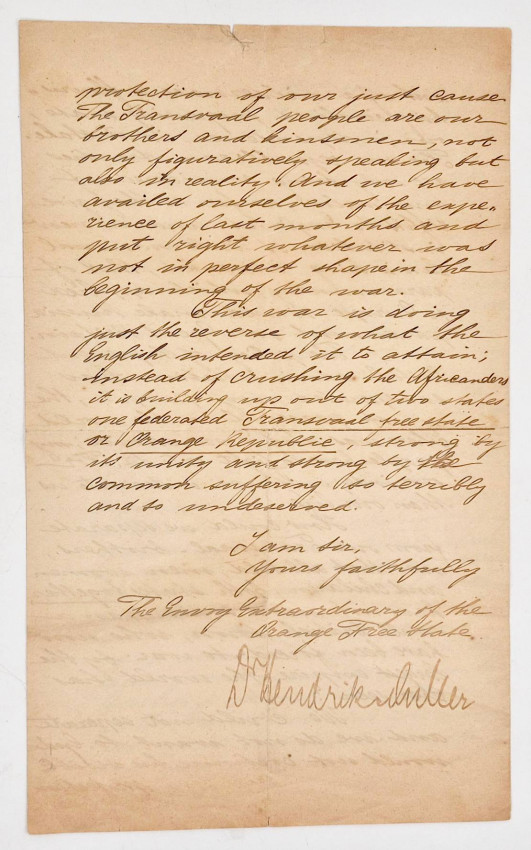
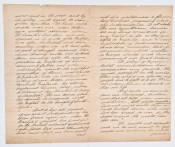
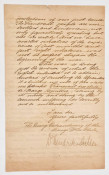
Four pages, in a legible hand, dated The Hague, 31st January 1900. To an unnamed correspondent. Folded twice and a little weak at the folds, the paper a little yellowed, with very slight soiling and small tears but no loss.
'Sir, I have no objection to reply to your question whether there is any truth in the rumors spread in England, pretending that the Freestaters are abandoning the Transvalers and are giving up fighting or intend to do so. These rumors are altogether false. On the contrary! The Jameson Raid had already brought the two Republics together as it had shown the designs of the present British administration as regards the independence of the two South African Republics. And now this war is making one nation of the two states and brothers of their burghers, who before were treating each other as cousins.
‘The Free State has done its very utmost to avert war, but its inward policy, by its policy towards Great Britain now and in the past, and by its policy with regard to our sister Republic. We have not made war nor even taken up a spiteful attitude after the Basuto's had been armed against us in spite of the treaties, nor after the British took their country when we at last after 14 years of struggle against their never ceasing raids, had subdued them; no more after the appropriation by England of our diamond fields, nor when arbitration about the rightful ownership of them was refused by England; nor on account of any of our bitter grievances against England, so clearly explained by our chief justice de Villiers in The Nineteenth Century of March 1899. For we desired peace. We desired to cooperate with the English to the benefit of South Africa.
‘But it has all proved of no avail. Independence has been forced upon us, when the Basuto's proved too powerful for the British colonial government who first had made them strong and now that we have made out of a wilderness a flourishing civilised progressing state, our independence is at stake. For our republican treaties are only being considered of any value, as far as they give rights to England, and a new institution of international law is being invented, that of paramountcy, which applied to Europe, would make Russia paramount over Great Britain.
‘The policy of the present British administration has exasperated my people, the most peacefull in the world. There was and is no choice; my people have to fight or to die. For our independence is dearer to us than our life.
‘How could we separate from our Transvaal brothers, now that all told, men women and children, both states together have not more souls than a small British town, who now have been forced to war by the largest empire the world has ever seen?
‘We could not separate and we do not want to. God would not continue his visible protection of our just cause. The Transvaal people are our brothers and kinsmen, not only figuratively speaking but also in reality. And we have availed ourselves of the experience of last months and put right whatever was not in perfect shape in the beginning of the war.
‘But it has all proved of no avail. Independence has been forced upon us, when the Basuto's proved too powerful for the British colonial government who first had made them strong and now that we have made out of a wilderness a flourishing civilised progressing state, our independence is at stake. For our republican treaties are only being considered of any value, as far as they give rights to England, and a new institution of international law is being invented, that of paramountcy, which applied to Europe, would make Russia paramount over Great Britain.’
'Signed: 'The Envoy Extraordinary of the Orange Free State,
Dr. Hendrik Muller.'
The final paragraph is historically important. Writing on 31 January 1900, with the war only three months old, Muller articulates what would become the cornestone of Afrikaner national identity that British aggression was forging, rather than destroying, a unified Afrikaner nation. His prediction of "one federated Transvaal free state or Orange Republic" proved wrong in its immediate political form and right in its cultural and political consequences, the suffering of the war and the concentration camps became the crucible of Afrikaner nationalism for the next half century.
‘Hendrik Pieter Nicolaas Muller (https://en.wikipedia.org/wiki/Hendrik_Pieter_Nicolaas_Muller), was a Dutch entrepreneur, diplomat and publicist. He started his career as a businessman, trading with East and West Africa. In his mid-twenties he travelled to Zanzibar, Mozambique, and South Africa for business purposes, but showed himself a keen ethnographer as well.
‘In 1896, he was first appointed consul and later consul general for the Orange Free State. Muller held this position all through the Second Boer War and his high-profile performance as European representative for this Boer republic won him considerable notoriety. After the Treaty of Vereeniging was signed in 1902, Muller retired to a life of travelling and writing for some years, making Muller a household name with his travel books. In 1919, the Dutch government appointed him envoy extraordinary and minister plenipotentiary to Romania, and later to Czechoslovakia.
‘Muller was a prolific writer. Over the course of his life he published well over two hundred articles, brochures, and books about his travels, South Africa and the Boers, and Dutch foreign policy. Muller gathered a large fortune with well-appointed private investments. He bequeathed his considerable wealth to a private fund in support of academic research and cultural heritage.’
He is the author of INDUSTRIE DES CAFFRES DU SUD-EST DE L'AFRIQUE, Leyden, No date (ca 1893) which is arguably one of the most beautiful and scarce publications on 19th-century Southern African material culture. Published in a very small edition of no more than 100 copies.
- Size: Small folio (300 x 200 mm)