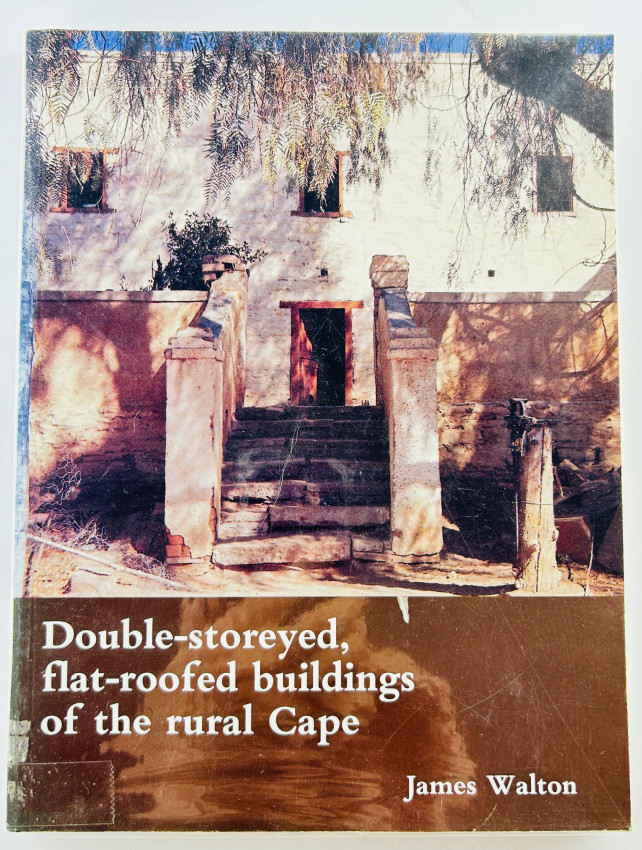
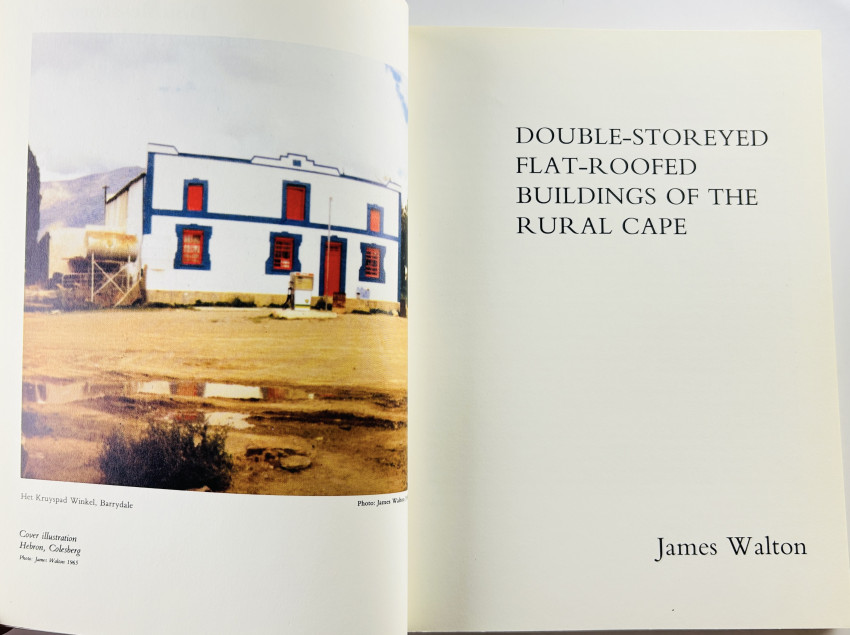
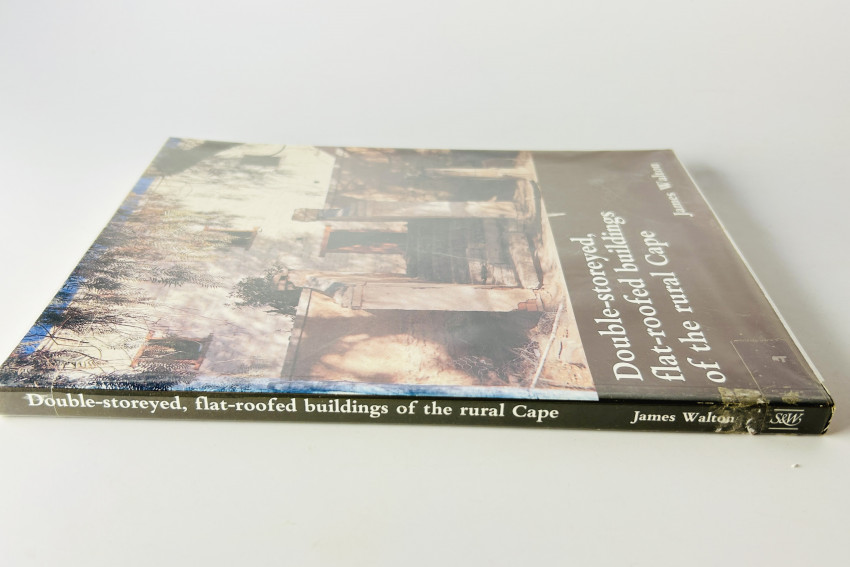
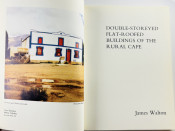
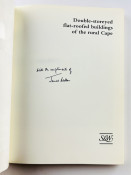
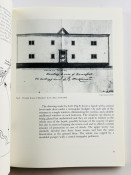
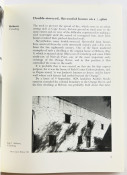
113pp. Limited edition. Colour frontis. Profusely illustrated throughout. Signed by James Walton on the title page.
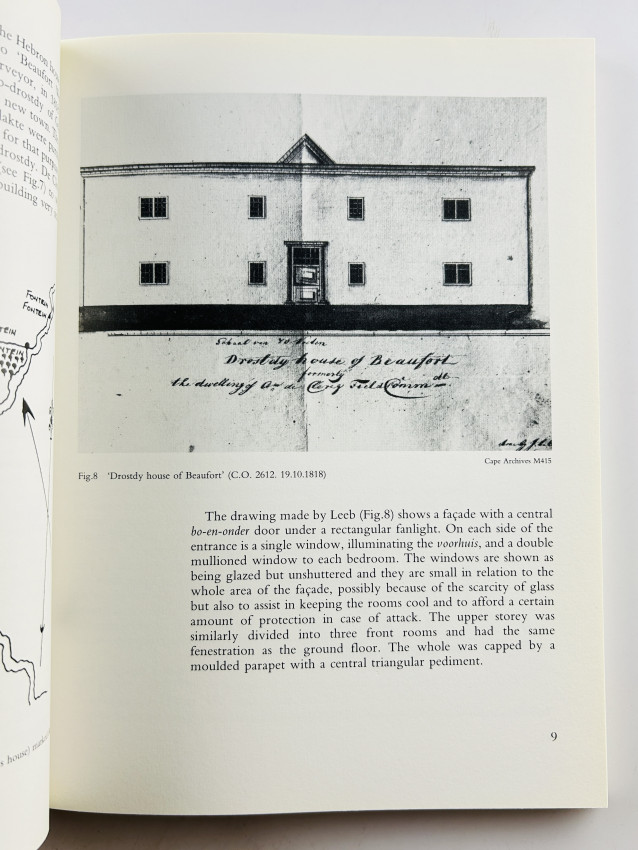
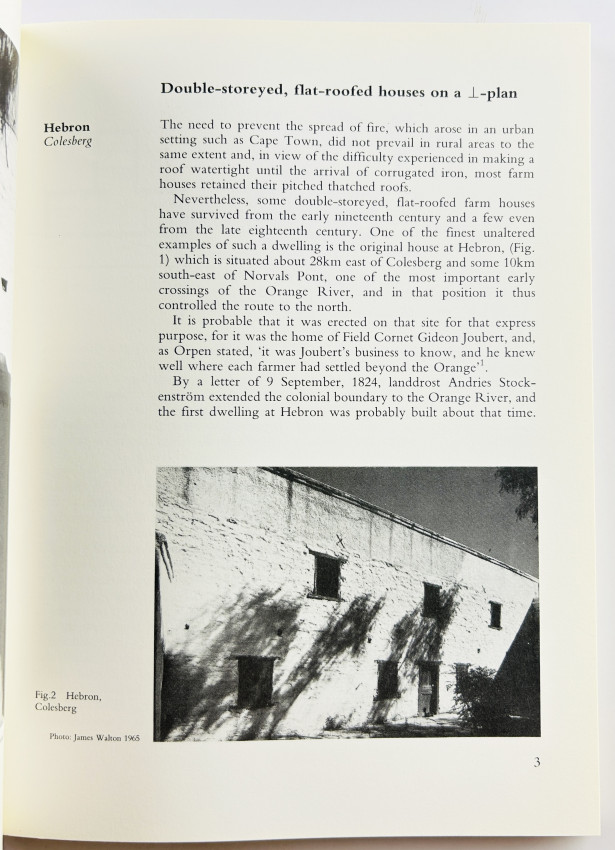
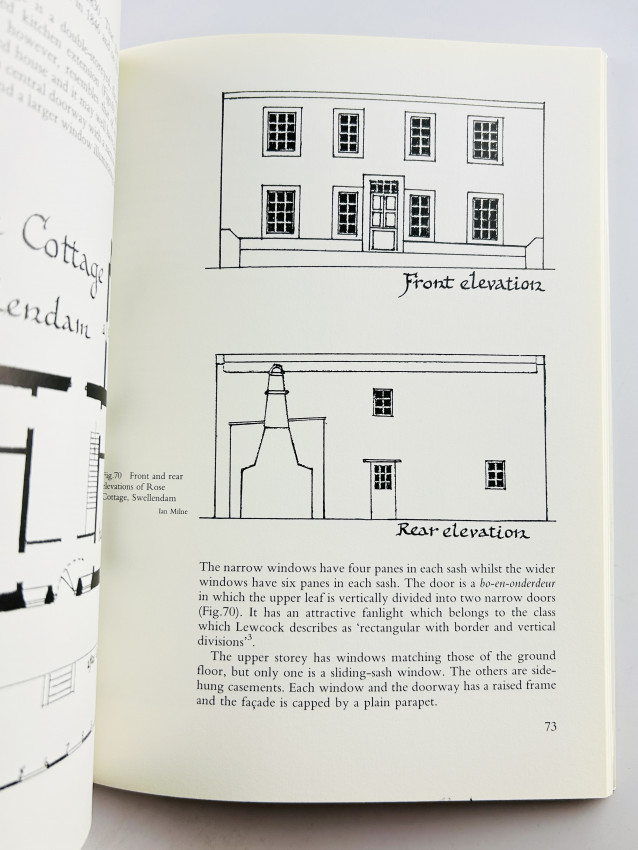
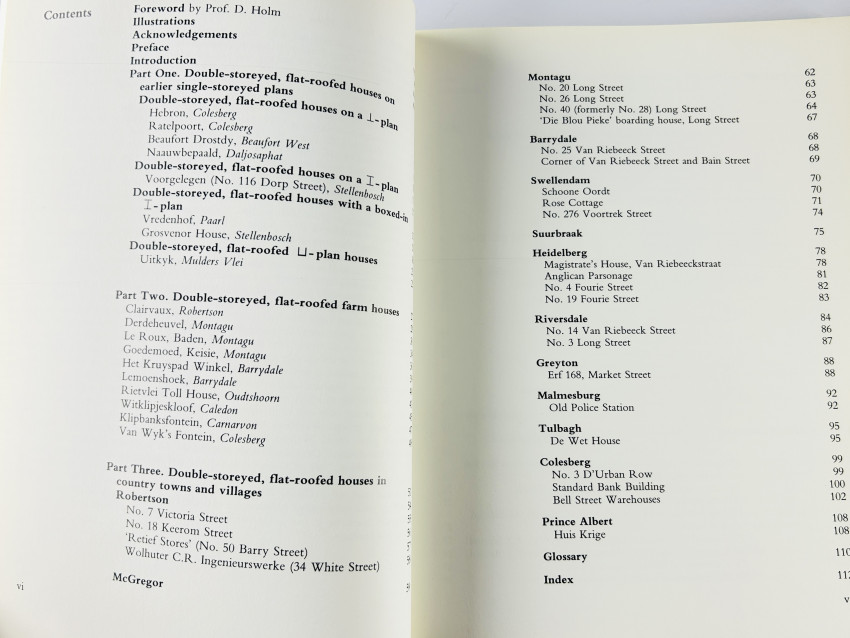
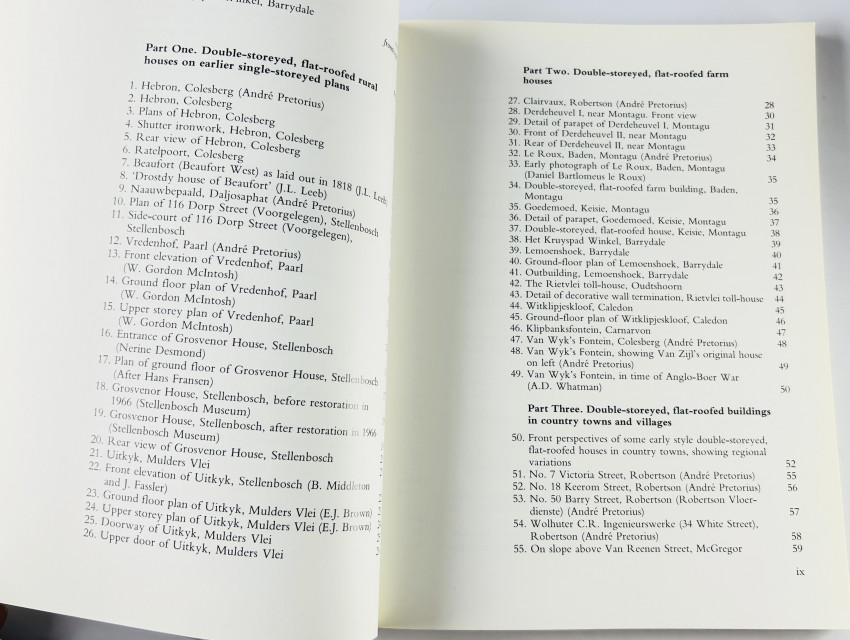
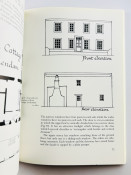
The book focuses on the unique evolution of double-storey, flat-roofed architectural styles that migrated from Cape Town into rural South African districts [1]. Walton meticulously traces how this specific building design adapted to socio-economic changes, shifting agricultural needs, and climate conditions during the 19th and early 20th centuries. It features precise structural analysis, architectural elevation plans, and historical photographs documenting old country hotels, trading stores, and prominent farmsteads.
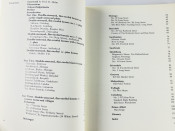
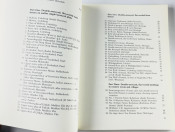
The book is divided into three parts:
Part 1: Deals with rural double-storeyed, flat-roofed houses built on earlier single-storeyed
Part 2: Describes farm buildings which originated as double-storeyed, flat-roofed buildings with rectangular plans.
Part 3: Includes double-storeyed, flat-roofed houses in country towns and villages such as Robertson, Montagu, Riversdale and Colesberg.
Source: Publishers Saayman and Weber
Walton was hailed as ‘The father of vernacular architectural science in South Africa’ by the national press when he died peacefully in his sleep, aged eighty-seven in the early hours of 24 April 1999.
VASSA founder James Walton, OBE, BSc, was born of farming stock near Brighouse, in the West Riding of Yorkshire, on 2 November 1911 and went to Rastrick Grammar School, and later took a science degree at London University and also studied at Leeds University, probably for a postgraduate teaching diploma. Walton joined the Halifax Antiquarian Society in 1938 and focused his research on local farm buildings and implements.
In 1947 he arrived in South Africa as an education officer in Lesotho and took early retirement in 1960 as Deputy Director of Education there. He went to live in Cape Town in the same year and decided to settle permanently in the country. In 1952 he was a founder member of the Vernacular Architecture Group to promote the study of ‘lesser traditional buildings’ and to put researchers in touch with one another. Appropriately, Walton was elected the first honorary life member of the Group.
He continued to publish papers in English periodicals but his first monograph, Homesteads and Villages of South Africa, was published in 1952 in that country, illustrated by Walton’s own photographs and detailed drawings. It included material on the interior of the houses, utensils, cupboards, pottery and a host of other aspects of household life, beginning and ending with an urgent plea for the establishment of a South African folk museum on the Scandinavian pattern, where surviving early house types are re-erected and conserved, since they are fast disappearing.
In 1973 he received the Award of Merit of the Cape Tercentenary Foundation for ‘outstanding services to vernacular architecture in the Cape of Good Hope’, followed by the gold medal of the South African National Monuments Council in 1981. The University of Natal conferred an honorary doctorate in architecture upon him in 1987, and in 1992 he was awarded a gold medal by the Society for Afrikaans Culture.
Walton published papers regularly in African Studies, the South African Archaeological Bulletin and African Notes and News in South Africa and, in England, in Country Life, Man and Antiquity.
He gave his archive of articles and notes (annotated in his neat calligraphy), pen and ink drawings and photographs to the University of Stellenbosch, where they are deposited in the J S Gericke Library for the use of future researchers.
Many of Walton’s pioneer studies in Britain, Europe, Southern Africa and elsewhere have engendered more extensive research in those fields by successive students and this is, perhaps, the most important aspect of his work. His drawings and photographs are often the only surviving records of hundreds of buildings, now demolished. They have also provided a basis for subsequent restoration.
- Binding Condition: Good
- Overall Condition: Good
- Size: 4to