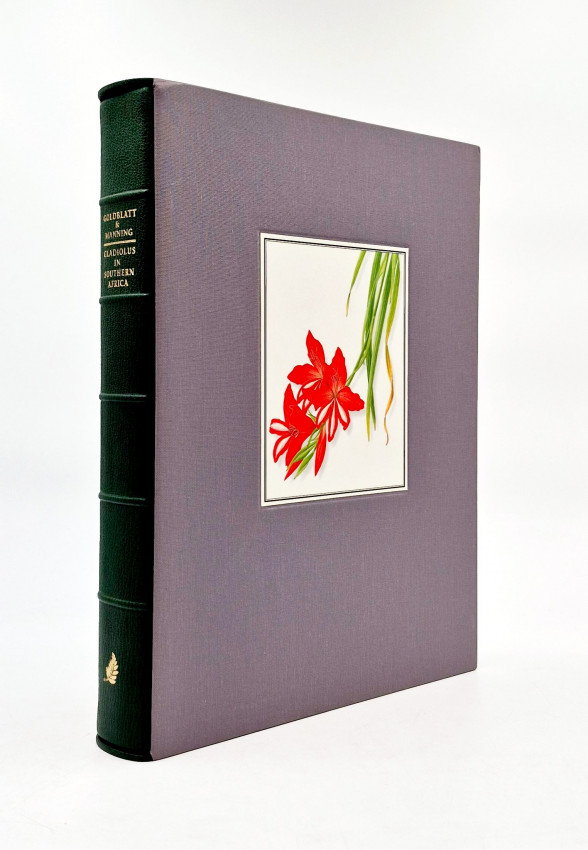


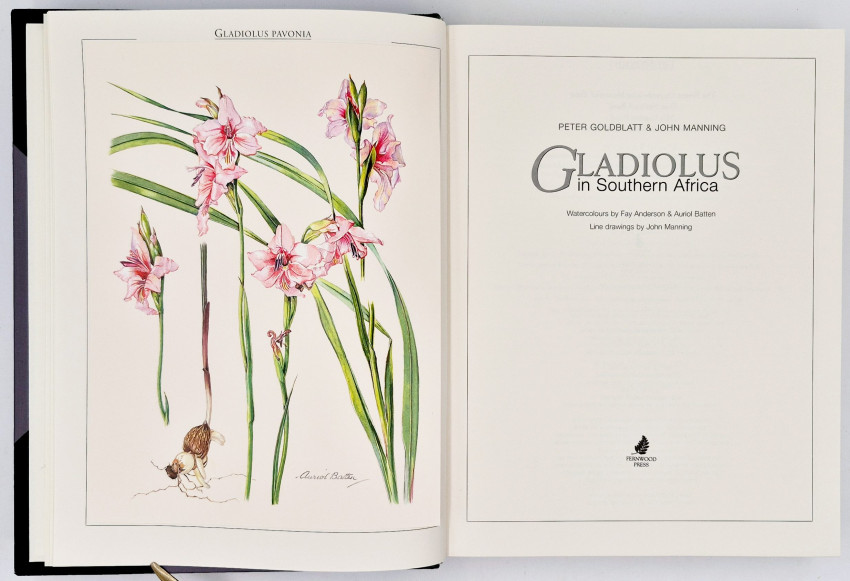
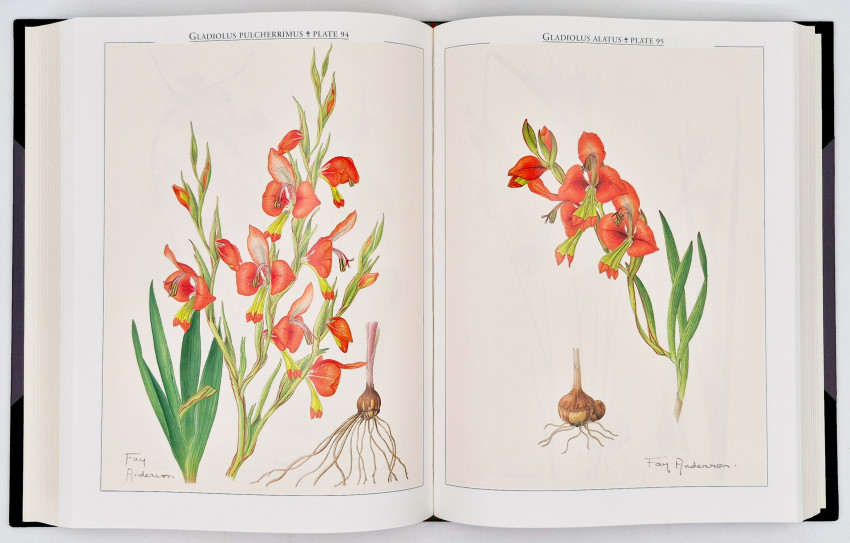
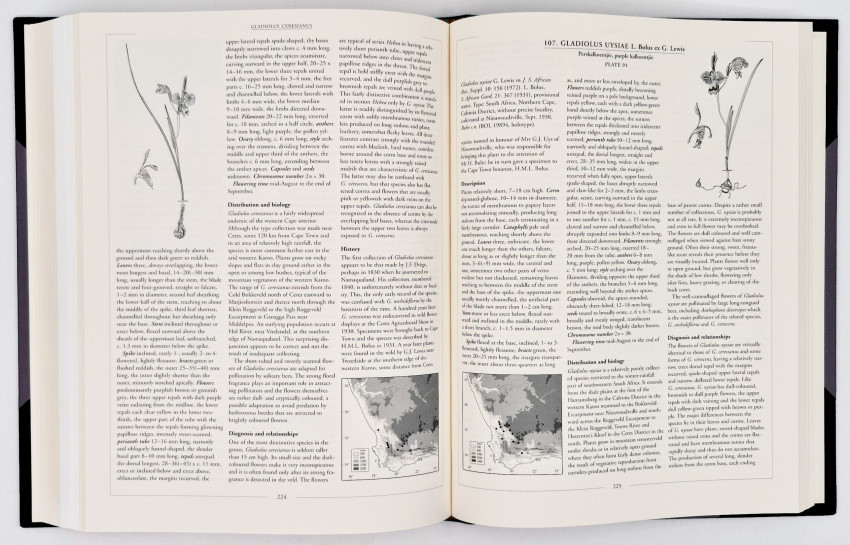
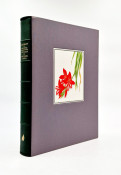


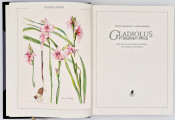
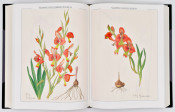
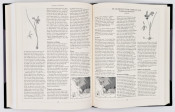
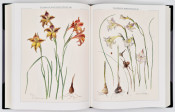
Collectors' Edition: 320 pages, tipped in colour frontispiece and 144 colour plates, many line drawings and distribution maps, bound by Peter Carstens in half green leather with grey cloth boards, titled gilt on the spine with gilt vignette on the upper cover, housed in a matching slip case with leather lips and an illustration of a gladiolus mounted on the upper panel, a fine copy.
A Special edition limited to 100 copies. This is number 19 signed by the authors which contains an additional tipped-in print, numbered 19/100 signed by Fay Anderson.
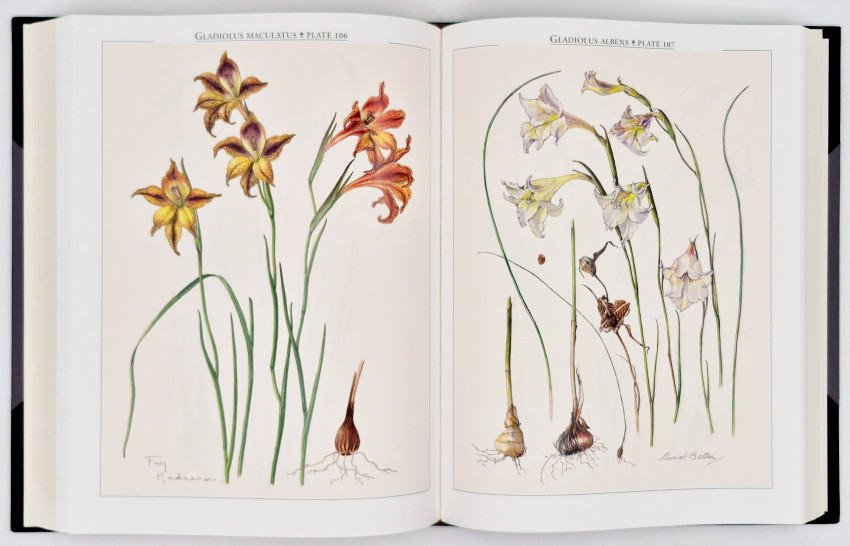
Editor's Note: One of the most important botanical studies published in recent times, this monograph of the genus Gladiolus in southern Africa combines the artistry of two of the world's foremost botanical illustrators with the meticulous work of two highly respected biologists. The exquisitely delicate watercolour paintings by Fay Anderson and Auriol Batten capture faithfully the fragile elegance of almost all the Gladiolus species of the region.’
From the Introduction: 'Gladiolus, the largest genus of the petaloid monocot plant family Iridaceae, is thought to comprise some 255 species. A member of the mainly African subfamily Ixioideae, it is far and away the largest genus in this, the largest subfamily of the Iridaceae with some 950 species in 27 genera. It is rivalled in size only by Iris, a member of subfamily Iridoideae, which may have close to 250 species. Gladiolus is also one of the world's most important horticultural plants, valued both as an ornamental garden subject and as a cut-flower crop. Yet despite its size and importance, the genus has until recently been surprisingly poorly understood in the wild. Such basic facts as the number of species that exist, their geographical ranges and their patterns of variation have not until now been known with any certainty. Not only has this information been lacking, but the generic definition and circumscription of Gladiolus have only recently been satisfactorily established. Beginning in 1988, the circumscription and systematics of the genus have been methodically investigated, first for Madagascar (Goldblatt, 1989) and then for tropical Africa (Goldblatt, 1993; 1996). Finally, the systematics of Gladiolus in southern Africa, undoubtedly the centre of the genus in terms of both species richness and overall diversity, is revised and presented here in monographic detail.'
- Overall Condition: A fine copy
- Size: Folio (310 x 240 mm)