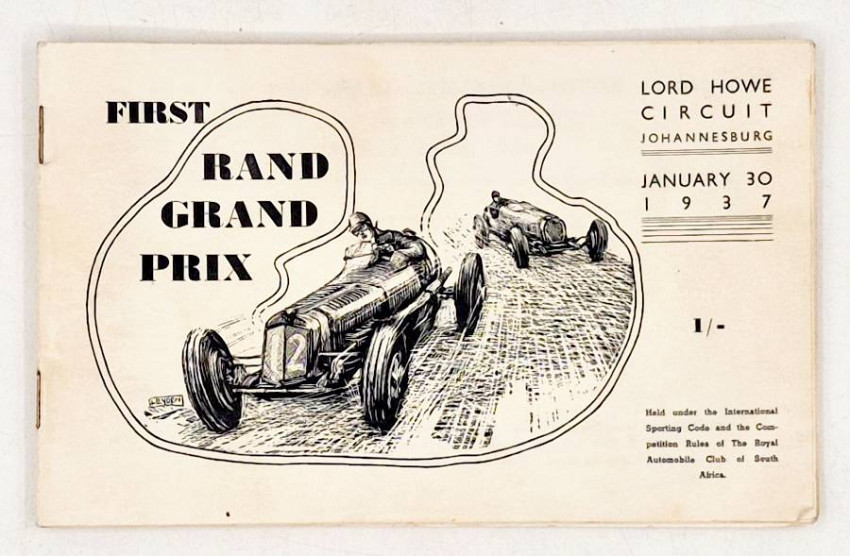
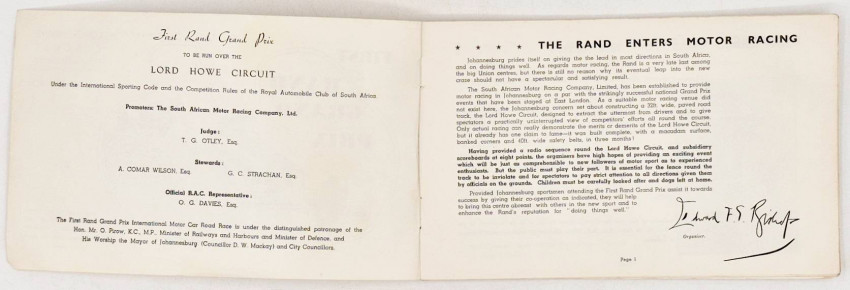
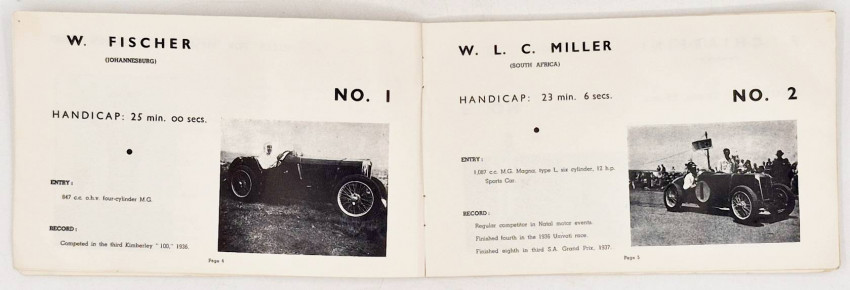
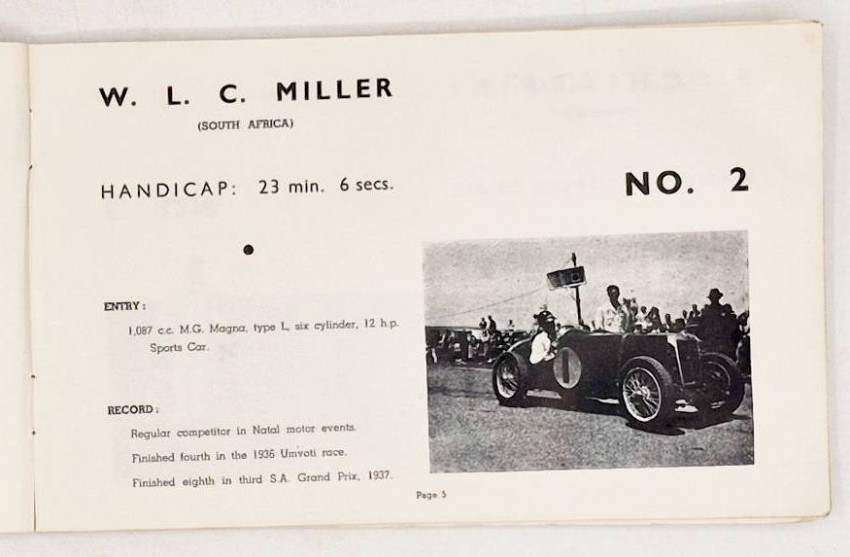
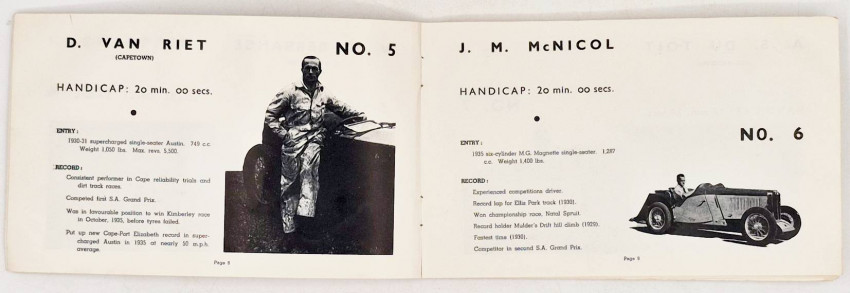
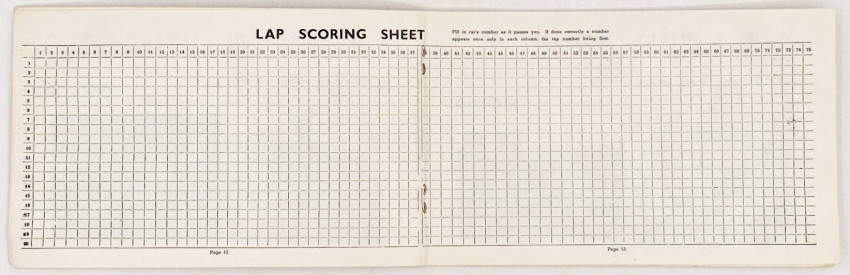
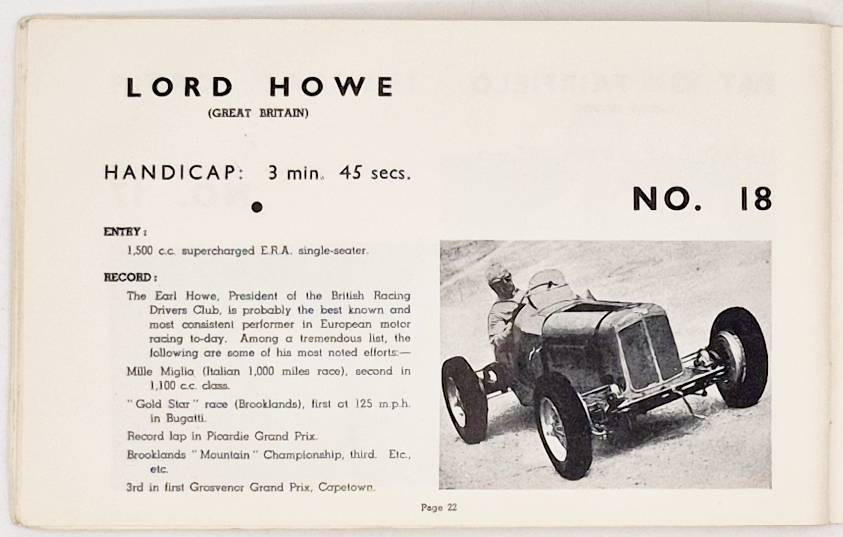
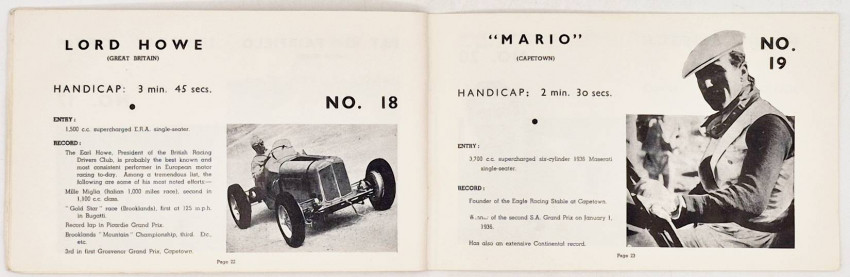
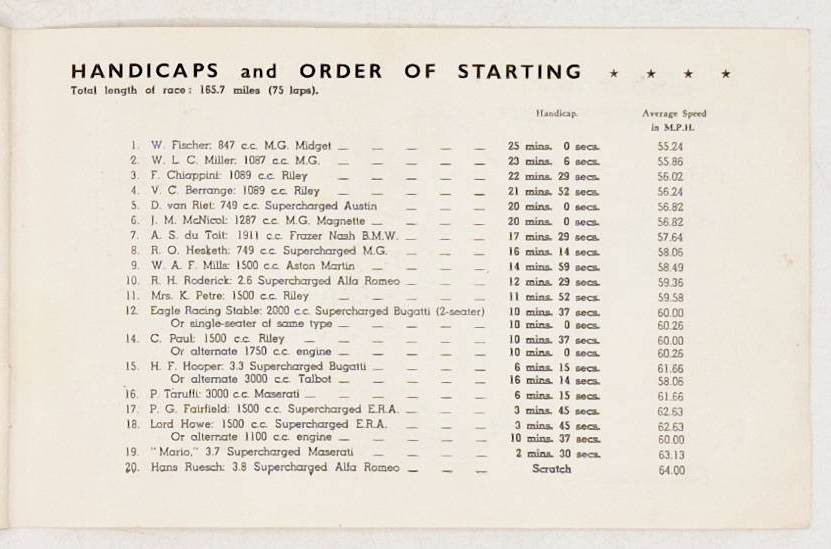
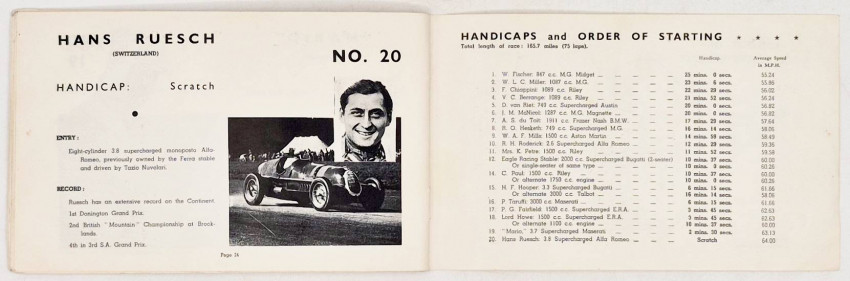
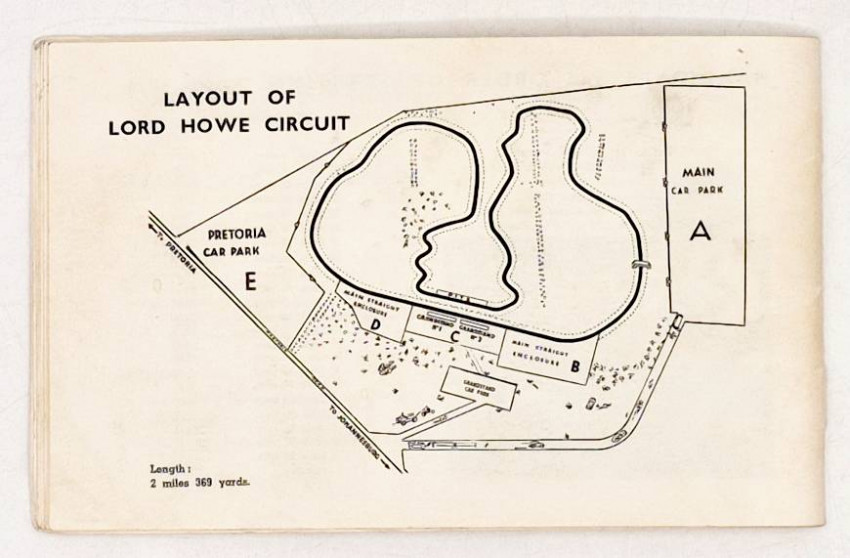
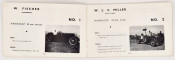
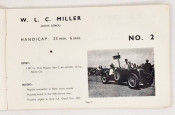
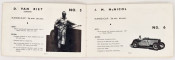
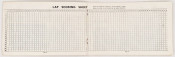
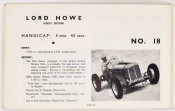
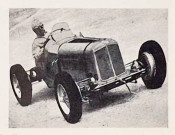
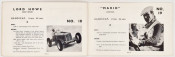
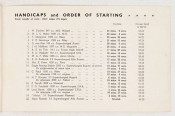
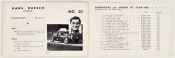
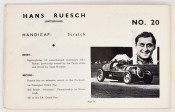
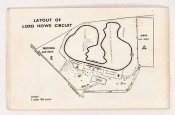
24 pages, 103 x 169 mm, pictorial printed light card covers, layout plan of the Lord Howe Circuit on the back cover, the contents includes the Sequence of Events and times, Prizes for the First Rand Grand Prix, names and photographs of the twenty drivers and their cars in the race, the centre two pages are a Lap Scoring Sheet (unused) and the final page is a list of the Drivers and cars and their handicaps and order of starting.
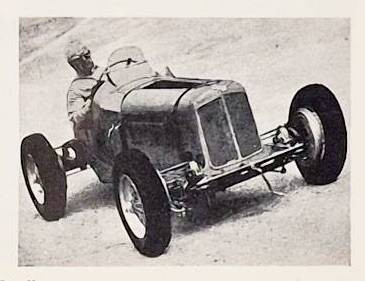
Lord Howe, son of the Earl of Athlone who was Governor General of South Africa between 1923 and 1931, was a force in establishing pre-war motor racing in South Africa. He competed regularly in local races driving various Bugatti and English Racing Automobiles (ERA) cars. In 1936 he bought the farm Bergvlei in Kelvin, 15km north-east of Johannesburg and constructed a purpose-built track on the 600-acre site adjoining the Pretoria Road. In a race against time, hampered by the area’s worst rainfall for 35 years, in only four months the 3,56 km circuit was completed just 30 minutes before the inaugural race, the First Rand Grand Prix in January 1930. (from Franschoek Motor Museum - https://www.fmm.co.za/lord-howes-family-visit-fmm/)
There were twenty entries including Lord Howe who came second in the race. Later that year, the circuit had been altered and the more dangerous curves straightened out and the second Grand Prix was held on 16 December. A newspaper report of the time states that 'all entries [are] capable of 100 m.p.h.' and that the South African drivers would mount excellent resistance to the overseas challenge!
The first Grand Prix was attended by 65,000, but despite the enormous interest, the lack of road access spelt doom to the continuing existence of the race track. It took more than six hours for people to return to their homes in Johannesburg after the race and faced with the fact that further annual Grand Prix events were unlikely to attract spectators, the shareholders of the track, which included Sir Ernest Oppenheimer, F.A. Unger and others, began steps to liquidate their company. (The Heritage Portal, https://www.theheritageportal.co.za/article/sandtons-forgotten-race-track).
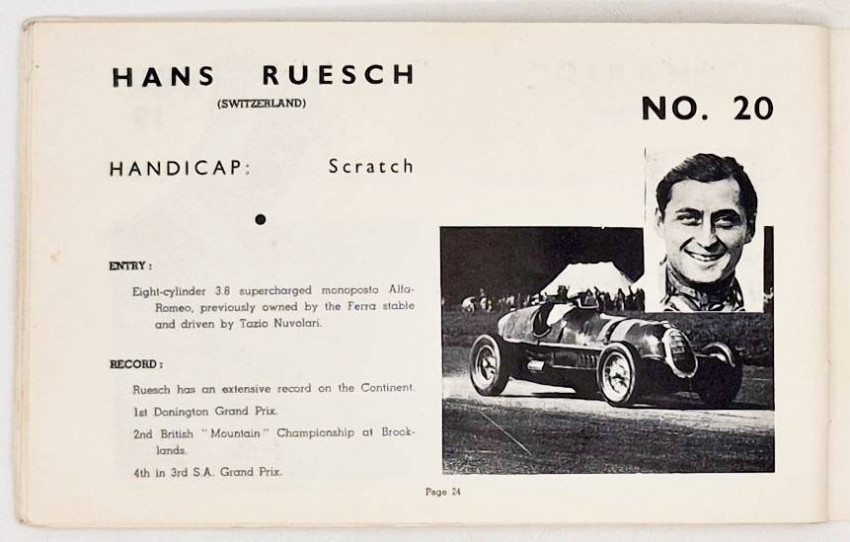
The race ran over 75 laps of the 3.588 km circuit, a total distance of 269.105 km. Pole position was taken by H. Ruesch in the Alfa Romeo, who also set fastest lap at 2 minutes 17.6 seconds. The result was: 1st Pat Fairfield, ERA B; 2nd Lord Howe, ERA B; 3rd J. McNicol, MG Midget; 4th H. Ruesch, Alfa Romeo 8C-3500; 5th C. Paul, Riley; 6th H.F. Hooper, Talbot 105; 7th Johnny Whitehead, Aston Martin; 8th W.H. Roderick, Alfa Romeo B. Among those who did not finish were Piero Taruffi's Maserati, Kay Petre's Riley (the only woman driver in the race), Mario Massacurati's Maserati, and Roy Hesketh's MG. Among those who did not start were V.C. Berrange and A.S. du Toit — both struck by engine problems before the start.
(https://www.formula1results.co.za/19261949/1937rnd1.htm)
The race was a time handicap race which was the popular format for British and colonial motor racing throughout the 1930s. Pat Fairfield's ERA winning from Lord Howe's ERA, with Hans Ruesch's far more powerful Alfa Romeo 8C-3500 finishing only fourth despite taking both pole and fastest lap. On outright speed the Alfa Romeo was almost certainly the fastest car in the race, yet it finished fourth. It started from scratch whereas J.M. McNicol's 1287 c.c. M.G. Magnette, which finished third had a handicap start of 20 minutes.
The RAC handicapper assessed each car's likely performance based on engine capacity, supercharger, state of tune, and the driver's known ability. From this assessment, each car was assigned a time allowance relative to the scratch car, the fastest car in the field, which started last and received no allowance.
Cars were then sent off at staggered intervals before the scratch car. The slowest cars went first, The ERA's and Maserati's followed at intervals, with the scratch car, Ruesch's Alfa Romeo departing last.
Preface:
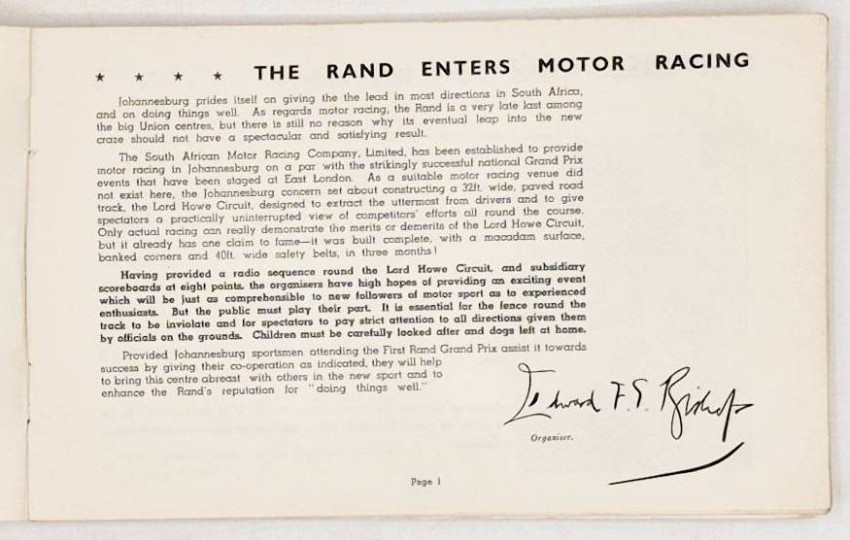
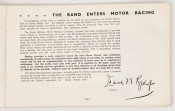
THE RAND ENTERS MOTOR RACING
Johannesburg prides itself on giving the lead in most directions in South Africa, and on doing things well. As regards motor racing, the Rand is a very late last among the big Union centres, but there is still no reason why its eventual leap into the new craze should not have a spectacular and satisfying result.
The South African Motor Racing Company, Limited, has been established to provide motor racing in Johannesburg on a par with the strikingly successful national Grand Prix events that have been staged at East London. As a suitable motor racing venue did not exist here, the Johannesburg concern set about constructing a 32ft. wide, paved road track, the Lord Howe Circuit, designed to extract the uttermost from drivers and to give spectators a practically uninterrupted view of competitors' efforts all round the course. Only actual racing can really demonstrate the merits or demerits of the Lord Howe Circuit, but it already has one claim to fame—it was built complete, with a macadam surface, banked corners and 40ft. wide safety belts, in three months!
Having provided a radio sequence round the Lord Howe Circuit, and subsidiary scoreboards at eight points, the organisers have high hopes of providing an exciting event which will be just as comprehensible to new followers of motor sport as to experienced enthusiasts. But the public must play their part. It is essential for the fence round the track to be inviolate and for spectators to pay strict attention to all directions given them by officials on the grounds. Children must be carefully looked after and dogs left at home.Provided Johannesburg sportsmen attending the First Rand Grand Prix assist towards success by giving their co-operation as indicated, they will help to bring this centre abreast with others in the new sport and to enhance the Rand's reputation for "doing things well."
Edward F. G. Bishop.
Organiser.
- Size: 103 x 169 mm