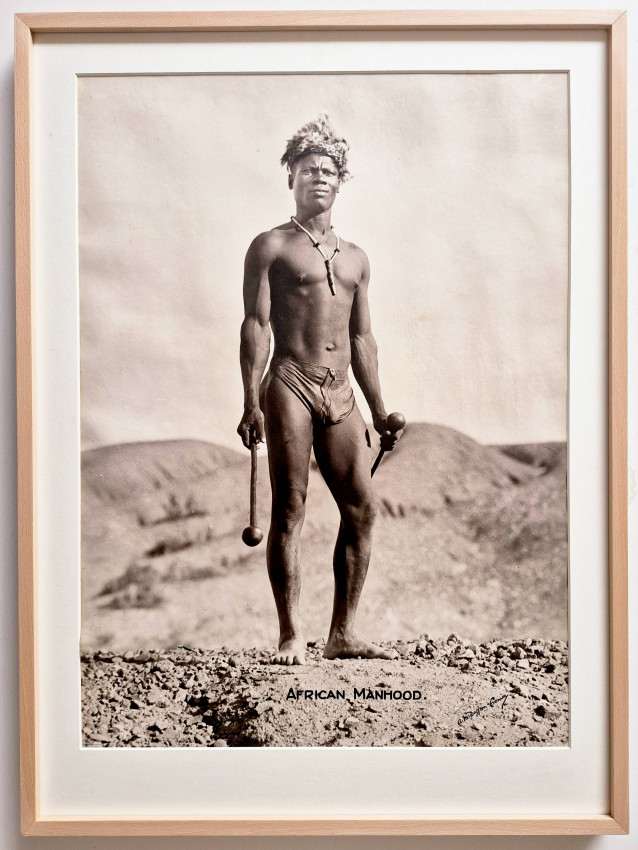
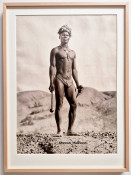
63 x 46 cm, framed under high quality, non-reflective museum grade UV glass
(McGregor Museum, Kimberley, Duggan-Cronin collection reference number dc4519a)
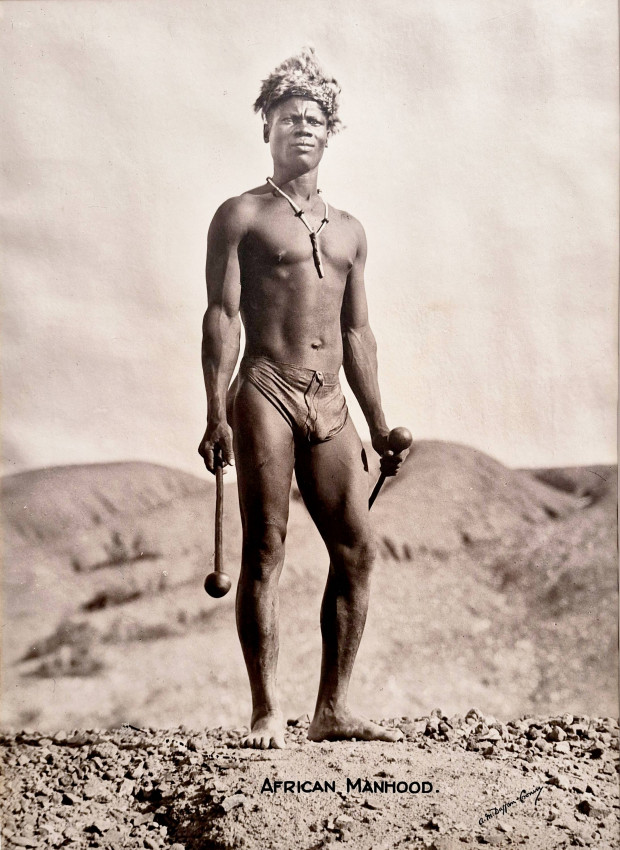
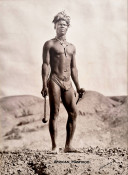
This image appears in Duggan-Cronin's THE BANTU TRIBES OF SOUTH AFRICA, Reproductions of photographic studies, Volume II, Section 1, Plate 10. THE SUTO-CHUANA TRIBES, (1929) with the title NGWAKETSE MINE-BOY with the caption on the facing tissue guard:
'Photographed in one of the compounds of the De Beer's Co., Kimberley. He wears the skin cap (puane) and the loin-skin (tshega), characteristic of the Chuana tribes. The pendant of wood, often finely carved, contains an awl, used in kaross making and for extracting thorns from the feet. It is only worn by men who have passed through the initiation school. He carries the short knobkerrie (molamu) formerly used in war.'
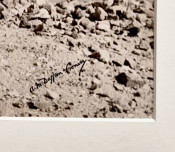
The size of this print is much larger than anything produced for the published volumes and is most likely to have been an exhibition print made for display.
In 1925 Duggan-Cronin opened his first Bantu Gallery at his home at Kamfersdam, outside Kimberley, which, twelve years later he offered it to the city of Kimberley on condition that the collection be suitably housed and accessible to the public. When Duggan-Cronin presented his 750 framed photographs to the city of Kimberley and deeded the rest of his photographic material to the McGregor Museum, De Beers generously made "The Lodge" available for exhibiting the collection. In 1938 it was officially opened as the Duggan-Cronin Bantu Gallery, with Duggan-Cronin as first curator in an honorary capacity.
There were also exhibitions of his work in London in 1924 and 1931. These are the two documented instances of his work being shown in a formal public exhibition context outside South Africa. Large-format exhibition prints would have been essential for such shows because small prints would have been less visible in a public gallery. A print measuring 63 x 46 cm is likely the scale which would have been produced for a London exhibition in the late 1920's or early 1930's. To produce such a large print at the time required either an enormous glass plate negative or careful enlargement in a dark room. Duggan-Cronin is known to have worked with large-format glass plate negatives throughout his career, which made enlargement to exhibition scale not only feasible but technically possible and made prints of which the tonal richness is excellent.
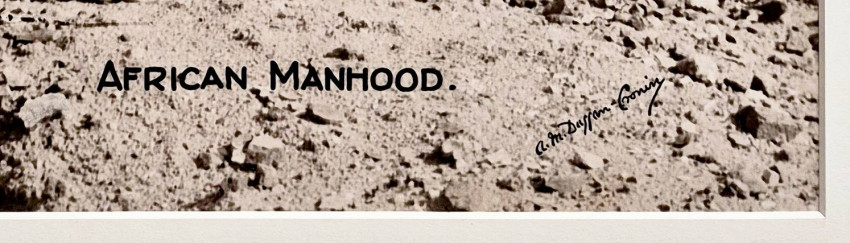
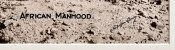
The title, AFRICAN MANHOOD on the image surface in a display typeface, further suggests it was made for the 1924 or 1931 London exhibitions, or for the Kamfersdam gallery, or for the 1938 official opening of The Lodge.
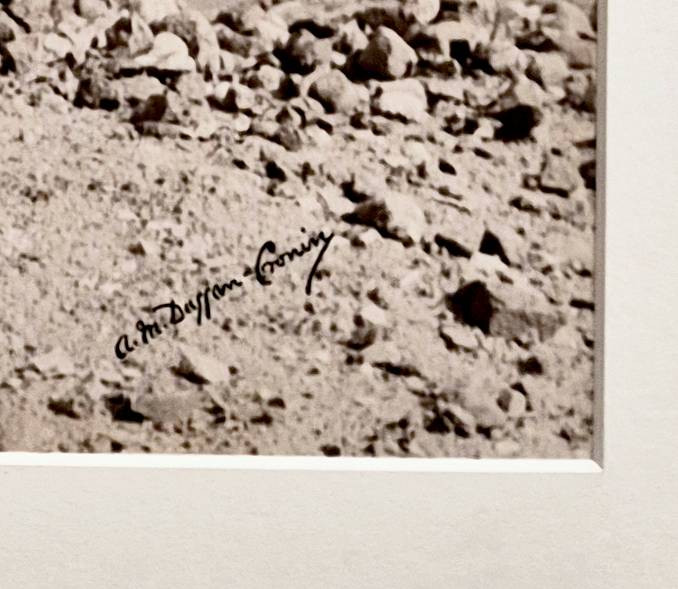
Duggan-Cronin (Alfred Martin), Irish-South African, was born on the 17 May 1874 at Innishannon, County Cork, Ireland. He was educated at Mount St. Mary’s College, Derbyshire, England. In 1897 he came to South Africa and settled in Kimberley to begin working with the mining company De Beers. He worked there until his retirement in 1932.
Duggan-Cronin purchased his first box camera in 1904. He photographed a variety of subjects from the still life, to portraits and landscapes. He began to turn his camera towards men working at the mines and these images became his first photographs of indigenous people. The migrant labour system was introduced by the mining industry in the 19th century in order to prevent permanent settlement of the labourers and their families. The colonial authorities introduced poll and hut taxes on rural settlements, which forced these settlements to enter the monetary system. Men therefore sought employment on the mines which separated them from their families for long periods of time. This began to disrupt these rural settlements, forever changing their culture and way of life. The migrant labour system therefore brought a variety of people from rural communities to the mines. Duggan-Cronin photographed these workers in their traditional dress.
At the mine it became evident to him that a modern way of life was encroaching upon the traditional lifestyle of the indigenous people. His passion for photography was therefore fuelled by this desire to record their culture before it became further eroded and so he began to travel around southern Africa in order to document these cultures. His first expedition was in 1919 whereby he travelled to Laneberg to photograph the San of this region. He would further go on at least 18 expeditions covering an estimated 128 000km in order to photograph the people of southern Africa. His travels would take him as far as the Victoria Falls, the Indian coastline of South Africa, the deserts of Namibia and the forests of Mozambique.
These expeditions were financed by the MacGregor Museum and by grants from the South African government and the Carnegie Foundation.
See also: Alfred Martin Duggan-Cronin's photographs for the Bantu tribes of South Africa (1928-1954): the construction of an ambiguous idyll, by Michael Godby, Department of Historical Studies, University of Cape Town. Kronos vol.36 n.1 Cape Town Nov. 2010. (https://scielo.org.za/scielo.php?pid=S0259-01902010000100003&script=sci_arttext)