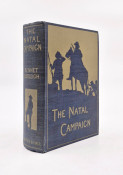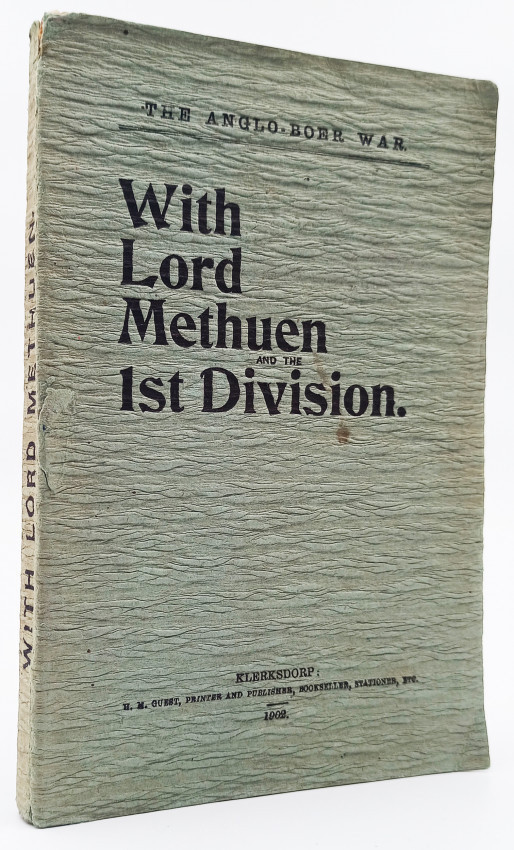
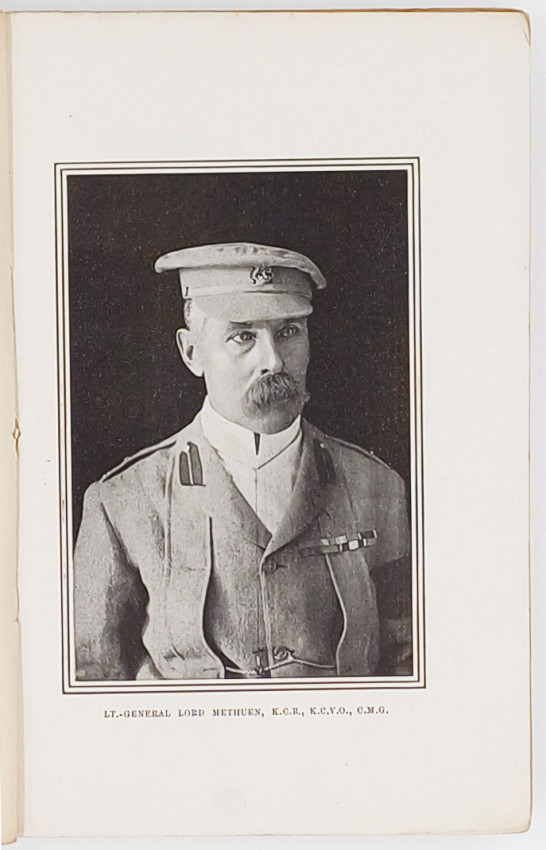
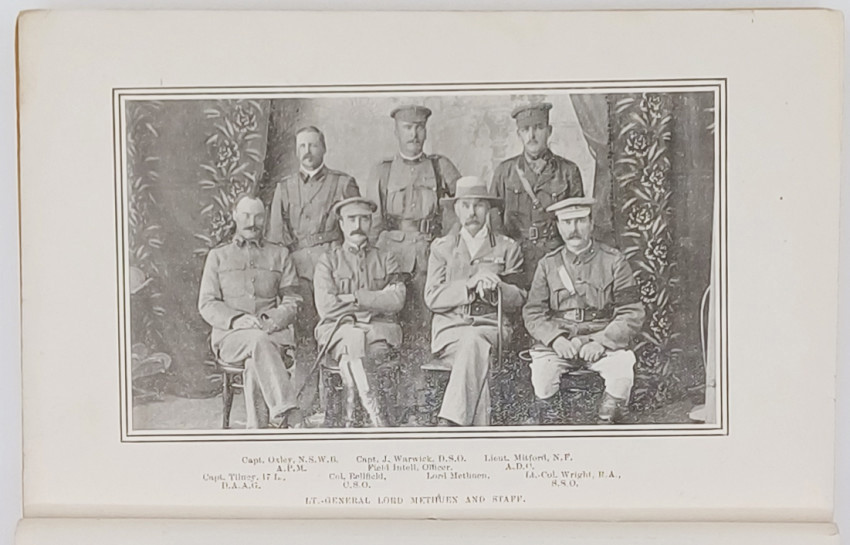
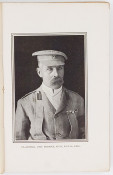
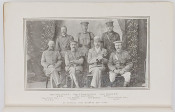
Fourth edition: 122 + 4 pages, frontispiece portrait of Methuen and 9 plates all bound in after the frontispiece, original grey wrappers worn at the top and bottom of the spine, a very good copy.
By ‘fourth edition’ the author means that with each succeeding edition he extended the account of the campaign as the war progressed. In his Preface to the Fourth Edition he writes, 'The story of the doings of the historic First Division of the South African Field Force, and its gallant commander, Lt.-General Lord Methuen, practically closed on the day of the disastrous fight at Klipdrift, when Lord Methuen was wounded and captured. The remnant of the Division was then divided and separated, amid the general regrets of the officers and men, who had fought, bled and suffered in company, but always cheerful and proud of the reputation of their Division and commander'.
S2A3 Biographical Database of Southern African Science (https://www.s2a3.org.za/bio/Biograph_final.php?serial=3511)
'Guest (Herbert Melville) 1853 - 1938, Herbert Melville Guest was a son of Herbert Guest and his wife Mary Bates, and an older brother of Reginald Stewart Guest. He came to the Cape Colony with his parents in 1861 and they settled in Grahamstown. His father worked for the Frontier Times and at the age of 13 young Guest was apprenticed to the Grahamstown Journal. In 1870 he moved to the diamond fields around Kimberley and joined the staff of the region's first newspaper, the Diamond News, founded by the owners of the Grahamstown Journal and published at Pniel from 16 October that year. The next year, following the discovery of diamonds at Colesberg Kopje, he began prospecting with mixed success. After a few years he returned to Grahamstown to join his father in a printing, bookselling and stationer's business. On 19 April 1877 he married Lucy Charlotte Lucas, with whom he had several sons and a daughter. He remained in Grahamstown until 1889, when he moved to Klerksdorp in the South African Republic (Transvaal).
'At Klerksdorp Guest acquired the newspaper The Representative and changed its name in August 1889 to the Klerksdorp Mining Record (from August 1910 the Record of Klerksdorp and the Western Transvaal). Shortly after his arrival he was instrumental in founding the Klerksdorp Chamber of Mines, but it became defunct after a few years. He also founded the Klerksdorp Chamber of Commerce, with more success. He was a member of the first Hospital Board of Klerksdorp and through his newspaper and in other ways contributed much to the public institutions of the town. In 1899, a few weeks before the outbreak of the Anglo-Boer War (1899-1902) he suspended publication of his newspaper for about a year and left the Transvaal with his family, though his printing works continued to operate. He returned to Klerksdorp with one of his sons in February 1901. During the years following the war he played a leading role in many local public institutions such as the Chamber of Commerce, Transvaal Municipal Association, local Public Health Committee, and several local sporting clubs. He owned many claims in the neighbourhood of Klerksdorp and by 1911 was mayor of the town. He was an expert rifle shot and won numerous trophies.
'During 1901-1902 Guest wrote and published several short works about the Anglo-Boer War, including Vicissitudes of a Transvaal dorp, Klerksdorp; With Lord Methuen from October 1899 to December 1901; With Lord Methuen: From Belmont to Hartebeestfontein; With Lord Methuen and the First Division; Incidents in the Western Transvaal, Klerksdorp; and Prisoners' experiences. Many years later he wrote and published Some reminiscences of sixty years ago (Klerksdorp, 1925), dealing with his life in Grahamstown, on the diamond fields, and at Klerksdorp.'
- Overall Condition: Very good
- Size: 8vo (207 x 135 mm)